
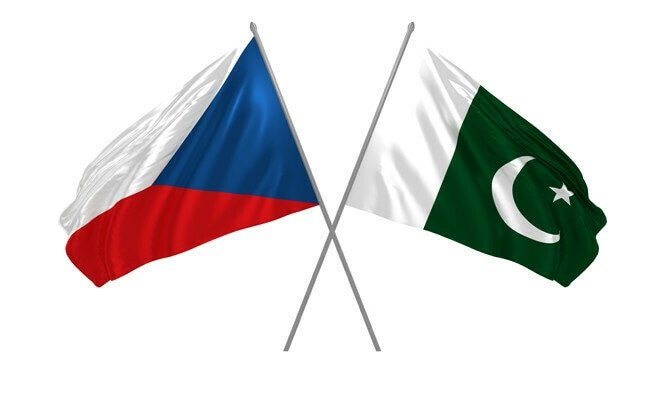
The Czech Republic and Pakistan are forging stronger geo-economic ties through trade expansion, joint commissions, and investment opportunities. This partnership blends Czech innovation with Pakistani dynamism, promising mutual growth in energy, IT, and agriculture.
Key Points
- Diplomatic Momentum: Ninth Bilateral Consultations in 2025 reviewed economic ties; first Joint Commission on Economic Cooperation in April 2025 signed protocols for trade, investment, and sector-specific collaboration.
- Trade Surge: Bilateral trade reached $379 million in 2024, with Pakistan exporting $337 million (textiles leading) and importing $42 million; GSP+ enhances duty-free EU access.
- Investment Horizons: Czech software firm invested $1 million in Pakistan’s data center in 2024; potentials for €200 million in SEZs, focusing on renewables and mining.
- Sectoral Complementarities: Opportunities in automotive, renewable energy, IT, pharmaceuticals, and agriculture align Czech expertise with Pakistan’s resources for sustainable development.
- Labor and Education Ties: Agreements promote manpower export, student exchanges, and vocational training, fostering people-to-people links.
- Future Projections: Trade could exceed $600 million by 2030 through JWGs and green initiatives, driving job creation and innovation.
In the evolving geo-economic landscape, the Czech Republic and Pakistan are poised to transform their partnership into a model of mutual benefit, addressing policymakers’ needs for strategic frameworks that leverage the Czech Republic’s EU membership and industrial strengths with Pakistan’s strategic location and youthful workforce. The ninth round of Annual Bilateral Consultations in 2025, held in Islamabad, reviewed bilateral relations and agreed to intensify cooperation in defense, energy, mining, IT, tourism, and climate change. This followed the activation of the 2023 Economic Cooperation Agreement, effective in 2024, which established institutional mechanisms for trade and investment. The first session of the Pakistan-Czech Joint Commission on Economic Cooperation in April 2025, co-chaired by high-level officials, signed protocols to streamline trade, reduce barriers, and form Joint Working Groups (JWGs) in trade, health, pharmaceuticals, and IT. These diplomatic bonds, dating back to 1950, provide a stable foundation, immune to short-term fluctuations, rooted in shared commitments to UN peacekeeping and multilateralism.
Contemporary trade data reveals robust growth. Bilateral volumes totaled $379 million in 2024, with Pakistan exporting $337 million to the Czech Republic and importing $42 million, creating a positive surplus. Pakistan’s exports to the Czech Republic grew to $52.77 million in 2024, up from prior years, fueled by GSP+ duty-free access to the EU market. This imbalance highlights untapped potentials, as the Czech Republic’s high-value goods complement Pakistan’s labor-intensive sectors.
Top traded products underscore this complementarity:
Direction | Top Products (2024 Values in USD Millions) | Key Sectors |
Pakistan to Czech Republic | House Linens (57), Non-Knit Men’s Suits (16.8), Knit Sweaters (11) | Textiles and Apparel |
Czech Republic to Pakistan | Orthopedic Appliances (34.6), Scented Mixtures (7.93), Medical Instruments (7.19) | Pharmaceuticals and Medical Equipment |
This table illustrates a rational cooperative ecosystem: Pakistan’s textiles meet Czech consumer demands, while Czech medical and machinery exports support Pakistan’s healthcare and industrialization. Rationales include the 1999 Bilateral Investment Treaty, ensuring investor protection and double taxation avoidance, stable beyond economic cycles.
For investors, high-return opportunities abound. A Czech software company invested $1 million in a Pakistan data center in 2024, aiming to support digital transformation with affordable services. Discussions in 2025 emphasized SEZs, inviting Czech investments in automotive, renewable energy, agri-tech, IT, and manufacturing, potentially attracting €200 million. Czech mining firms show interest in Pakistan’s resources, aligning with energy and environmental cooperation. Academics can analyze soft power dynamics, as education exchanges and Erasmus+ programs enhance human capital, while JWGs in health and IT foster research collaborations. The public benefits from labor mobility agreements, job creation in joint ventures, and cultural events promoting tourism.
Challenges like tariff barriers are being tackled via JC protocols, ensuring seamless cooperation. Overall, this geo-economic axis fosters resilience, with trade projected to exceed $600 million by 2030.
Conclusion
The Czech Republic-Pakistan geo-economic partnership heralds shared success, integrating Czech expertise with Pakistani potential. Policymakers should advance JWGs and investment treaties; investors, capitalize on SEZs for renewables and IT; academics, explore sustainable models; and the public, reap benefits from jobs and exchanges. With trade at $379 million in 2024 and protocols from 2025 JC, this alliance drives green growth amid challenges. By deepening ties, both nations can navigate global uncertainties, achieving inclusive prosperity that endures.
* Dr. Muhammad Jahanzaib is the Founder & Chief Visionary Officer (CVO) of Diamanium Thinkers, a global think tank. He holds a PhD in International Relations, specializing in the intersection of geo-politics and geo-economics in Pakistan’s foreign and domestic policy. A double gold medalist and published scholar, he writes on economic intelligence, economic diplomacy, political economy, AI and regional cooperation in South Asia and beyond. He can be reached at jahanzaibdgc@gmail.com.
Key References
- Economic Cooperation Agreement between the Czech Republic and Pakistan – https://mzv.gov.cz/islamabad/en/economic_and_trade/economic_cooperation_agreement_between.mobi
- Government of Pakistan – Economic Affairs Division – https://www.ead.gov.pk/NewsDetail/MTRhODAwZjYtMzg0Mi00MTkwLWI1MzUtOWI3OTk2NjM3MTRj
- First session of Pak-Czech Republic JC on Economic Cooperation held – https://www.nation.com.pk/29-Apr-2025/first-session-of-pak-czech-republic-jc-on-economic-cooperation-held
- Ninth Round of Annual Bilateral Consultations between Pakistan and the Czech Republic – https://mofa.gov.pk/press-releases/ninth-round-of-annual-bilateral-consultations-between-pakistan-and-the-czech-republic
- Czech software company to invest $1 million in Pakistan data center – https://www.arabnews.com/node/2502096/%257B%257B
- Czech Republic Imports from Pakistan – https://tradingeconomics.com/czech-republic/imports/pakistan
- Czech Republic Exports to Pakistan – https://tradingeconomics.com/czech-republic/exports/pakistan
- Pakistan Exports to Czech Republic – https://tradingeconomics.com/pakistan/exports/czech-republic
- Pakistan (PAK) and Czechia (CZE) Trade – https://oec.world/en/profile/bilateral-country/pak/partner/cze
- Country comparison Czechia vs Pakistan 2025 – https://countryeconomy.com/countries/compare/czech-republic/pakistan