
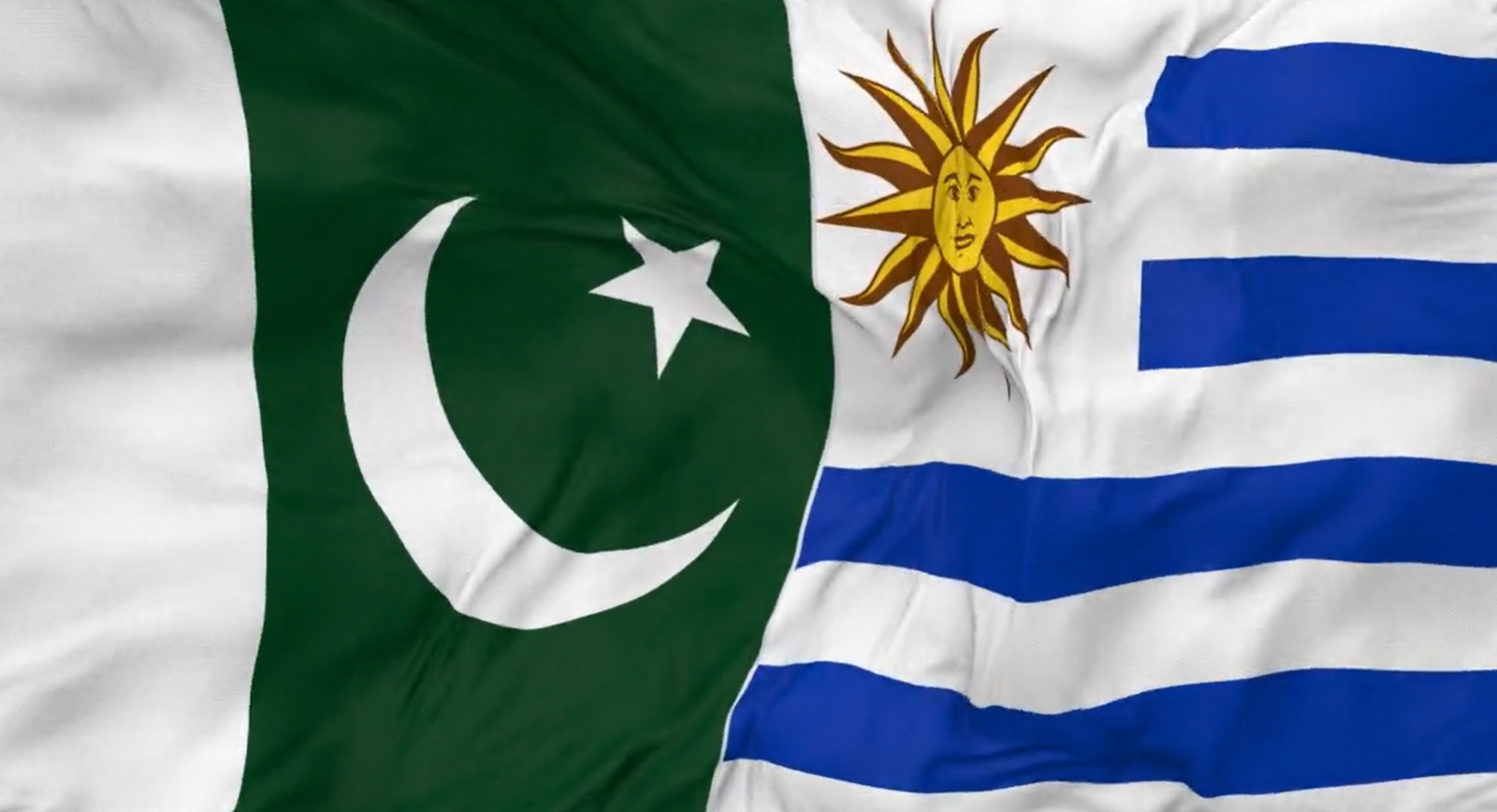
Uruguay and Pakistan, distant yet complementary economies, are poised for enhanced geo-economic ties through trade, investment, and cooperation in agriculture, renewables, and textiles, leveraging recent stabilizations to unlock mutual growth potentials amid global shifts.
Key Points
- Policy Alignment: Recent diplomatic engagements signal opportunities for bilateral agreements, potentially via MERCOSUR-Pakistan PTA, fostering regulatory harmony.
- Trade Growth: Bilateral trade reached approximately $18M in FY2024-25, with untapped potential in Pakistan’s textiles and Uruguay’s agri-business.
- Investment Avenues: Uruguay’s stable business climate attracts Pakistani FDI in renewables; Pakistan offers markets for Uruguayan exports like meat.
- Economic Resilience: Both nations show GDP recovery—Uruguay at 2.1-2.5% growth in 2025, Pakistan at 3.2%—bolstered by reforms.
- Cooperative Sectors: Synergies in pharma, IT, and sustainable agriculture could drive innovation and job creation.
- Global Context: Amid rising protectionism, joint ventures enhance supply chain diversification and South-South cooperation.
As global economic landscapes evolve amid geopolitical tensions and trade realignments, Uruguay and Pakistan emerge as promising partners in geo-economics. This partnership, though nascent, holds immense potential to bridge South American stability with South Asian dynamism, benefiting policymakers, investors, academics, and the general public alike. By prioritizing policymakers through strategic frameworks, investors via lucrative opportunities, academics with research synergies, and the public through inclusive growth, this collaboration can amplify mutual prosperity.
For policymakers, the foundation lies in recent diplomatic and economic stabilizations. Uruguay’s institutional strength and active reform policies—evidenced by its A4 country risk rating and universal healthcare—complement Pakistan’s “Uraan Pakistan” five-year plan (2024-2029), which targets 6% export-led growth. Bilateral relations, marked by cordiality since 1964, saw renewed impetus in 2024 with Pakistan’s cabinet approval for MERCOSUR engagement, aiming for a Preferential Trade Agreement (PTA). Progress in 2025, building on MERCOSUR’s FTAs with EFTA and the EU, could integrate Pakistan into this bloc, reducing tariffs and enhancing access to a $4.3T market. Such policies would promote balanced trade, with Pakistan’s textiles and pharmaceuticals addressing Uruguay’s import needs, while Uruguay’s meat and wool fill Pakistan’s food security gaps.
Investors stand to gain from diversified portfolios in high-potential sectors. Bilateral trade, though modest at $18.4M in FY2024-25 (Pakistan exports $8.5M, imports $9.9M), reveals asymmetries ripe for exploitation. Pakistan’s exports to Uruguay grew 4% YoY, focusing on textiles and leather, while imports declined 18%, mainly agribusiness products. Untapped export potential for Pakistan in MERCOSUR exceeds $2.6B in top products like rice, surgical instruments, and apparel. Uruguay’s abundant renewables (over 90% green energy) offer investment in joint ventures for Pakistan’s energy transition, where FDI rose 20% in H1 FY2025. Conversely, Pakistan’s booming IT sector (28% YoY growth) and minerals could attract Uruguayan capital, especially post-2025 U.S.-Pakistan minerals cooperation talks. With Uruguay’s business climate ranked A3 and Pakistan’s reforms slashing IPP costs, cross-investments in agrotech—combining Uruguay’s dairy expertise with Pakistan’s arable land—promise high returns.
|
Economic Indicators Comparison (2025 Projections) |
Uruguay |
Pakistan |
|
GDP (Nominal, USD Billion) |
81 |
410.5 |
|
GDP Growth (%) |
2.1-2.5 |
3.2 |
|
Exports (Goods, USD Billion) |
10.2 |
40.7 |
|
Key Exports |
Beef, Cellulose, Soybeans |
Textiles, Rice, Pharmaceuticals |
|
FDI Inflows (Net, USD Million, FY2024-25) |
~1,500 |
1,785 |
|
Inflation (%) |
~5 |
4.1 |
Academics and researchers can delve into rational analyses of cooperative models. Geo-economics here transcends trade, encompassing shared commitments to sustainability and multilateralism. Both nations prioritize climate resilience—Uruguay via renewable leadership, Pakistan through IMF’s Resilience Facility ($1.4B in 2025). Joint studies could explore supply chain integrations, such as Uruguay’s wool enhancing Pakistan’s textile value chains, or pharma collaborations leveraging Pakistan’s low-cost manufacturing with Uruguay’s R&D strengths. Data from 2025 shows Uruguay’s services exports at $6.9B, aligning with Pakistan’s IT remittances surge to $31.2B. Such synergies, analyzed through lenses of comparative advantage, suggest a 10-15% bilateral trade boost via PTA, fostering academic exchanges on South-South economic models amid global fragmentation.
For the general public, these developments translate to tangible benefits. Enhanced trade could lower costs for essentials—Uruguayan meat diversifying Pakistan’s protein sources, Pakistani textiles providing affordable goods in Uruguay. Job creation in cooperative sectors like tourism and e-commerce would uplift communities, with Uruguay’s social uniformity (universal education) inspiring Pakistan’s inclusive growth initiatives. Public awareness of these potentials, amplified by 2025’s stable currencies (Uruguayan peso steady, Pakistani rupee gaining), underscores equitable progress.
|
Bilateral Trade Snapshot (FY2024-25, USD Thousand) |
Pakistan Exports to Uruguay |
Pakistan Imports from Uruguay |
|
Total Value |
8,482 |
9,932 |
|
YoY Change (%) |
+4 |
-18 |
|
Key Products |
Textiles, Leather, Pharma |
Beef, Wool, Dairy |
|
Global Rank (for Pakistan) |
48th |
48th |
|
Potential Cooperation Sectors |
Opportunities for Uruguay |
Opportunities for Pakistan |
|
Agriculture & Agrotech |
Export beef/dairy to growing Pakistani market |
Tech transfers for sustainable farming |
|
Renewables & Energy |
Invest in Pakistan’s grids |
Access Uruguay’s wind/solar expertise |
|
Textiles & Manufacturing |
Import cost-effective goods |
Expand exports to MERCOSUR |
|
IT & Pharma |
Collaborate on R&D |
Leverage low-cost production |
|
Tourism & Services |
Joint eco-tourism ventures |
Cultural exchanges boosting remittances |
In essence, this geo-economic alliance promotes resilience, innovation, and shared prosperity, positioning both nations as bridges in a multipolar world.
Conclusion
Uruguay and Pakistan’s geo-economic partnership, fueled by recent stabilizations and cooperative potentials, promises transformative benefits. Policymakers can forge PTAs for regulatory wins; investors tap diversified markets; academics advance research; and the public enjoys affordable goods and jobs. With projected trade growth and synergies in key sectors, this collaboration exemplifies South-South solidarity, enhancing economic security amid global uncertainties. Embracing these opportunities will not only boost GDPs but also foster enduring ties, unlocking a brighter, interconnected future for both nations.
* Dr. Muhammad Jahanzaib is the Founder & Chief Visionary Officer (CVO) of Diamanium Thinkers, a global think tank. He holds a PhD in International Relations, specializing in the intersection of geo-politics and geo-economics in Pakistan’s foreign and domestic policy. A double gold medalist and published scholar, he writes on economic intelligence, economic diplomacy, political economy, AI and regional cooperation in South Asia and beyond. He can be reached at jahanzaibdgc@gmail.com.
Key References
- Uruguay – Ministry of Foreign Affairs – https://www.mofa.gov.pk/buenos-aires-uruguay
- Economic Report 2025 Pakistan – https://swissbusinesscouncil.com.pk/wp-content/uploads/2025/11/Economic-Report-2025.pdf
- Potential for Pakistan – MERCOSUR Free Trade Agreement – https://www.pbc.org.pk/research/potential-for-pakistan-mercosur-free-trade-agreement
- Uruguay Economic Outlook June 2025 – https://www.bbvaresearch.com/en/publicaciones/uruguay-economic-outlook-2025
- Pakistan Economy Overview 2025 – https://en.wikipedia.org/wiki/Economy_of_Pakistan
- IMF Executive Board Concludes 2025 Article IV Consultation with Uruguay – https://www.imf.org/en/news/articles/2025/10/30/pr-25352-uruguay-inflation-imf-executive-board-concludes-2025-article-iv-consultation
- Pakistan’s path towards sustainable and inclusive growth – https://www.weforum.org/stories/2025/01/pakistan-economic-revival-sustainable-and-inclusive-growth
- Pakistan (PAK) and Uruguay (URY) Trade – https://oec.world/en/profile/bilateral-country/pak/partner/ury
- Foreign trade figures of Uruguay – https://www.lloydsbanktrade.com/en/market-potential/uruguay/trade-profile
- 2025 Investment Climate Statements: Pakistan – https://www.state.gov/reports/2025-investment-climate-statements/pakistan