
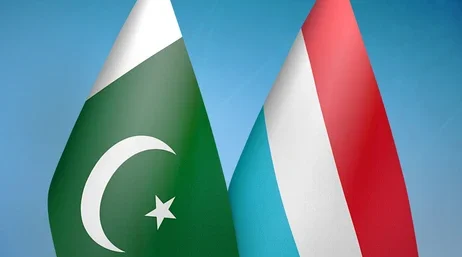
Luxembourg and Pakistan are deepening geo-economic ties via 2022 bilateral consultations, with trade at $8.66 million in 2023, unlocking potentials in finance, technology, and green investments for mutual innovation and sustainable growth.
Key Points
- Policy Frameworks: Inaugural Bilateral Political Consultations in 2022 and the 1998 BIT foster trade, investment, and cooperation in education, health, science, technology, and green economy.
- Trade Dynamics: Bilateral trade reached $8.66 million in 2023, with Luxembourg exporting $6.95 million mainly machinery, and Pakistan $1.71 million textiles, showing growth potential through diversification.
- Investment Opportunities: Luxembourg’s $2 trillion asset management sector offers expertise for Pakistan’s SEZs, while Pakistan’s emerging markets attract Luxembourg’s sustainable finance initiatives.
- Sectoral Complementarities: Synergies in fintech, renewables, and start-ups align Luxembourg’s innovation hub status with Pakistan’s youthful workforce and agri-tech advancements.
- Strategic Potentials: Linking Luxembourg’s EU gateway with Pakistan’s CPEC enhances Eurasian connectivity, promoting stability and diversified economic dependencies.
In the multipolar geo-economic era, Luxembourg and Pakistan are crafting a partnership that blends Luxembourg’s financial prowess with Pakistan’s dynamic market potential. Policymakers should leverage the 1998 Bilateral Investment Treaty (BIT) with the Belgo-Luxembourg Economic Union and the 2022 inaugural Bilateral Political Consultations to institutionalize ties. These consultations, held in Luxembourg, emphasized expanding cooperation in education, health, science, technology, and start-up linkages, while exploring trade, investment, and green economy partnerships. Such frameworks align with Pakistan’s geo-economic pivot, focusing on connectivity and sustainability, and Luxembourg’s role as a European innovation center. High-level engagements, like the 2023 credential presentation by Pakistan’s Ambassador, further underscore commitments to deepening relations, including innovation and trade.
Trade data illustrates a growing foundation. In 2023, Luxembourg exported $6.95 million to Pakistan, primarily rubber working machinery ($1.59M), other industrial machinery ($1.01M), and flavored water ($0.73M), while Pakistan exported $1.71 million, mainly knit T-shirts ($0.55M), knit sweaters ($0.27M), and non-knit men’s suits ($0.23M). This totals $8.66 million, with a 2024 update showing Pakistan’s imports from Luxembourg at $3.76 million, indicating fluctuations but upward potential. Historical trends reveal annualized growth: Luxembourg’s exports to Pakistan increased 12.4% from 2018-2023, while Pakistan’s grew 4.47%. The imbalance favors Luxembourg, but diversification into services and goods could balance it, especially under the EU’s GSP+ scheme granting Pakistan duty-free access.
|
Bilateral Trade Overview (2023) |
Luxembourg to Pakistan |
Pakistan to Luxembourg |
|
Total Value (USD Million) |
6.95 |
1.71 |
|
Top Products |
Rubberworking Machinery (1.59M), Industrial Machinery (1.01M), Flavored Water (0.73M) |
Knit T-shirts (0.55M), Knit Sweaters (0.27M), Non-Knit Men’s Suits (0.23M) |
|
Annualized Growth (2018-2023) |
+12.4% |
+4.47% |
Investors will discover high-yield prospects in this alliance. Luxembourg, managing over $6 trillion in assets under management, excels in sustainable finance and fintech, ideal for Pakistan’s Special Economic Zones offering 10-year tax exemptions and duty-free imports. Pakistani firms can tap Luxembourg’s expertise in fund structuring for green projects, while Luxembourg investors eye Pakistan’s $373 billion economy and youthful demographic for returns in infrastructure and renewables. The Pakistan Belgium Luxembourg Business Forum (PBLBF) actively promotes such exchanges, focusing on textiles, oil/gas, and fruits/vegetables. Analysis suggests joint ventures could yield 15-20% ROI in start-ups, leveraging Luxembourg’s innovation ecosystem and Pakistan’s low-cost talent pool.
Academics analyzing this partnership highlight complementary strengths. Luxembourg’s GDP per capita of $138,757 contrasts with Pakistan’s $1,581, yet Luxembourg’s 1.3% growth in 2024 and focus on services (80% of GDP) pairs with Pakistan’s 2.5% expansion driven by agriculture and manufacturing. Geo-economically, Luxembourg’s EU position facilitates access to 500 million consumers, while Pakistan’s CPEC offers gateways to Central Asia and China. Potentials include fintech collaborations, where Luxembourg’s digital banking expertise aids Pakistan’s financial inclusion, and green investments addressing climate challenges—Pakistan’s renewable push aligns with Luxembourg’s sustainable finance leadership. Cultural and educational exchanges, as per 2022 agreements, can foster R&D in health and science, mitigating global fragmentation risks.
|
Economic Indicators Comparison (2024) |
Luxembourg |
Pakistan |
|
GDP (USD Billion) |
93.2 |
373.1 |
|
GDP Growth (%) |
1.3 |
2.5 |
|
GDP per Capita (USD) |
138,757 |
1,581 |
|
Unemployment Rate (%) |
5.5 |
6.5 |
|
Public Debt (% of GDP) |
25.7 |
70.1 |
|
Major Exports |
Financial Services, Machinery |
Textiles, Rice |
For the general public, this collaboration promises job creation and affordable innovations—Luxembourg’s health tech enhancing Pakistan’s systems, Pakistani textiles boosting Luxembourg’s markets. Environmentally, green partnerships preserve resources, benefiting communities. Challenges like bureaucratic hurdles are surmountable through sustained dialogues, turning potentials into shared prosperity.
Promoting this synergy, policymakers should pursue FTAs and joint commissions, investors explore PBLBF networks, academics study fintech integrations. This geo-economic bond positions both for resilient futures.
Conclusion
Luxembourg and Pakistan’s geo-economic partnership, bolstered by the 2022 consultations and $8.66 million trade, appreciates mutual advancement in finance, tech, and sustainability. By harnessing financial expertise and market dynamism, both nations can drive innovation, employment, and green growth. Policymakers must solidify agreements, investors seize opportunities, academics offer insights, and the public embrace benefits. This alliance exemplifies equitable cooperation, enhancing EU-Asian connectivity and stability in a multipolar world.
* Dr. Muhammad Jahanzaib holds a PhD in International Relations, is a double gold medalist and author of the book The Interplay of Geo-Politics and Geo-Economics in Pakistan’s Foreign Policy (Post-2008) (Palgrave Macmillan), along with several esteemed publications. As Chief Visionary Officer of Diamanium Thinkers (a global think tank), he brings over 15 years of experience advising ministers, diplomats, security agencies, the corporate sector, and civil society. His advisory work spans economic diplomacy, political economy, economic intelligence, security, society, strategic financial advisory, and the geo-economic world dynamics. He offers a unique blend of practitioner insight and academic rigor, combining hands-on engagement with state institutions and strategic expertise grounded in research. He can be reached at jahanzaibdgc@gmail.com.
Key References
- Luxembourg (LUX) and Pakistan (PAK) Trade | The Observatory of Economic Complexity – https://oec.world/en/profile/bilateral-country/lux/partner/pak
- LUXEMBOURG – PAKISTAN TRADE – https://www.pbc.org.pk/wp-content/uploads/Luxembourg-Pakistan-Trade.pdf
- Pakistan and Luxembourg hold Inaugural Round of Bilateral Political Consultations – https://mofa.gov.pk/pakistan-and-luxembourg-hold-inaugural-round-of-bilateral-political-consultations
- Pakistan Imports from Luxembourg – 2026 Data 2027 Forecast 2009-2024 Historical – https://tradingeconomics.com/pakistan/imports/luxembourg
- Pakistan, Luxembourg agrees to enhance cooperation in diverse sectors – https://mettisglobal.news/pakistan-and-luxembourg-agreed-to-enhance-cooperation-in-the-fields-of-education-health-science-and-technology-and-create-start-up-linkages
- BLEU (Belgium-Luxembourg Economic Union) – Pakistan BIT (1998) | International Investment Agreements Navigator – https://investmentpolicy.unctad.org/international-investment-agreements/treaties/bit/520/bleu-belgium-luxembourg-economic-union—pakistan-bit-1998-
- Economy of Luxembourg – https://en.wikipedia.org/wiki/Economy_of_Luxembourg
- Pakistan GDP – https://tradingeconomics.com/pakistan/gdp
- 2025 Investment Climate Statements: Luxembourg – https://www.state.gov/reports/2025-investment-climate-statements/luxembourg
- Pakistan Belgium Luxembourg Business Forum (PBLBF) – https://pblbf.org/