
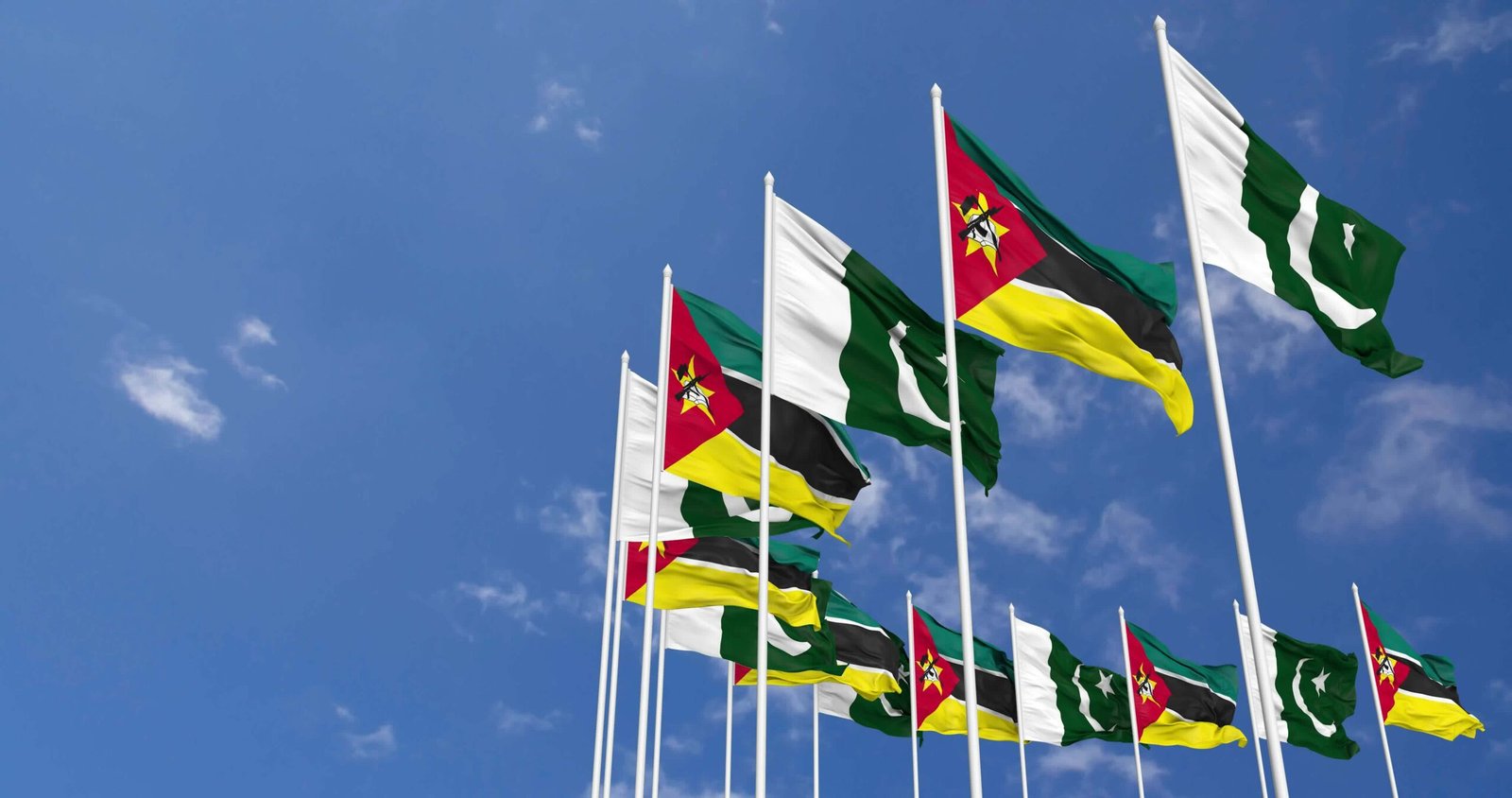
Mozambique and Pakistan are enhancing geo-economic ties through the Look Africa policy and trade MoUs, unlocking potentials in energy, agriculture, and textiles for mutual prosperity and Afro-Asian connectivity in a multipolar era.
Key Points
- Policy Momentum: Pakistan’s Look Africa initiative and the 2022 MoU on trade and investment foster frameworks for economic cooperation, emphasizing mutual benefits and sustainable development.
- Trade Surge: Bilateral trade exceeded $174 million in 2024, with Pakistan’s exports dominating at $158.36 million, signaling room for balanced growth through diversified exchanges.
- Investment Opportunities: Mozambique’s rich natural resources in gas and minerals offer high-return ventures for Pakistani investors, supported by incentives like Mozambique’s 2023 Private Investment Law.
- Sectoral Complementarities: Pakistan’s expertise in textiles and rice production aligns with Mozambique’s agricultural and mining strengths, promising joint ventures in value-added industries.
- Strategic Potentials: Integrating Mozambique’s Indian Ocean ports with Pakistan’s CPEC enhances regional trade routes, mitigating geopolitical risks and boosting connectivity.
In the dynamic geo-economic landscape, Mozambique and Pakistan are emerging as strategic partners, leveraging their positions to drive mutual growth. Policymakers should harness this alliance under Pakistan’s Look Africa policy, initiated in 2017 and reinforced through 2024-2025 engagements, to diversify trade and reduce dependencies. The 2022 Memorandum of Understanding on trade and investment remains a cornerstone, facilitating information exchange, standards adoption, and joint economic activities. This framework aligns with Mozambique’s 2023 Private Investment Law, which promotes FDI through incentives like tax reductions for projects in priority sectors. By prioritizing such policies, both nations can build resilient economies, with Pakistan gaining access to African markets and Mozambique benefiting from South Asian expertise.
Recent trade data highlights a robust yet imbalanced foundation. In 2024, Pakistan exported $158.36 million to Mozambique, primarily cereals (rice) and textiles, while importing $15.78 million, mainly cotton and raw materials. This results in a favorable trade balance for Pakistan, but potentials for reciprocity abound, especially as Africa’s integration advances. Historical trends show growth; for instance, Pakistan’s exports to Africa as a whole rose, with Mozambique contributing significantly to this uptick. Investors will find allure in these figures, as Pakistan’s Special Economic Zones offer tax holidays, while Mozambique’s investment climate supports 100% foreign ownership in key areas.
|
Bilateral Trade Overview (2024) |
Pakistan to Mozambique |
Mozambique to Pakistan |
|
Total Value (USD Million) |
158.36 |
15.78 |
|
Top Products |
Cereals (96.03M), Textiles (41.28M), Salt & Stone (6.36M) |
Cotton (1.02M), Raw Materials |
|
Growth Trend (2023-2024) |
+Significant Increase |
Stable with Potential |
Academics analyzing this partnership note complementary economic structures. Mozambique’s GDP growth of 1.9% in 2024, estimated at rise to 1.8% in 2025 and 3.5% in 2026, is driven by natural gas exports and agriculture, while Pakistan’s 2.68% growth in FY2025 stems from manufacturing and services. Rational cooperation could see Pakistani firms investing in Mozambique’s LNG projects, addressing Pakistan’s energy needs, while Mozambique imports affordable textiles and pharmaceuticals. Potentials extend to agro-processing, where Pakistan’s rice technology enhances Mozambique’s food security, and joint mining ventures tap Mozambique’s coal and rubies. This synergy buffers against global fragmentation, promoting non-aligned growth.
Comparative indicators underscore opportunities. Pakistan’s larger economy provides scale for technology transfers, while Mozambique’s resource wealth offers raw inputs. Both face debt challenges—Mozambique at elevated levels, Pakistan at 70% of GDP—but collaborative R&D can mitigate these through sustainable projects.
|
Economic Indicators Comparison (2024-2025) |
Mozambique |
Pakistan |
|
GDP (USD Billion) |
~20 |
373 |
|
GDP Growth (%) |
1.9 (2024), 1.8 (2025) |
2.68 (FY2025) |
|
GDP per Capita (USD) |
~600 |
1,581 |
|
Unemployment Rate (%) |
High |
6.5 |
|
Public Debt (% of GDP) |
Elevated |
70 |
|
Major Exports |
Gas, Coal, Aluminum |
Textiles, Rice |
For the general public, this alliance promises job creation and affordable goods—Mozambican spices enriching Pakistani cuisine, Pakistani fabrics boosting Mozambican markets. Culturally, exchanges in tourism and education foster understanding, with eco-tourism packages blending Mozambique’s beaches and Pakistan’s heritage. Environmentally, joint initiatives in green energy preserve biodiversity, benefiting communities.
To amplify benefits, policymakers should expedite high-level visits and PTAs, as urged in recent dialogues. Investors can leverage Mozambique’s FDI reforms and Pakistan’s investment policy for ventures like textile factories in Mozambique’s economic zones. Academics might study supply chain integrations, highlighting gains from complementary resources. Despite challenges like logistics, this partnership positions both nations for prosperous, interconnected futures.
Conclusion
Mozambique and Pakistan’s geo-economic collaboration, bolstered by the Look Africa policy and rising trade volumes, heralds an era of shared advancement. By exploiting synergies in energy, agriculture, and manufacturing, both countries can attain economic resilience, employment growth, and cultural bonds. Policymakers must advance strategic accords, investors exploit incentives, academics furnish insights, and the public savor the advantages. This alliance not only elevates bilateral prosperity but also exemplifies equitable Afro-Asian cooperation, contributing to regional stability in a connected world.
* Dr. Muhammad Jahanzaib holds a PhD in International Relations, is a double gold medalist and author of the book The Interplay of Geo-Politics and Geo-Economics in Pakistan’s Foreign Policy (Post-2008) (Palgrave Macmillan), along with several esteemed publications. As Chief Visionary Officer of Diamanium Thinkers (a global think tank), he brings over 15 years of experience advising ministers, diplomats, security agencies, the corporate sector, and civil society. His advisory work spans economic diplomacy, political economy, economic intelligence, security, society, strategic financial advisory, and the geo-economic world dynamics. He offers a unique blend of practitioner insight and academic rigor, combining hands-on engagement with state institutions and strategic expertise grounded in research. He can be reached at jahanzaibdgc@gmail.com.
Key References
- Pakistan Exports to Mozambique – 2026 Data 2027 Forecast 2009-2024 Historical – https://tradingeconomics.com/pakistan/exports/mozambique
- Pakistan Imports from Mozambique – 2025 Data 2026 Forecast 2009-2024 Historical – https://tradingeconomics.com/pakistan/imports/mozambique
- Mozambique and Pakistan sign MoU on trade and investment – https://clubofmozambique.com/news/mozambique-and-pakistan-sign-mou-on-trade-and-investment
- 2024 Investment Climate Statements: Mozambique – https://www.state.gov/reports/2024-investment-climate-statements/mozambique
- Republic of Mozambique The Africa Country Series – https://www.pbc.org.pk/wp-content/uploads/Mozambique-Report-Final.pdf
- Mozambique – Approves a new law to foster private investment – https://investmentpolicy.unctad.org/investment-policy-monitor/measures/4325/approves-a-new-law-to-foster-private-investment
- 2025 Investment Climate Statements: Pakistan – https://www.state.gov/reports/2025-investment-climate-statements/pakistan
- Look Africa Policy Initiative – https://www.commerce.gov.pk/look-africa-policy
- An assessment of Pakistan’s ‘Engage Africa’ policy – https://issi.org.pk/wp-content/uploads/2024/01/IB_Areeba_Jan_22_2024.pdf
- ‘Look Africa’ initiative – https://www.brecorder.com/news/40397793
- [PDF] Geo-economics: a tectonic shift – https://www.afd.fr/sites/default/files/2025-02-12-17-21/MacroDev-N%C2%B061-UK-BAT-Web.pdf
- Mozambique Full Year GDP Growth – https://tradingeconomics.com/mozambique/full-year-gdp-growth
- MOZAMBIQUE MPO – https://thedocs.worldbank.org/en/doc/bae48ff2fefc5a869546775b3f010735-0500062021/related/mpo-moz.pdf
- Pakistan Economic Survey 2024-25 highlights – https://finance.gov.pk/survey/chapter_25/Highlights.pdf
- Pakistan’s trade with Africa – https://www.pbc.org.pk/wp-content/uploads/Pakistans-trade-with-Africa.pdf