
 Artificial Intelligence (AI) is transforming economic intelligence by enhancing data analysis and decision-making, significantly reshaping geo-economic strategies -especially among major powers like the US and China -while offering substantial economic benefits alongside challenges such as rising inequality, energy demands and potential disruptions to jobs and global economic balances, all of which demand nuanced policy responses.
Key Points:
- Artificial Intelligence (AI) is transforming economic intelligence by enhancing data analysis and decision-making, potentially boosting global GDP significantly.
- In geo-economics, AI is reshaping national strategies, with major powers like the US and China investing heavily to gain economic and geopolitical advantages.
- While AI offers substantial economic benefits, it may also increase inequality and energy demands, requiring careful policy responses.
- The evidence suggests AI’s impact is both promising and challenging, with debates around its potential to disrupt jobs and global economic balances.
Introduction
In 2025, Artificial Intelligence (AI) stands at the forefront of a global economic transformation. The United States’ $500 billion Stargate initiative, led by OpenAI, SoftBank and Oracle, aims to expand AI infrastructure, signaling a strategic push for technological dominance (McKinsey Global Economics). Meanwhile, China’s DeepSeek platform, which became the most downloaded free app in the US in January 2025, has disrupted global tech markets, wiping $1 trillion off the US tech stock index (McKinsey Global Economics). These developments highlight AI’s role as a pivotal force in economic intelligence – the collection and analysis of economic data – and geo-economics – the use of economic tools for geopolitical objectives. This blog explores how AI is reshaping these fields, offering immense opportunities while posing significant challenges.
AI in Economic Intelligence
Economic intelligence involves gathering and analyzing data on market trends, financial systems and trade policies to inform decision-making. AI revolutionizes this process by processing vast datasets at unprecedented speeds, enabling precise predictions and strategic insights.
Enhancing Data Analysis and Decision-Making
AI’s ability to analyze complex datasets is transforming industries. In financial markets, AI-driven algorithms enable high-frequency trading, executing trades in milliseconds to capitalize on market fluctuations. For example, hedge funds use AI to predict stock prices and manage portfolio risks, enhancing profitability (Capital Economics). In manufacturing, AI optimizes production lines by predicting maintenance needs and improving quality control. Retailers leverage AI to personalize customer experiences, forecast demand, and streamline inventory management, boosting efficiency and consumer satisfaction.
According to PwC, AI could contribute $15.7 trillion to the global economy by 2030, with $6.6 trillion from productivity gains and $9.1 trillion from consumption-side (PwC AI Study). This includes a projected 26% GDP boost for China and 14.5% for North America, driven by AI’s ability to enhance productivity and drive consumer demand through personalized products.
Challenges: Job Displacement and Privacy
Despite these benefits, AI’s impact on economic intelligence raises concerns. The International Monetary Fund (IMF) estimates that AI could affect nearly 40% of global jobs, particularly routine tasks, potentially leading to wage collapse and increased inequality (IMF AI Impact). In India, concerns about AI disrupting the services sector contributed to a 0.3% equity market decline in January 2025 (McKinsey Global Economics). To mitigate these risks, the IMF suggests implementing social safety nets, reskilling programs and ethical AI regulations (IMF Asia Economies).
Moreover, AI’s reliance on vast datasets raises privacy concerns. The ability to analyze consumer behavior at scale could erode trust if not managed responsibly, potentially impacting economic activity. Policymakers must balance AI’s efficiency gains with measures to protect data privacy and ensure equitable economic outcomes.
| Aspect | Details |
| AI Applications | Financial trading, supply chain optimization, consumer behavior analysis |
| Economic Impact | $15.7 trillion by 2030 (PwC), with 26% GDP boost for China, 14.5% for North America |
| Challenges | 40% of global jobs at risk (IMF), privacy concerns, potential inequality |
| Policy Needs | Social safety nets, reskilling programs, ethical AI regulations |
AI in Geo-Economics
Geo-economics explores how nations use economic tools to achieve geopolitical goals. AI is increasingly central to these strategies, as countries invest in AI to strengthen their economic and strategic positions.
Strategic Investments and Global Competition
The US’s Stargate initiative, a $500 billion investment announced in January 2025, aims to bolster AI infrastructure, positioning the US as a global leader in AI technology (McKinsey Global Economics). This move counters China’s advancements, exemplified by the DeepSeek platform, which disrupted global tech markets by becoming the most downloaded free app in the US, impacting tech stock valuations to wipe off $1 trillion from market (McKinsey Global Economics). These developments reflect a broader race for AI dominance, with nations leveraging AI to enhance economic competitiveness and geopolitical influence.
AI also plays a role in economic warfare. For instance, AI-powered systems monitor financial transactions to enforce sanctions, detecting evasion attempts with high accuracy. In cybersecurity, AI strengthens defenses against cyber threats, which can destabilize economies if left unchecked. These applications highlight AI’s role in reshaping global economic relationships.
Impacts on Global Trade and Power Dynamics
AI’s ability to optimize supply chains and logistics is transforming global trade. By predicting demand and streamlining operations, AI reduces costs and enhances efficiency. However, it also risks creating dependencies on specific technologies or nations, potentially shifting economic power dynamics. For example, China’s AI advancements could lead to market dominance, raising concerns about data sovereignty and intellectual property (IMF AI Impact).
Sizing the prize – Which regions gain the most from AI
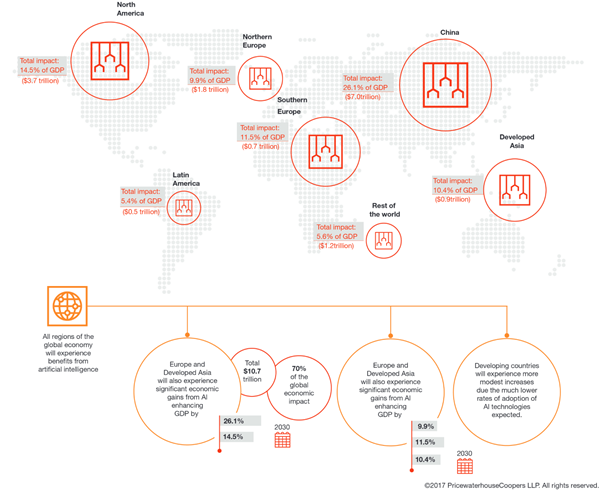
Source: PwC analysis
The IMF warns that AI may widen the gap between rich and poor countries, as developing economies struggle to adopt AI at the same pace (IMF Developing Economies). This could exacerbate global economic inequalities, necessitating international cooperation to ensure equitable access to AI technologies.
| Aspect | Details |
| Strategic Initiatives | US Stargate ($500B), China’s DeepSeek platform |
| Applications | Sanctions enforcement, cybersecurity, supply chain optimization |
| Challenges | Market dominance, data security, global inequality |
| Policy Needs | International cooperation, equitable AI access |
Environmental and Sustainability Challenges
AI’s economic benefits come with significant challenges, particularly in energy consumption. The IMF notes that data centers consumed 500 TWh in 2023, with projections suggesting this could triple to 1,500 TWh by 2030, comparable to India’s electricity use (IMF Power Supplies). This could add 1.7 gigatons of greenhouse gas emissions between 2025 and 2030, equivalent to Italy’s energy-related emissions over five years. Efficient AI models, like DeepSeek, may reduce computing costs, but increased usage could offset these gains, necessitating policies to expand sustainable energy supplies.
Conclusion
AI’s impact on economic intelligence and geo-economics in 2025 is profound, offering unprecedented opportunities for growth and efficiency while posing significant challenges. Its ability to enhance data analysis and strategic decision-making is transforming industries, with projections of a $15.7 trillion economic boost by 2030 (PwC AI Study). However, risks such as job displacement, increased energy demands and geopolitical tensions require careful management.
To harness AI’s potential, governments must invest in education and social safety nets to support workers affected by automation. Sustainable energy policies are critical to meet AI’s growing demands without exacerbating environmental challenges. Internationally, cooperation on AI governance is essential to ensure equitable benefits and mitigate risks. As we navigate this AI-driven landscape, the choices made in contemporary decade will shape the economic and geopolitical future for decades to come.
* Dr. Muhammad Jahanzaib is the Founder & Chief Visionary Officer (CVO) of Diamanium Thinkers, a global think tank. He holds a PhD in International Relations, specializing in the intersection of politics and economics in Pakistan’s foreign and domestic policy. A double gold medalist and published scholar, he writes on economic intelligence, economic diplomacy, political economy, AI, and regional cooperation in South Asia and beyond. He can be reached at jahanzaibdgc@gmail.com
Key Citations
- McKinsey Global Economics Intelligence Summary March 2025
- IMF Artificial Intelligence Topics Overview
- PwC Global Artificial Intelligence Study: Sizing the Prize
- IMF Blog: AI Needs More Abundant Power Supplies
- Capital Economics: AI’s Transformation of Global Economy
- IMF Blog: How AI Will Affect Asia’s Economies
- IMF Podcast: Impact of AI on Developing Economies