
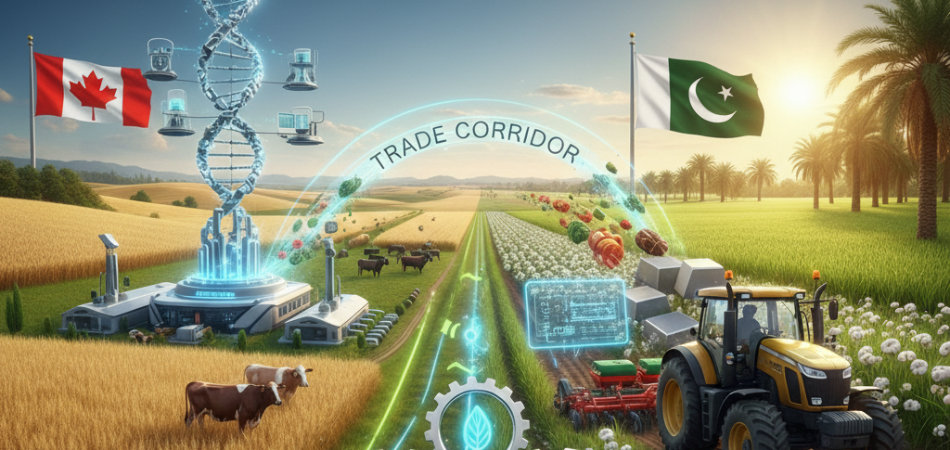
Canadian agri-tech innovations, including precision farming, hybrid seeds, and climate-smart solutions, are modernizing Pakistan’s agriculture, boosting productivity, sustainability, and bilateral ties for mutual economic growth and resilience.
Key Points
- Collaborative hybrid seed development and GMO canola approvals enhance crop yields and import substitution.
- Precision agriculture technologies like UAVs, AI, and IoT optimize resource use in Pakistan’s diverse farmlands.
- Climate-adaptive farming and green clusters promote sustainable practices amid environmental challenges.
- Joint ventures in machinery manufacturing, food processing, and livestock technologies foster innovation.
- Economic impacts include increased trade, job creation, and food security for both nations.
In a world where agriculture faces mounting pressures from climate change and population growth, the synergy between Canadian expertise and Pakistan’s vast agricultural potential offers a pathway to transformative modernization. These cross-border innovations not only address immediate challenges but also build evergreen foundations for sustainable growth, appealing to policymakers shaping bilateral strategies, investors seeking high-impact opportunities, academics exploring technological integrations, and the general public benefiting from enhanced food security and livelihoods.
Recent 2025 engagements highlight this momentum. On October 28, Pakistan’s Federal Minister for National Food Security and Research, Rana Tanveer Hussain, met with Canadian High Commissioner Leslie Scanlon to deepen agricultural ties. Discussions emphasized technology transfer, with proposals for hybrid seed development to boost crop resilience and yields. Pakistan’s approval of 43 GMO events aligns with international biosafety standards, facilitating Canadian canola imports while promoting domestic cultivation for edible oil self-sufficiency. This could reduce Pakistan’s import dependency, historically peaking at 1.35 million tonnes annually, and generate farmer incomes through high-value crops.
Canadian strengths in agri-tech shine here: expertise in bio-products and crop residue management from provinces like Saskatchewan can revolutionize Pakistan’s post-harvest processes, reducing waste estimated at 30-40% in the country. Joint ventures in agricultural machinery manufacturing promise to localize production, cutting costs and creating jobs. For investors, this opens avenues in value-added processing, such as frozen vegetables and French fries, leveraging Canada’s advanced agri-business models.
Precision agriculture stands as a flagship area for collaboration. Pakistan’s 2nd International Precision Agriculture Conference (IPAC 2025), held October 20-22 at Pir Mehr Ali Shah Arid Agriculture University, featured themes like UAVs for crop monitoring, AI applications, and variable rate technologies. With international experts from Canada among participants, the event underscored how digital tools can enhance efficiency in Pakistan’s 22 million hectares of arable land.
|
Precision Agri-Tech Applications |
Canadian Expertise |
Potential Impact in Pakistan |
Mutual Benefits |
|
UAVs & Remote Sensing |
Advanced drone tech for monitoring |
Crop health assessment in remote areas |
Tech exports for Canada; Yield optimization for Pakistan |
|
AI & IoT for Crop Management |
Data-driven platforms |
Resource efficiency in water-scarce regions |
Innovation sharing; Sustainable farming models |
|
Variable Rate Technologies |
Precision input application |
Reduced input costs by 15-20% |
Investment opportunities; Food security enhancement |
This table illustrates contemporary applications blended with evergreen benefits like resource conservation, crucial as Pakistan grapples with water scarcity affecting 80% of its agriculture. Rational analysis shows that adopting these could align with Pakistan’s goal of boosting ag exports to $10 billion by 2030, while Canada gains market access for its $3 billion agri-tech sector.
Climate-smart agriculture further amplifies this partnership. In November 2025 meetings, Pakistan and Canada agreed to deepen cooperation in resilient farming and green economic development. Federal Minister for Climate Change Senator Dr. Musadik Malik and Canadian High Commissioner Tarik Ali Khan discussed climate-adaptive technologies, with Canada offering support through government-to-government arrangements. Pakistan’s Green Clusters initiative aims to foster youth-led innovations in sustainable enterprises, pairing well with Canadian know-how in clean energy and carbon management.
For instance, embryo transfer technology and feed formulation from Canada could modernize Pakistan’s livestock sector, which contributes 60% to agricultural GDP. This addresses feed shortages and boosts dairy/meat production, potentially adding $2-3 billion in exports. Academics might note the alignment with UN Sustainable Development Goals, promoting biodiversity and climate resilience. The general public benefits from affordable, nutritious food, while policymakers see models for inclusive growth.
Invitations to events like the Pakistan Food & Agriculture Expo 2025 (November 25, Karachi) and Canada’s Food Safety Summit 2026 underscore commitment. These platforms enable knowledge exchange, such as Canadian support for Pakistan’s Foot-and-Mouth Disease control and BSE risk dossier, opening global markets for halal products.
Evergreen principles underpin this: diversified partnerships hedge against global volatility, as seen in canola trade resumption projecting $500-700 million in annual value. Contemporary data from 2025 shows bilateral trade at $525 million, with agriculture poised for 20-30% growth through tech infusions. Challenges like regulatory harmonization require ongoing dialogue, but the trajectory is promising, positioning both nations as leaders in sustainable agri-innovation.
Conclusion. Canadian agri-tech is catalyzing Pakistan’s agricultural modernization, from precision tools to climate-smart practices, yielding higher productivity and sustainability. This alliance offers policymakers strategic frameworks, investors lucrative ventures, academics research synergies, and the public enhanced livelihoods. By embracing these innovations, both countries can achieve resilient food systems, economic vitality, and global leadership in green agriculture. Continued collaboration will ensure enduring prosperity.
* Dr. Muhammad Jahanzaib is the Founder & Chief Visionary Officer (CVO) of Diamanium Thinkers, a global think tank. He holds a PhD in International Relations, specializing in the intersection of politics and economics in Pakistan’s foreign and domestic policy. A double gold medalist and published scholar, he writes on economic intelligence, economic diplomacy, political economy, AI and regional cooperation in South Asia and beyond. He can be reached at jahanzaibdgc@gmail.com.
Key References
- Ministry of National Food Security & Research – https://mnfsr.gov.pk/NewsDetail/YzRhNDUyOTgtNDMwMi00MzZkLWI3OTMtMzZiZjJmYTA4NmQ4
- Pakistan, Canada agree to deepen cooperation on climate and agriculture – https://profit.pakistantoday.com.pk/2025/11/13/pakistan-canada-agree-to-deepen-cooperation-on-climate-and-agriculture/
- Pakistan, Canada Push for Stronger Climate Cooperation and Green Growth – https://thediplomaticinsight.com/pakistan-canada-climate-cooperation/
- PAPC – Center for Precision Agriculture – https://c4pa.net/papc/
- Hanif Abbasi stresses modernization of agriculture at precision farming conference – https://profit.pakistantoday.com.pk/2025/10/21/hanif-abbasi-stresses-modernization-of-agriculture-at-precision-farming-conference/
- Pakistan, Canada to boost Collaboration in mining, agriculture, and IT – https://mettisglobal.news/Pakistan-Canada-to-boost-Collaboration-in-mining-agriculture-and-IT-56357
Canada-Pakistan Joint Statement: Reaffirming strong and enduring ties – https://www.canada.ca/en/global-affairs/news/2025/11/canada-pakistan-joint-statement-reaffirming-strong-and-enduring-ties.html