
Lord Kelvin, the legendary British mathematician and physicist, is famous for his contributions towards formulating laws of thermodynamics. Curiously, his scepticism about flight is clear when he said “Heavier-than-air flying machines are impossible” as the President of Royal Society (London) in 1895. He also stated that he had “not the smallest molecule of faith in aerial navigation other than ballooning”. Another infamous quote on the topic which is often wrongly attributed to him is “If God had meant man to fly, he would have given him wings.” However, despite all the doubt, the Wright brothers showed the world visibly the endless possibilities of flying in 1903.
Key Points
- The aircraft crash of Indian made Tejas at Dubai airshow on 21 Nov,25 resulted in death of the pilot and embarrassment for Indian state’s defence industry.
- Hindustan Aeronautics Limited (HAL) released a statement on 24th Nov that this was just an isolated incident which was caused by exceptional circumstances.
- However, the empirical evidence of numerous facts points towards the reality of some deep-rooted problems that prove that the Indian delusional echo chamber claims of regional dominance are just jingoistic talk.
- The professionalism of Indian Air Force may not be the root cause of high accident rate but the bureaucratic red tape, saffronization of armed forces through undue political coercive influence and corruption accusations by Opposition leaders.
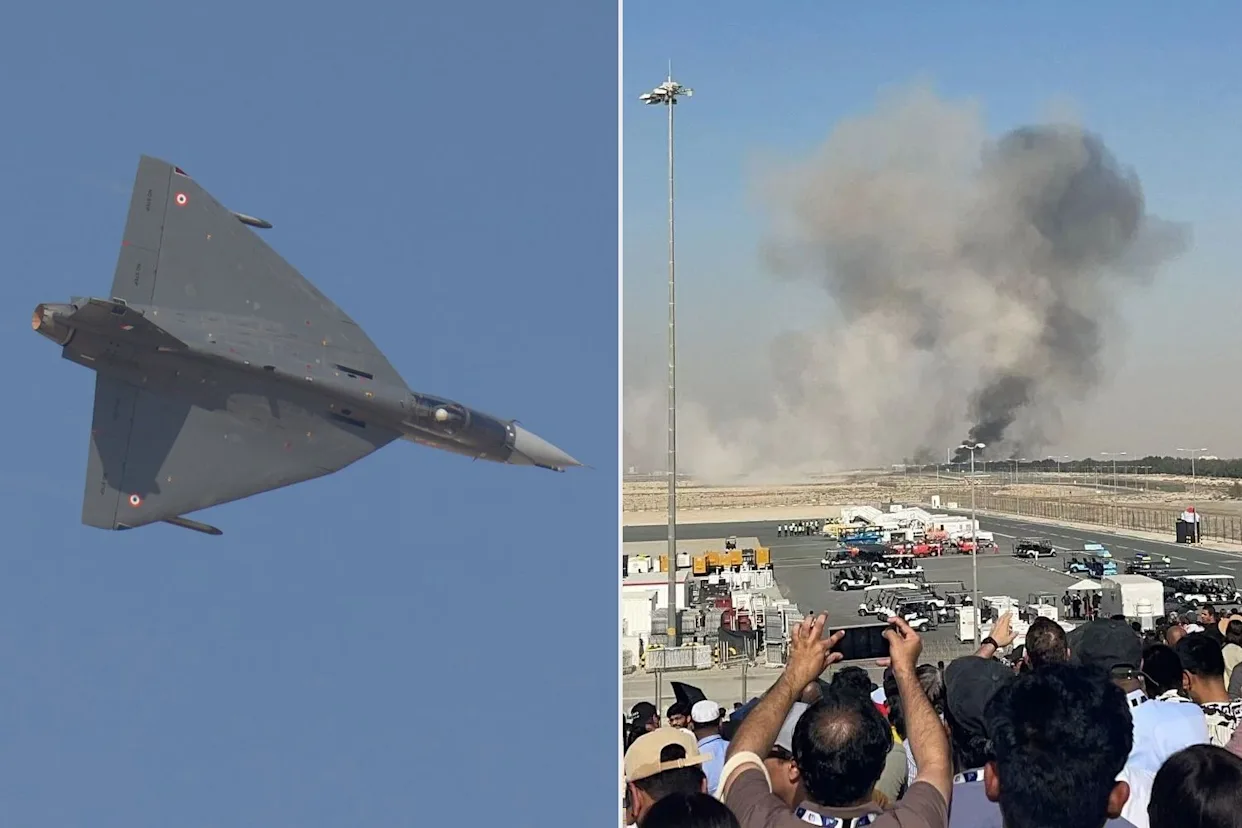
The airshows are meant to celebrate the aviation as an achievement of human progress and its triumph against the bounds of gravity. The public exhibition of aerobatic manoeuvring by fighter jets is the epitome of any aerial display and flypasts and the one at Dubai is no exception being among the biggest ones around the world. The low-level flyovers and stunts by single demonstration pilot (solo demo) as well as teams flying in formation are a remarkable feat to watch for any aircraft aficionado. However, jet flying is a risky business and sometimes it results in the tragic loss of life like the recent Indian Air Force Tejas crash at Dubai airshow on 21 November during a live display.(Tejas crash dampens India)
The Crash Incident details
Wg Cdr Namansh Syal, an experienced IAF Pilot lit the afterburner (AB) of his Tejas Fighter Jet and pulled back on his control stick to blast into the skies of Dubai. As he climbed, he wasn’t rising alone, as he carried with him the hopes of HAL, the Indian Air Force, and a government eager to see the Tejas become a symbol of national pride, a testament of Indian production and defence industries and a viable export aircraft. A few minutes into the flight with the expectations of the nation riding on his shoulders, which ultimately proved to be too heavy for the aircraft he was flying, he carried out a demanding manoeuvre known as the “Knife’s Edges Pass”. As the aircraft rolled into an inverted position, the nose of the aircraft dropped below horizon, far below from where it should have been i.e. above or at least on horizon. Moments later, the aircraft crashed, taking Wg Cdr Namansh and the Indian hopes vested in the demonstration, with it in the ground.
There was no ejection, most probably due to the low altitude and less reaction time or speculation regarding his partial impairment due to oxygen deprivation in the brain, a physiological phenomenon common during transition to negative and positive G forces. The reasons for crash are not very clear at this moment and IAF has order an inquiry to find the exact cause. However, what is obvious beyond any doubt is the underpowered jet with a thrust-to-weight ratio of less than 1 and an aerodynamic tailless delta design that leaves a pilot high and dry in a coffin corner at the edge of flight envelope or when flying low and slow. The pilot came in for a knife-edge pass with a 90-degree right roll and subsequently inverted the aircraft where the problem began. The nose dropped about 45 degrees below horizon and the aircraft lost precious altitude with no recovery possible.
Probable Causes for Crash
As the burning wreckage settled, aviation enthusiasts and analysts speculated about its reasons. Some categorized it as ‘human error’ others as “a failure of the flight control system” but crashes rarely come down to single, split-second mistakes. Aviation safety experts usually subscribe to a “Swiss Cheese Model” where all the holes of every slice of cheese align and allow the accident to happen due to failure of all checks and balances. Hence, that unexpected roll over Dubai was merely the final slice. The first flaw in the chain traces all the way back to 1983, when the Tejas project was first conceived.
Though the reason for the aircraft’s nose not kept above horizon by pilot is unclear, an educated guess can be made for it with two possible explanations: pilot error or fly-by-wire system’s technical malfunction. In case of former, the pilot was sluggish in giving forward pressure on the control stick for any reason from loss of consciousness to mental preoccupation or distraction where he momentarily lost situational awareness. For the latter, the aircraft flight control system which is digital and sends electric signals from cockpit to actuators for movement of control surfaces may had some fault where timely input by pilot was not transmitted to pitch control surfaces i.e. elevons. The confirmation of one of these two probable causes is only possible after a thorough investigation of all the partakers involved in it, including human factors as well as machine performance.
Not an Isolated Incident
Without going in too much technical details of aerodynamics, aeroengine, the protracted timeline of Tejas project which started in 1983 and is yet to be seen in numbers, the inefficiency of HAL is clear as day. A statement by HAL on November 24 called it an “isolated incident” under “exceptional circumstances” (Dubai crash isolated incident) is misleading and an affront to the professionalism of slain IAF pilot. The list of crashes is too long to cover here, but it will suffice to say that this is the sixth crash this year for IAF, including 5 jet fighters. The very long delays in various projects, below-par production quality that results in pilot deaths, accusations of corruption in aircraft deals (PM Modi stole 30,000 crore) and zero export orders are some indicators of the empirical evidence that shows this incident not just to be a one-odd case.
Conclusion
To conclude, one can easily collect enough data for analysis to see that the results prove the hypothesis that there are deep-rooted chronic issues plaguing the Indian defence industry. The claims of BJP government of Atmanirbhar Bharat (self-reliant India) and chest thumping of self-proclaimed regional power and a rising great power are just political slogans. In reality, even with world’s largest population and fourth-largest economy, the state of India has still a long way to go to become self-reliant with an indigenous military industrial complex that is at par with modern weapons. Indian state has a lot of potential, but the delusions of grandeur will only result in a downfall from pride.
Key Citations
- PM Modi Stole Rs 30000 Crore From Indian Air Force: https://www.ndtv.com/india-news/congress-president-rahul-gandhi-says-prime-minister-narendra-modi-stole-rs-30-000-crore-from-indian-2001719
- India’s Tejas jet-maker HAL calls Dubai crash an isolated occurrence: https://www.reuters.com/world/india/indias-hindustan-aeronautics-calls-tejas-jet-crash-an-isolated-occurrence-2025-11-24/
- Tejas crash dampens export hopes for Indian fighter jet: https://www.reuters.com/world/asia-pacific/tejas-crash-dampens-export-hopes-indian-fighter-jet-2025-11-23/
- Aerodynamics of Tailless Delta: https://www.steelpillow.com/aerospace/tailless.html
- Crashes: https://www.bharat-rakshak.com/indianairforce/database/accidents/
Author bio
Squadron Leader Ali Hamza is a retired PAF pilot with 20 years of experience, defence analyst, airpower expert, gold medallist in MSc DSS (Defence & Strategic Studies) from QAU, currently doing MPhil IR from NUML, Rawalpindi and has a keen interest in modern airpower’s role in the geopolitics at global and regional levels.
Great article by Ali Hamza