
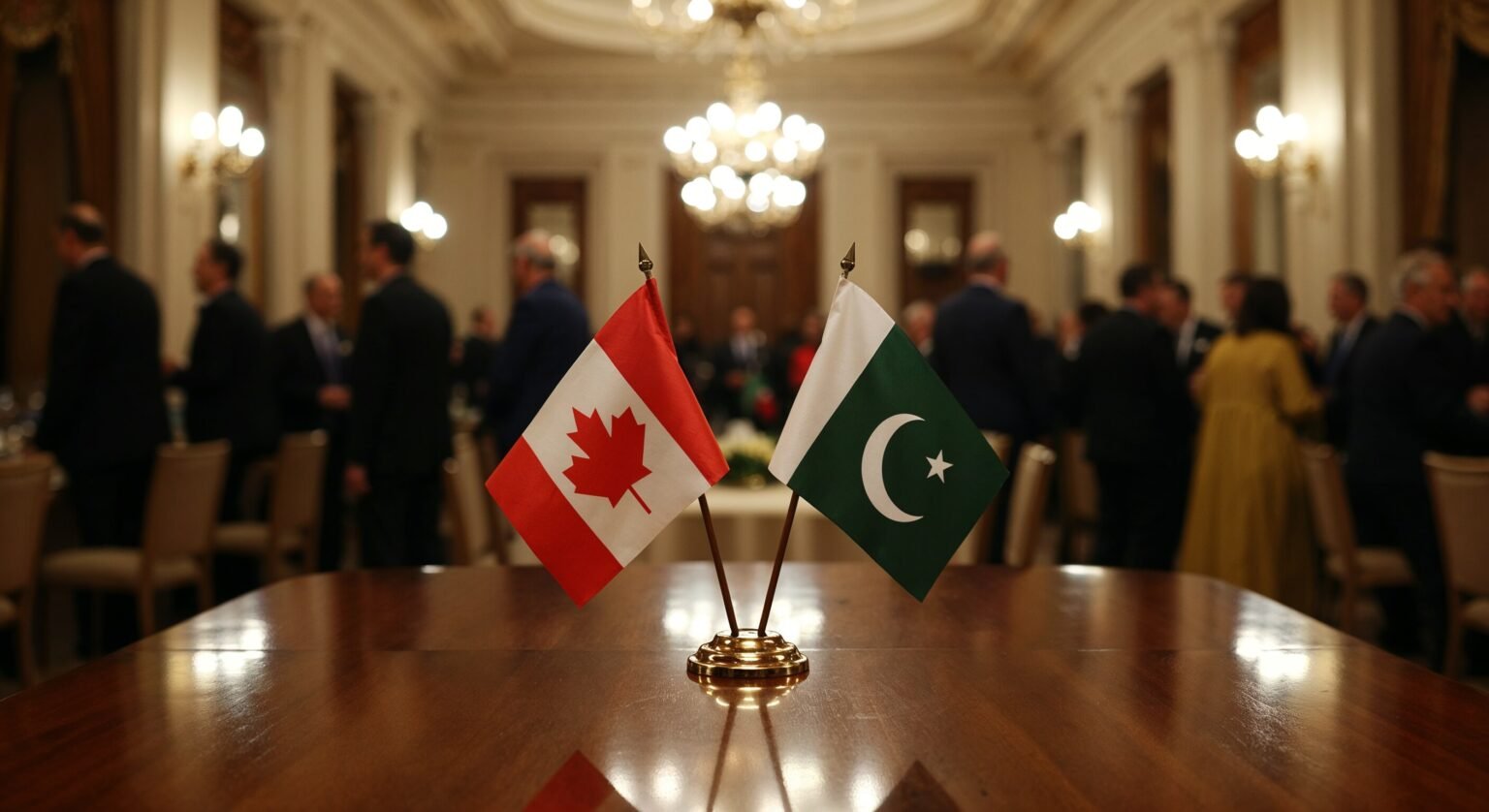
Building on 2025 outcomes like canola trade resumption and FIPPA progress, Pakistan-Canada ties are advancing through active implementation, unlocking potentials in IT, renewables, and climate action for sustained mutual economic benefits and innovation-driven growth.
Key Points
- Outcomes from recent (2025) meetings include canola market reopening and FIPPA negotiations, fostering immediate trade boosts.
- Implementation highlights include resumed canola imports and Reko Diq advancements, with tangible economic impacts.
- Further potentials span IT collaborations, renewable energy investments, and climate resilience initiatives.
- Rational analysis shows evergreen benefits like diversified supply chains and technology transfers for long-term prosperity.
- Promotional outlook emphasizes job creation, GDP growth, and diaspora-driven synergies for both nations.
In a world increasingly defined by interconnected economies, the implementation of recent (2025) Pakistan-Canada agreements represents a strategic pivot toward actionable, future-oriented partnerships. These developments not only deliver on immediate outcomes but also illuminate pathways for expanded collaboration, appealing directly to policymakers crafting bilateral strategies, investors seeking high-return opportunities, academics dissecting global economic models, and the general public reaping everyday benefits like affordable goods and employment prospects.
The foundation lies in the outcomes of key 2025 engagements, starting with the October 30 telephonic dialogue between Deputy Prime Minister and Foreign Minister Ishaq Dar and Canadian Foreign Minister Anita Anand, culminating in the November 3 joint statement. This accord facilitated Canadian canola exports, addressing Pakistan’s edible oil demands while aiding Canada’s diversification amid global trade shifts. Implementation has been swift: Pakistan’s lifting of the three-year GM canola ban has enabled imports to resume, with early shipments projected to reach 1 million tonnes in 2025/26, valued at over US$500 million. This move exemplifies rational cooperation, blending contemporary market needs with evergreen principles of agricultural resilience.
|
Implementation Milestones for Canola Trade (2025) |
Status |
Projected Impact |
|
Joint Statement Issuance |
Completed (Nov 3) |
Sets legal framework for exports |
|
Market Reopening Announcement |
Effective Immediately |
Revives annual imports of 1M+ tonnes |
|
First Shipment Projections |
Q4 2025 Onward |
US$500M+ in trade value |
|
Long-Term Supply Agreements |
In Negotiation |
Stabilizes prices for Pakistani consumers |
This table highlights the progression from agreement to action, underscoring benefits for policymakers in food security planning and investors in agro-commodities.
Building on this, the Foreign Investment Promotion and Protection Agreement (FIPPA) negotiations, concluded in their first round, provide a robust framework for investor confidence. For policymakers, FIPPA’s emphasis on transparent dispute resolution aligns with international best practices, reducing risks in cross-border ventures. Implementation is evident in ongoing projects like the Canadian-led Reko Diq mining initiative by Barrick Gold. As of late 2025, the project has achieved 77% local employment from Balochistan, with feasibility studies approved and construction accelerating toward 200,000 tonnes of annual copper production by the decade’s end. This not only boosts Pakistan’s export revenues but also supplies Canada with critical minerals essential for green technologies, illustrating a sound cooperative analysis where resource extraction meets sustainable development.
Looking ahead, these outcomes open doors to further implementable potentials in emerging sectors. In information technology (IT), Canada’s advanced ecosystem—home to hubs like Toronto’s tech corridor—pairs seamlessly with Pakistan’s burgeoning startup scene, which boasts over 5,000 firms and a workforce of 300,000 IT professionals. Potential collaborations could involve joint ventures in software development and AI, with diaspora networks facilitating knowledge exchange. Investors might explore opportunities under FIPPA, such as establishing R&D centers, potentially adding US$1-2 billion in annual FDI inflows based on similar models in India-Canada ties.
Renewable energy presents another high-potential avenue, amplified by discussions on battery energy storage systems (BESS) and transmission infrastructure. Pakistan’s solar potential exceeds 2,900 GW, while Canada excels in clean energy tech. Implementable steps could include Canadian investments in Pakistan’s 30 GW renewable target by 2030, fostering job creation (estimated 100,000+ positions) and reducing carbon emissions. A November 2025 push for climate cooperation, highlighted in bilateral talks, underscores this: Canada’s expertise in resilient infrastructure could aid Pakistan’s adaptation to climate vulnerabilities, promoting evergreen strategies like diversified energy mixes for economic stability.
|
Potential Sectors for Expanded Collaboration |
Current Bilateral Trade Contribution (US$ Million, 2024) |
Projected Growth (2026-2030) |
Mutual Benefits |
|
IT and Digital Services |
50 |
200-300% |
Tech transfer for Pakistan; Market access for Canada |
|
Renewables and BESS |
20 |
400%+ |
Energy security; Green tech exports |
|
Climate Resilience Projects |
Emerging (10) |
150-200% |
Adaptation funding; Expertise sharing |
|
Education and Skills Training |
15 |
100%+ |
Diaspora scholarships; Workforce upskilling |
This table blends contemporary data from 2024 trade figures with forward-looking projections, drawn from OEC and bilateral reports, to rationalize expansion. Academics can appreciate the analytical depth, noting how these sectors align with UN SDGs, while the public benefits from lower energy costs and skill-building programs.
Moreover, the December 1 meeting between Dar and Canadian High Commissioner Tarik Ali Khan reinforced these trajectories, appreciating progress in trade and investment while emphasizing people-to-people ties. The Pakistani diaspora in Canada, numbering over 215,000, serves as a vital bridge, channeling remittances (US$300 million annually) and entrepreneurial ventures back home. This evergreen element of human capital enhances implementation by fostering trust and cultural synergies.
For investors, the rational appeal is clear: Pakistan’s young demographic (median age 22) offers a vibrant market, complemented by Canada’s stable capital. Policymakers can leverage these for strategic alliances, such as joint climate funds, while academics study the model’s replicability in South-North partnerships. Overall, this promotional narrative positions both nations for win-win scenarios, where implementation today paves the way for tomorrow’s innovations.
Conclusion. The implementation of 2025 Pakistan-Canada outcomes, from canola resurgence to mining milestones, is catalyzing economic momentum, with vast potentials in IT, renewables, and climate action awaiting realization. This partnership promises enhanced trade, innovation, and sustainability, benefiting policymakers through strategic depth, investors via lucrative avenues, academics with research fodder, and the public through prosperity and resilience. By pursuing these horizons collaboratively, both countries can model global cooperation, driving inclusive growth and shared success in an interconnected future.
* Dr. Muhammad Jahanzaib is the Founder & Chief Visionary Officer (CVO) of Diamanium Thinkers, a global think tank. He holds a PhD in International Relations, specializing in the intersection of politics and economics in Pakistan’s foreign and domestic policy. A double gold medalist and published scholar, he writes on economic intelligence, economic diplomacy, political economy, AI and regional cooperation in South Asia and beyond. He can be reached at jahanzaibdgc@gmail.com.
Key References
- Canada-Pakistan Joint Statement: Reaffirming strong and enduring ties – https://www.canada.ca/en/global-affairs/news/2025/11/canada-pakistan-joint-statement-reaffirming-strong-and-enduring-ties.html
- Pakistan allows canola imports that may include GM material – https://www.ofimagazine.com/news/pakistan-allows-canola-imports-that-may-include-gm-material
- Barrick Reports Third Quarter 2025 Results – https://www.barrick.com/English/news/news-details/2025/q3-2025-results/default.aspx
- Canada (CAN) and Pakistan (PAK) Trade – https://oec.world/en/profile/bilateral-country/can/partner/pak
- Pakistan, Canada strengthen partnership on trade, investment – https://mettisglobal.news/Pakistan-Canada-strengthen-partnership-on-trade-investment-56377
- 2025 Investment Climate Statements: Pakistan – https://www.state.gov/reports/2025-investment-climate-statements/pakistan
- Pakistan, Canada Push for Stronger Climate Cooperation and Economic Resilience – https://thediplomaticinsight.com/pakistan-canada-climate-cooperation/
- Ishaq Dar meets Canadian envoy – https://www.nation.com.pk/02-Dec-2025/ishaq-dar-meets-canadian-envoy