
When stoic fatalism is imbued in the minds, sanity takes the back seat.
The perpetual crisis on the Durand Line between Pakistan and Afghanistan is fueled by Kabul’s ideological rejection of the border that is rooted in irredentism, and damaged by Islamabad’s internal incoherence, preventing a realistic resolution to the TTP-driven security dilemma.
Key Points
- A British imperial device, the 1893 Durand Line, arbitrarily divided the Pashtun heartland, constructing a permanent political and cultural wound.
- Every Afghan government which includes the current Taliban regime has embraced stoic fatalisme. rejecting the ideological unity over pragmatic, realistic state interests.
- This rejection of ideology translates directly into the TTP’s ability to use Afghan soil as a sanctuary, driving the latest round of cross-border clashes and economic devastation.
- Pakistan must maintain domestic and strategic coherency in order to execute a unified policy that integrates security enforcement with sustainable economic interdependence.
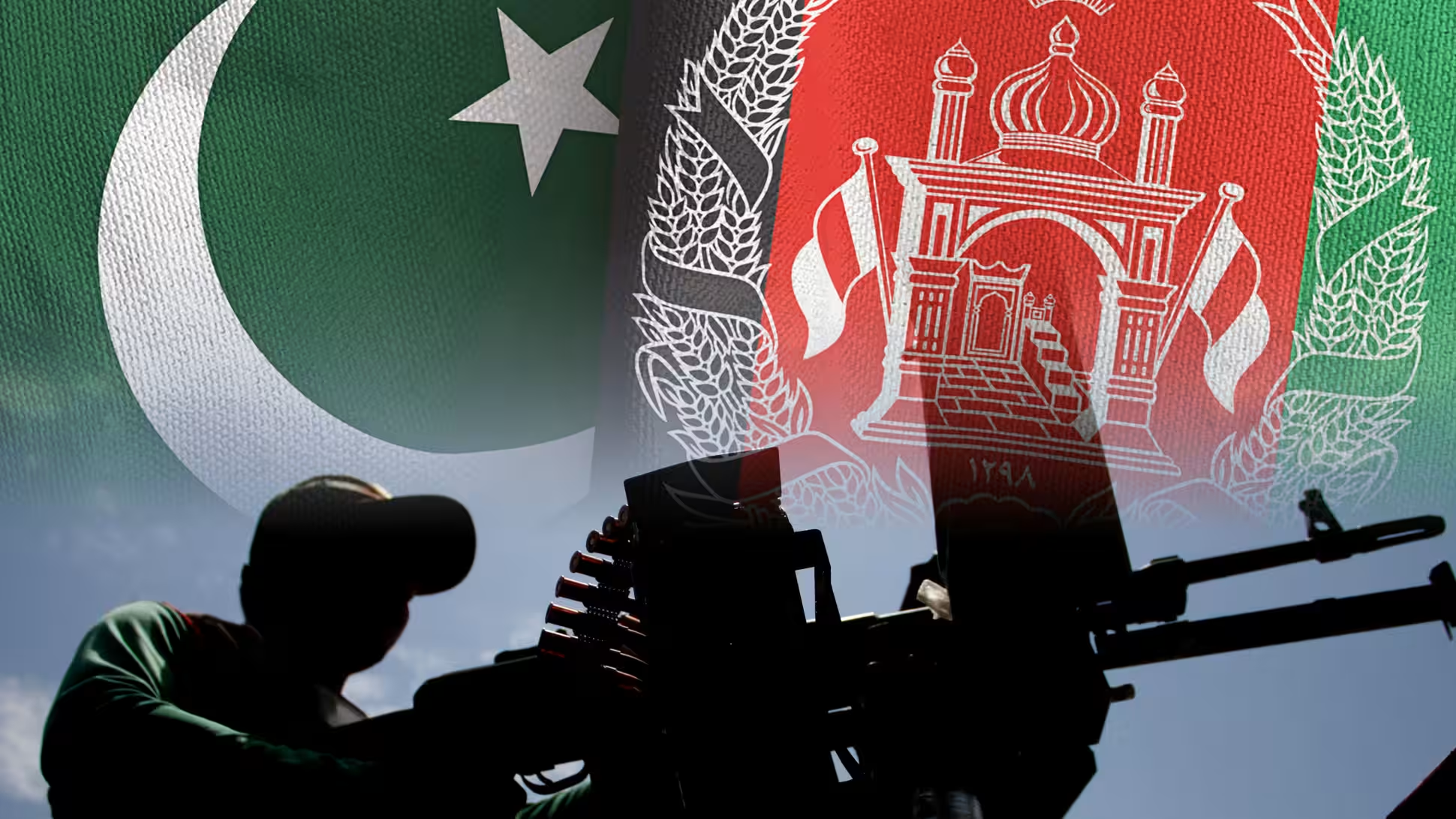
The 2,670-kilometre border that separates Pakistan and Afghanistan is not merely a geopolitical boundary, rather it is the most volatile fault line in South Asia, a scar that periodically tears open into diplomatic confrontation and outright military hostility. The recent barrage of cross-border skirmishes and retributive airstrikes causing a dramatic escalation, is the latest manifestation of a conflict rooted not just in instantaneous security threats alone, but in a century-old historical wound: the colonial demarcation known as the Durand Line.
To examine the current crisis, one must return to 1893. The line that was negotiated between Sir Mortimer Durand of British India and Afghan Emir Abdur Rahman Khan, was a classic “Great Game” tactic to define their corresponding spheres of influence. The tragedy of this agreement was its arbitrary decussating of the Pashtun ethnic heartland. When Pakistan got independence in 1947, it inherited this boundary under the principle of uti possidetis juris which meant that successor states inherit colonial administrative lines which are universally accepted in international law. However, Afghanistan immediately rejected it politically, becoming the only United Nations member to vote against Pakistan’s entry.
Since 1947, every Afghan regime be it monarchy, republic, communist, or Islamist has maintained this defiant posture. This is exactly where the political philosophy of Kabul takes a critical posture. Afghanistan has consistently chosen a path that defied pragmatic or realistic politics, but of a stoic fatalism which is a relentless, ideological commitment to an irredentist claim i.e. the reunification of Pashtun lands at the expense of palpable state interests and immediate welfare. Despite the continuing political and security tensions, bilateral trade between Afghanistan and Pakistan historically reached nearly $2 billion USD annually, demonstrating a fundamental economic reliance that Kabul sacrifices by rejecting the border. A pragmatic state would focus on recognizing the international boundary so as to secure transit trade, unlock economic chances via Pakistan’s ports, and achieve regional legitimacy. Unfortunately, the current regime chooses to prioritize a transnational Islamist narrative that aligns with the TTP’s ideological objectives which is a vision that disregards modern state sovereignty in favor of a political and ethnic unity that has existed since 1893.
Therefore, this fatalist choice has earnest security implications for Pakistan. The turndown to acknowledge the border creates the perfect ideological and practical cover for non-state actors. By keeping the border dispute alive, Kabul has sustained domestic nationalistic support while concurrently exerting pressure on Islamabad. This sturdy adhesion to an ideological goal that provides zero economic or strategic benefit is conceivably the single greatest obstacle to regional stability.
The ramification of this fatalism is now painfully evident in the surge of militancy in Pakistan. The TTP known as the “ideological cousin” of the Afghan Taliban, has intensified its attacks since the Taliban takeover in 2021. Since the Taliban’s return to power in August 2021, terrorist attacks in Pakistan that are largely attributed to the TTP operating from Afghan soil have seen a surge of over 70% (some sources report up to a 79% rise in 2023 alone), marking an eight-year high in casualties for security forces. TTP leaders and fighters that are sheltered on the Afghan side have tried to use the disputed border as a launching pad. Pakistani officials have constantly voiced this concern. For instance, a Pakistani Army spokesperson provided evidence and stated publicly that “Afghanistan is being used as a base of operations against Pakistan.” This is not just a diplomatic spat instead it is a security dilemma where one sovereign state is perceived to be actively facilitating attacks on another.
When diplomatic requests for decisive action fail, the relation begins to descend into open conflict. The recent retaliatory airstrikes by Pakistan into Afghan territory condemned by Kabul as a violation of sovereignty and the corresponding border clashes highlight the current danger. This escalation closed vital trade routes like Torkham and Chaman, inflicting economic devastation on each side, particularly on a humanitarian crisis-ridden Afghanistan. Pakistan’s mass deportation of undocumented Afghan nationals, undertaken somewhat to pressurize the Kabul regime, has further aggravated the humanitarian and political costs. The exchange of fire and rhetoric which includes Pakistan’s Defense Minister’s warning of potential “open war” demonstrating the critical collapse of mutual trust.
While the origin of the ideological poison lies across the border, the tragedy for Pakistan is its response which remains hampered by its own need in order to secure internal coherency.
Pakistan, therefore, requires a unified and a non-partisan national security strategy that can survive political cycles. The policy incoherence of the past which includes debates over distinguishing ‘good’ and ‘bad’ militants and changing diplomatic priorities has often left Islamabad in a reactive state. A consistent, long-term policy demands the state to speak with one voice doubling security enforcement with economic stabilization.
Setting the house in order means: (a) maintain uncompromising border security and control; (b) use of economic interdependence (Afghanistan’s reliance on Pakistani ports) as a leverage line, to make the costs of non-cooperation undeniable; and (c) Sheathe the Afghan policy from domestic political turbulence so as to ensure strategic continuity. Only a unified and resilient Pakistan can impel Kabul to recognize that pragmatic realpolitik is the sole sustainable path forward, with a need to replace their ideological fatalism with responsible statecraft.
Way Forward
The Durand Line although legally settled is politically toxic. Afghanistan’s insistence on irredentism, a stoic fatalism that prioritizes an ethnic ideal over state stability has ensured that the TTP will keep exploiting the border, guaranteeing a perennial conflict. For Pakistan, the path to a peaceful western frontier is directly through Islamabad. Until Pakistan formulates and executes a unified, rational, and coherent long-term strategy, the relationship will stay trapped in a destructive sphere. Securing the border is intrinsically connected to securing strategic and political coherency at home, so that raising the political and economic cost of Kabul’s ideological defiance.
Bio
Amna Maryam is an MPhil International Relations Scholar at NUML University. She is also working as a Research Assistant on a HEC Funded project related to CPEC’s Socio-economic impacts in Balochistan. She can be contacted at maryamamna09@gmail.com.
Key References
- Durand Line | Geography, History, Geopolitics, & Facts
o URL: https://www.britannica.com/event/Durand-Line
- Pakistan Army alleges Afghanistan Taliban facilitating infiltration of terrorists across border
- Pakistan edges towards a ‘two-front’ crisis | East Asia Forum
o URL: https://eastasiaforum.com/2025/12/03/pakistan edges-towards-a-two-front-crisis/
- Afghanistan and the Durand Line Dilemma – Republic Policy o URL: https://republicpolicy.com/afghanistan-and-the durand-line-dilemma/