
Diamanium Thinkers

Crescent Star and Maple: How Art and Food Forge an Inclusive Canada–Pakistan Identity 

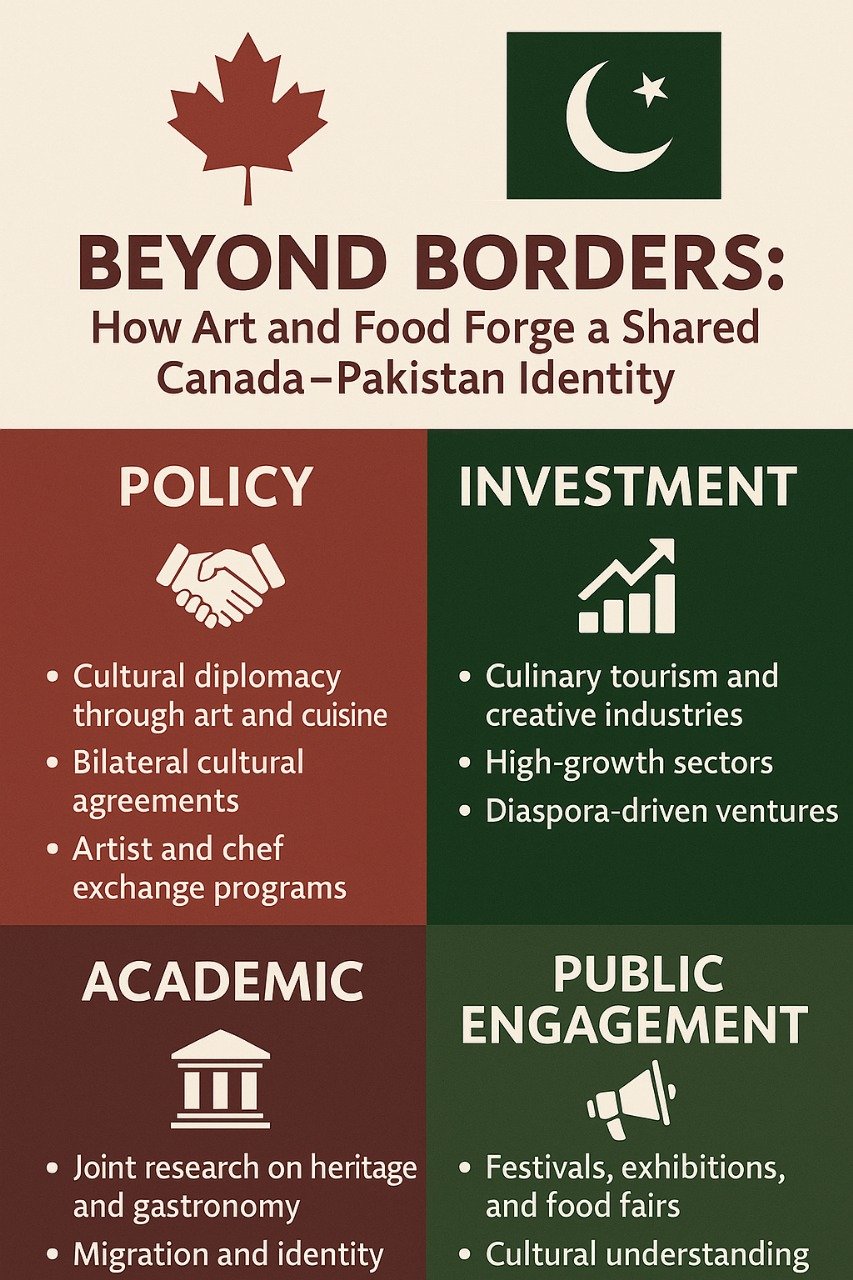
Art and cuisine are not just cultural expressions — they are economic, diplomatic, and academic bridges. Canada–Pakistan exchanges in these realms can deepen bilateral ties, attract investment, and foster inclusive, sustainable growth for both nations.  Key Points 
  • Policy leverage: Cultural diplomacy through art and food can strengthen bilateral relations. 
  • Investment potential: Culinary tourism, creative industries, and diaspora-led ventures are high-growth sectors. 
  • Academic collaboration: Joint research on heritage, gastronomy, and migration enriches both societies. 
  • Public engagement: Festivals, exhibitions, and food fairs create grassroots cultural understanding. 
Policy Perspective: Culture as Soft Power  Cultural exchange is more than symbolic for policymakers – it’s strategic. Canada’s multicultural policy framework and Pakistan’s rich heritage offer fertile ground for soft power diplomacy. According to Statistics Canada (2024), over 300,000 Pakistani-origin residents live in Canada, forming a vibrant diaspora that influences political, economic, and cultural landscapes. Bilateral cultural agreements could:  – Cultural festivals: Think of Canada-Pakistan cultural weeks across cities like Toronto, Ottawa, Lahore, and Karachi – hosting combined exhibitions of contemporary Pakistani painters, Canadian Indigenous artists, and diaspora musicians. Government support through grants from Canada’s Multiculturalism Program and Pakistan’s Ministry of Culture can institutionalize these events.  Culinary diplomacy: Chefs from Pakistan hosted at “Canada Cooks” events in Vancouver, while Canadian culinary ambassadors appear at Pakistan’s National Food Festival – these initiatives spark dialogue, tourism and mutual appreciation.  Institutional exchanges: Governments can fund visits by cultural attachés, joint-curated exhibitions for national galleries and residency programs – reinforcing people-to-people linkages.  Shared challenges and narratives: Climate change, youth empowerment, social inclusion – storytelling through art and food can foster collaborative awareness and local action.  Such initiatives amplify both countries’ soft power, present progressive narratives and foster goodwill in global forums. Long-term policy planning – embedding culture within trade missions, diaspora strategy and tourism frameworks – offers sustainable, multifaceted dividends.  Table 1: Potential Policy Outcomes from Cultural Cooperation 
Policy Action  Expected Outcome 
Bilateral Cultural Accord  Enhanced diplomatic goodwill 
Artist & Chef Exchange  Increased cultural literacy 
Heritage Preservation Fund  Shared historical narratives 
Investor Lens: The Business of Culture  Art and food are not just passions for investors – they are profitable sectors. The global creative economy is valued at over $2.25 trillion (UNCTAD, 2023), while the culinary tourism market is projected to grow at 16.8% CAGR through 2030. In the Canada–Pakistan context: 
  • Pakistani cuisine — from biryani to chapli kebabs — is gaining traction in Canadian cities with Pakistani restaurants seeing double-digit annual growth in Toronto, Vancouver and Calgary. 
  • Canadian art galleries are increasingly showcasing South Asian contemporary art, attracting both diaspora and mainstream audiences. 
Table 2: High-Potential Investment Areas in Art and Cuisine 
Sector  Opportunity  Market Trend 
Culinary Tourism  Food festivals, cooking schools  Rising demand for authentic ethnic cuisine 
Art Market  Cross-border exhibitions, online art sales  Growth in digital art platforms 
Media & Film  Co-productions, streaming content  Expanding South Asian audience in Canada 
  Academics: Mapping the Intersections of Diaspora, Artistry, and Gastronomy  Academics play a pivotal “translator” role – making sense of how art, food and identity circulate between Canada and Pakistan. Interdisciplinary research across cultural studies, sociology, culinary anthropology and arts management offers fertile ground.  Diaspora identity studies: Scholars can investigate how second-generation Pakistani-Canadians negotiate identity – through fusion cuisine, Urdu poetry nights in Toronto or calligraphy workshops in Calgary.  Food heritage research: How has Pakistani street-food culture – karahi, biryani, chai – evolved when sited in Canadian kitchens and eateries? Conversely, what’s the impact of Canadian produce and cooking methods on Pakistani-style dishes in Karachi cafés?  Artistic collaborations: Joint projects—like multimedia exhibitions exploring the immigrant experience, digital archives of diaspora culinary stories or art installations by Pakistani and Canadian artists—create new vocabularies of belonging.  Funding avenues – via SSHRC (Canada) and HEC (Pakistan) – can be tapped for joint grants. Academic-government-community partnerships can translate research into public exhibitions and policy briefs.  Public Engagement: Experiencing the Fusion and Feeling the Connection   At the heart of this cultural bridge is the everyday individual – citizens, families, artists, entrepreneurs, etc. When they encounter Pakistani-Canadian identity through art, taste and experience, transformation occurs.  Pop-up culinary markets: Imagine Toronto’s St. Lawrence Market hosting weekend pop-ups of Pakistani street-food stalls – paired with short performances of qawwali or regional folk poets. Karachi’s Empress Market likewise featuring Canadian maple-themed desserts and coffee.  Community art fests: Grassroots festivals where local artists (Pakistani-origin and Canadian-born) paint murals on shared themes – ‘roots & routes’, ‘climate & culture’, ‘remembrance & belonging’.  Entrepreneurial synergies: Pak-Canadian chefs launching fusion cafés; artisans selling blended-style handicrafts; book clubs hosting bilingual literary evenings – these micro-enterprises deepen everyday awareness and economic momentum.  These experiences strengthen multicultural social bonds – families, friends, neighbors – who then become organic ambassadors of mutual respect and curiosity.  Conclusion   Cultural bridges between Canada and Pakistan—hinging on art, food, and identity—hold exceptional promise. When policymakers invest in cross-border festivals and culinary diplomacy, academics decode evolving identities and heritage, and everyday communities partake in creative, immersive experiences, an empowering circle of connection emerges. These exchanges reinforce soft power, enrich scholarship, ignite entrepreneurial opportunities, and deepen social cohesion. Promoting and sustaining these bridges isn’t just culturally meaningful—it’s strategically vital. By embracing art, cuisine, and the lived stories of identity, both nations can craft a future defined by mutual respect, innovation, and lasting kinship. Ultimately, these efforts are mutually reinforcing: policymakers lay the groundwork, academics generate insight, and citizens live the culture—transforming policy into lived connection.  * Dr. Muhammad Jahanzaib is the Founder & Chief Visionary Officer (CVO) of Diamanium Thinkers, a global think tank. He holds a PhD in International Relations, specializing in the intersection of politics and economics in Pakistan’s foreign and domestic policy. A double gold medalist and published scholar, he writes on economic intelligence, economic diplomacy, political economy, AI, and regional cooperation in South Asia and beyond. He can be reached at jahanzaibdgc@gmail.com.  Key References 
  1. Culinary Tourism Market Size Report – Grand View Research – https://www.grandviewresearch.com/industry-analysis/culinary-tourism-market 
  1. Statistics Canada: Immigration and Ethnocultural Diversityhttps://www.statcan.gc.ca/en/subjects-start/immigration_and_ethnocultural_diversity 

Leave a Comment

Your email address will not be published. Required fields are marked *

Scroll to Top