
The possible deployment of Pakistani troops to Gaza represents a landmark decision in Pakistan’s foreign policy and must be guided by the principles of legality, legitimacy, and a clear humanitarian focus. While moral duty and long-standing historical ties with the Palestinian people may encourage active engagement, concerns over operational risks, political fragility, and the complex dynamics of regional powers warrant caution. Any use of force should occur strictly within a UN-backed multilateral framework, with a mandate limited to humanitarian purposes and full parliamentary approval. Without these safeguards, such a move could undermine Pakistan’s international credibility, strain its security posture, and risk unnecessary military involvement. Therefore, a prudent approach combining effective diplomacy, sustained humanitarian assistance, and strictly regulated peacekeeping would best preserve Pakistan’s moral authority, safeguard its national interests, promote long-term regional stability, and meaningfully alleviate the suffering of the Palestinian people.
Key points
- Pakistan faces a historic decision regarding whether it will participate in the proposed Gaza peace mission, as the world increasingly scrutinizes its stance.
- The government’s position is not fixed but reflects internal deliberations and the uncertainty created by external doubts.
- Pakistan’s consistent support for Palestinian self-determination and civilian protection contributes to public expectations and creates a moral obligation in the eyes of its citizens.
- Any military action involves immense operational, strategic, and political risks and requires a strong legal framework, strict rules of engagement, and broad domestic consensus.
- Non-combat, multilateral, and humanitarian-oriented engagement is essential for maintaining Pakistan’s global image and regional respect.
- This move will mark a historic moment for Pakistan in the international arena—either as an active peacemaker or as an outsider.
As the world’s attention is focused on Gaza, the humanitarian crisis there has reached unprecedented levels in contemporary memory. Innocent civilians continue to be trapped in endless cycles of violence, mass displacement, and destruction, with brief ceasefires offering only faint relief. What they urgently need is not temporary pauses in fighting, but material justice, restored dignity, and systems of lasting security.
In this critical moment, Pakistan faces a profound question: should it commit its military to an international stabilisation force, actively join the effort,or remain on the margins by offering moral support without direct involvement? This crisis represents not only a policy challenge, but a test of Pakistan’s role and moral vocation in the international system.
According to recent statements by senior officials, discussions regarding the possible deployment of troops are ongoing and await finalisation, reflecting the seriousness and complexity of the issue. At the same time, the Ministry of Information has officially denied earlier media reports claiming that Pakistan had categorically agreed to send troops, describing such claims as false. This apparent duality illustrates the sensitivity of the matter, as Islamabad balances domestic political pressures, its relationships across the Middle East, and its humanitarian responsibilities towards Palestine.
Pakistan’s foreign policy has long been grounded in principled positions: support for Palestinian self-determination, opposition to occupation, and a commitment to the protection of civilian lives in conflict. Translating this rhetoric into action through a peacekeeping mission would allow Pakistan to demonstrate not only solidarity, but also the willingness to shoulder responsibility by moving from advocacy to meaningful
cooperation in alleviating suffering.
Supporters of intervention argue that a multilateral or UN-mandated mission—particularly one involving Muslim-majority states such as Indonesia, Jordan, and Egypt—could be transformative. Such participation would elevate Pakistan’s standing and send a strong message of unity and resolve. Pakistan’s long history in UN peacekeeping, with contributions to more than forty missions worldwide, including in Congo and Somalia, provides both precedent and operational capability. Its armed forces, experienced in complex environments, could contribute significantly to civilian protection, ceasefire monitoring, and humanitarian delivery, demonstrating both moral leadership and strategic competence.
Recent diplomatic engagements, including visits by the Chief of Army Staff, Field Marshal Asim Munir, to Jordan and Egypt, have fuelled speculation about quiet diplomatic efforts to coordinate a broader Islamic response. Furthermore, Pakistan’s support for United Nations resolutions related to Gaza peace plans indicates a willingness to play a constructive role, provided such efforts do not undermine Palestinian aspirations.
However, the appeal of morally driven action must be balanced against the considerable dangers of the Gaza theatre. The enclave remains highly volatile, marked by recurring hostilities, fragmented internal authority, and severe civilian suffering caused by crossfire and blockade. Deployment without a clear and precise mandate could expose Pakistani forces to ambushes, escalation, or accusations of partiality. Defence Minister Khawaja Muhammad Asif has repeatedly stressed that legal authorisation, clear rules of engagement, force protection measures, and the exclusion of disarmament obligations against Hamas must be defined before any deployment. Parliamentary oversight is widely considered essential to ensure democratic legitimacy and shield the decision from domestic backlash.
Public sentiment in Pakistan remains strongly pro-Palestinian, yet cautious about participation in Western-driven initiatives, including proposals associated with former US President Donald Trump, which many view as biased. A miscalculation could
fracture national unity, provoke unrest, and damage Pakistan’s image as a neutral and principled representative of the Muslim world.
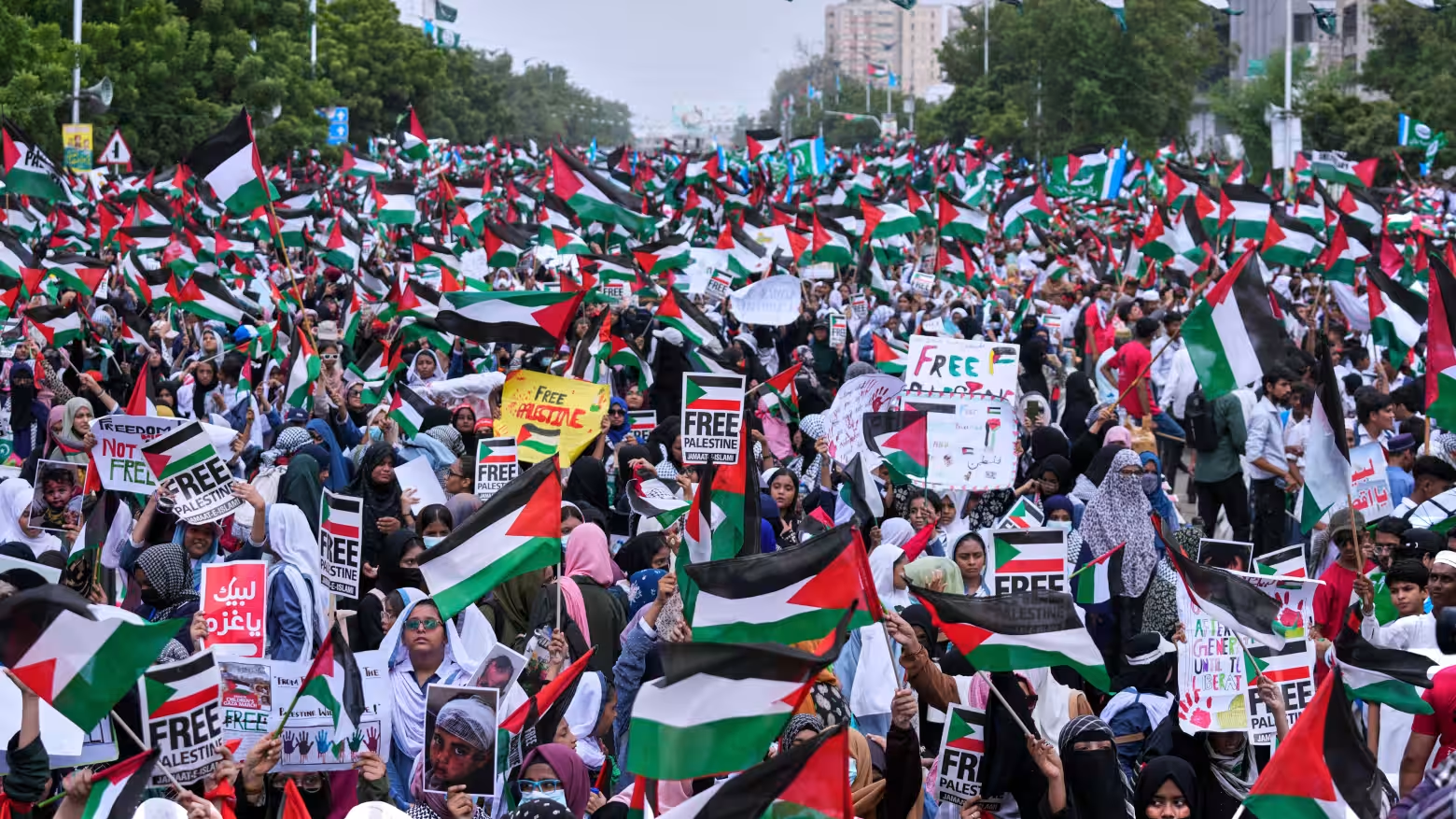
Domestically, the debate is highly nuanced. While public demonstrations reflect deep sympathy for Gaza, sceptics warn of potential political backlash. Retired military officials, such as General (Retd.) Muhammad Saeed, have called for transparency through deliberations in the National Security Council and parliament. Analysts like Qamar Cheema have noted that limited troop deployment should not undermine border security vis-à-vis India or Afghanistan. Conversely, senior figures such as former Foreign Secretary Salman Bashir have highlighted structural constraints, including managing relations with the United States amid Pakistan’s economic challenges.
The prospect of indirect coordination with Israeli forces—however mediated through allies such as Saudi Arabia—remains deeply controversial. This makes it essential that any Pakistani involvement be strictly limited to ceasefire monitoring and civilian protection.
Regionally, the strategic calculus is equally complex. Pakistan’s relations with Saudi Arabia, Turkey, Iran, and Gulf partners are deeply entangled with the politics of Gaza, and any perceived alignment could trigger strategic repercussions. Parallel discussions by Indonesia— the world’s largest Muslim-majority country—elevate the importance of a collective Islamic position. China’s caution regarding UN resolutions, particularly ambiguities surrounding the structure and mandate of any International Stabilisation Force, mirrors Pakistan’s own concerns. Hamas’s rejection of trusteeship arrangements further complicates the issue of local acceptance, given its insistence on sovereignty.
While participation might improve relations with the United States and Gulf countries and ease external economic pressures, it could also risk diluting Pakistan’s strategic autonomy. Therefore, a calibrated strategy focused on de-escalation rather than entrapment appears to be the most rational approach.
For any Pakistani deployment to be justified, strict preconditions must be met:
A strong, UN-approved multilateral mandate to ensure legitimacy and prevent perceptions of unilateralism.
A narrowly defined mission centred on civilian protection, humanitarian access, and reconstruction, avoiding combat operations or forced disarmament without Palestinian consent.
Clear prohibitions against politically charged tasks, such as the disarmament of Hamas.
Domestic transparency through parliamentary debate, public briefings, risk audits, and consultation with religious and societal leaders.
Regional coordination with Muslim-majority countries, potentially under the umbrella of the Organisation of Islamic Cooperation (OIC), to share responsibilities and enhance unity.
These pillars would allow Pakistan to act decisively while remaining responsible, ensuring its contributions serve humanitarian purposes rather than geopolitical competition.
Ultimately, the human dimension of this debate renders it deeply urgent and morally compelling. One can imagine a Pakistani peacekeeper walking through the rubble-strewn streets of Gaza, assisting wounded children, or distributing food to families sheltering in tents. Such scenes would not only relieve immediate suffering but also reflect Pakistan’s national ethos as a bridge-builder, consistent with moral and humanitarian ideals.
Pakistan’s decision in the shadow of Gaza—where more than two million people teeter on the brink of survival—is not merely tactical. It will determine whether words are transformed into actions, and whether solidarity becomes sacrifice
Conclusion
The choice at this crossroads is full of complexity and consequences, making it a challenge of moral strength and long-term planning. The path of peacekeeping is a dangerous one, and a legacy awaits; however, the path of non-intervention would mean bearing the charge of witnessing our blood in pain. Islamabad needs to bring ideals and pragmatism into harmony, and perception and peril onto the same plane. The present consultations represent two-sided possibilities: the threat of premature or unclear
statements, and the opportunity to be among the first to play an active role in one of the most serious crises in the history of humanity with dignity and strength. Pakistan is prepared to show, once again, that it is the protector of the defenseless, offering moral suasion and concrete support to Gaza, without losing the skill of walking the fine line between national prerogative and international relations.
Bio
Syed Kashif is pursuing an MPhil in International Relations at NUML University, Islamabad.His research interests include the foreign policies of major powers, especially the foreign policy of the United States. He is also interested in global security and regional geopolitics.
Email: syed.kashifggr@gmail.com
References
- Decision on sending troops for Gaza peace force ‘in process, has to be finalised’: Asif, Dawn — https://www.dawn.com/news/1951805
- Govt, parliament to decide on sending troops to Gaza: DG ISPR, Business Recorder — https://www.brecorder.com/news/40390644/govt-parliament-to-decide-on-sending-troops-to-gaza-dg-ispr
- Pakistan may join international stabilization force for Gaza: Dar, The Tribune — https://tribune.com.pk/story/2569938/dar-pakistan-may-join-international-stabilization-force-for-gaza
- Decision on deployment of Pakistani troops to Gaza not yet finalized: Defence chief, Anadolu Agency — https://www.aa.com.tr/en/asia-pacific/decision-on-deployment-of-pakistani-troops-to-gaza-not-yet-finalized-defense-chief/3729369
- Govt deliberating troop deployment to Gaza under Trump’s peace plan: Asif, The News — https://www.thenews.com.pk/latest/1354258-govt-deliberating-troop-deployment-to-gaza-under-trumps-peace-plan-asif
- Defence Minister Khawaja Asif rubbishes contentious remarks about disarming Hamas, Dawn — https://www.dawn.com/news/1952376
- Final decision on Pakistan troop deployment to Gaza awaits due process: Asif, GeoTV — https://www.geo.tv/latest/631006-final-decision-on-pakistan-troop-deployment-to-gaza-awaits-due-process-asif
- Can Pakistan join the Gaza stabilisation force without facing backlash?, Al Jazeera — https://www.aljazeera.com/news/2025/11/22/can-pakistan-join-the-gaza-stabilisation-force-without-facing-backlash