
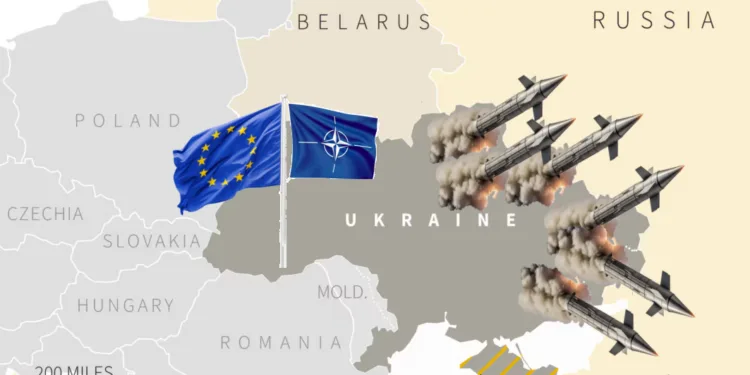
The EU approach to the Russia-Ukraine war is a mixture of sanctions, military and financial aid to the Ukrainian government, diversification of the European energy sources, humanitarian intervention, and long-term security planning to enhance the stability of Europe and to defeat the aggression of Russia.
Key points:
- The EU aid to Ukraine has reached out to humanitarian, economic, and military spheres.
- EU has given the biggest regime of sanctions on Russia.
- Diversification of energy and the lack of reliance on Russian gas are to be considered.
- There are still internal divisions within the EU but they have become narrow since 2022.
- The security reforms and defense integration in EU have been stepped-up by the war.
- The EU also seeks to enforce the international law, and defend European security architecture.
Strategic awakening of Europe
Russia-Ukraine war is the greatest security crisis in Europe since World War II. In the case of the European Union, it has altered historical perceptions on matters relating to security, energy interdependence, and geo-political actions. When Russian troops entered Ukraine in February 2022, the EU reacted in a way that marked a degree of cohesion and decisiveness never witnessed before in the EU foreign policy. The war has triggered a historic change where EU was focused on the old meaning of diplomacy and economic statecraft to a more proactive one in the hard security.
Response of EU towards Russia-Ukraine War
- Sanctions Regime
The unprecedented sanctions regime on Russia has been one of the most powerful aspects of the response of the EU. The EU applied several packages on Russian banks, individuals around the Kremlin, exportation of technology, aviation, energy and the Central Bank of Russia. The sanctions would undermine the military-industrial strength of Russia and increase the political price of its further action. The more aggressive economic approach is represented with the freeze of Russian assets, including sovereign reserves kept in Europe. EU has been coherent in spite of arguments between its member nations, particularly the ones who had, in the past, been reliant on Russian energy. The sanctions have slowly developed on economic regulations to media censorship on media outlets such as RT and Sputnik considered as disinformation platforms by the EU.
2. Humanitarian and Military assistance
Historically, the EU has been playing the role of direct involvement in military assistance but the war has changed the norm. The EU has spent billions of euros on weapons, ammunition, and military training of Ukrainian forces through a program called European Peace Facility (EPF). It is the first instance when the EU finances lethal weapons to a warring country. At the same time, the EU has provided a large-scale humanitarian aid in the form of medical supplies, the system of refugee support, as well as financial aid to infrastructure and institutions. The adoption of Temporary Protection Directive (TPD) gave Ukrainian refugees unrestricted entry into health care, education, and labor in the states of the EU, which manifested a concerted humanitarian effort.
3. Energy Independence: Europe gets out of the Pocket of Russia
Prior to the war, Russia was the provider of close to 40 percent of EU gas imports. This dependence was revealed as very weak during the war. In reaction, the EU initiated REPowerEU, a policy that was to see a faster pace in renewable energy, more LNG imports with allies such as the US and Qatar, and enhanced inter-EU energy connectivity. The sudden decline of Russian gas has changed the structure of energy in the EU. The change has been challenging but it has strengthened long-term climate and security objectives of the EU. The crisis escalated the use of renewable energy and brought about renewed debate about the use of nuclear energy, especially in France and Central Europe.
Collective Action Problem of EU
The EU is divided within itself and these divisions are seen even in the collective action. The resistance to some of the sanctions and a delay in decision-making have been witnessed in countries such as Hungary. Meanwhile, Eastern European states, Poland, Lithuania, Latvia and Estonia demand more serious action, referring to their experience with Russia. These divergences in policy framework depict a long standing tension in EU foreign policy: balancing national interests. Nevertheless, the general direction since 2022 is less interdependent and unity in the perception of threat, which was partially led by the fact that the instability in Ukraine directly poses a threat to the security of the EU.
EU’ Long term Strategic Goal
The strategy of the EU is a wider strategic goal, which is to strengthen the European security order under the sovereignty, the international law, and territorial integrity. The war has brought about more EU-NATO cooperation, with member countries raising defense expenditure and improving their capabilities. Further, EU is aiding long-term state building of Ukraine such as anti corruption reforms, economic restructuring, and measures leading to eventual EU membership. This is an indication of the notion that having a stable and democratic Ukraine will lead to a secure Europe.
Conclusion
The therapy of the EU during the war in Russia-Ukraine is a significant change in the European strategic thinking. Its reaction, including the sanctions, the military support, the diversification of the energy structure, and the humanitarian intervention, are the reflection of the moral obligations and the security needs. Irrespective of the internal struggles, EU has become stronger, more capable of security, and has reasserted its position as a geopolitical power. The war has turned out to be a booster in the restructuring of the European defense policy and minimizing the vulnerability to external threats. Since the war moves on, the EU tries to enforce international law and assist the sovereignty of Ukraine, its stability, and integration toward Europe.
Bio
I am Tayyaba Hameed. A student of M.Phil International Relations at NUML, Rawalpindi. My research areas included sustainable development, climate-driven disaster, regional security, role of the US in disaster management in Indo-Pacific. I am also ambassador of TCF’ Alumni Pathways Department. Where I lead outreach session, motivational engagement and guide students about higher education and career choices.
References
Steinbach, A. (2023). The EU’s Turn to ‘Strategic Autonomy’: Leeway for Policy Action and Points of Conflict. European Journal of International Law, 34(4). https://academic.oup.com/ejil/article/34/4/973/7334305
European Parliamentary Research Service (EPRS). (2022). EU strategic autonomy 2013–2023: From concept to capacity. https://www.europarl.europa.eu/thinktank/sv/document/EPRS_BRI%282022%29733589
European Parliamentary Research Service (EPRS). (2023). EU Strategic Autonomy 360°. https://www.europarl.europa.eu/RegData/etudes/BRIE/2023/747465/EPRS_BRI%282023%29747465_EN.pdf
European External Action Service (EEAS). (2023). Why European strategic autonomy matters. https://www.eeas.europa.eu/eeas/why-european-strategic-autonomy-matters_en
Kilic, S. (2024). Half‑Hearted or Pragmatic? Explaining EU Strategic Autonomy and the European Defence Fund through Institutional Dynamics. Central European Journal of International and Security Studies, 18(1). https://cejiss.org/half-hearted-or-pragmatic-explaining-eu-strategic-autonomy-and-the-european-defence-fund-through-institutional-dynamics
European Parliament. (2024). European defence, strategic autonomy and NATO. https://www.europarl.europa.eu/thinktank/en/document/EPRS_BRI%282024%29759601
European Papers. (2022). The Legal Framework of the EU Defence Industry and the Pursuit of Strategic Autonomy. https://www.europeanpapers.eu/europeanforum/legal-framework-eu-defence-industry-and-pursuit-strategic-autonomy
European Commission / EEAS. (2022). A Strategic Compass for Security and Defence. https://www.eeas.europa.eu/eeas/strategic-compass-security-and-defence-1_en
·