
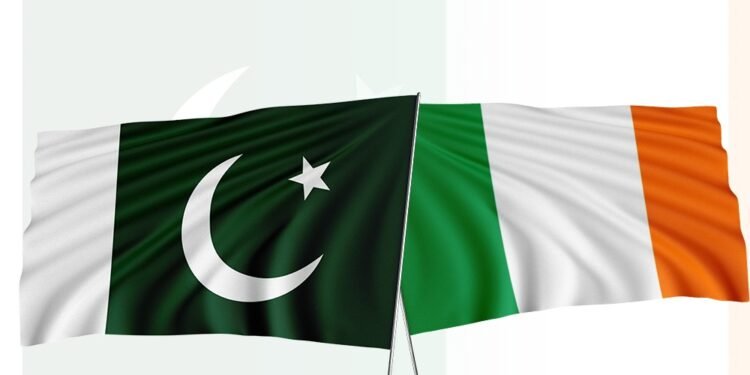
Ireland and Pakistan are unlocking geo-economic potentials through surging trade, strategic investments, and shared innovation. This alliance promises mutual growth in tech, pharma, and sustainability, benefiting policymakers, investors, academics, and the public amid global shifts.
Key Points
- Diplomatic Momentum: Ireland’s 2024 embassy opening in Islamabad marks a pivotal step, enhancing policy coordination and economic dialogues.
- Trade Surge: Two-way trade reached €563 million in 2023, with services as the growth engine; goods trade hit $134 million in 2024, focusing on textiles from Pakistan and medical tech from Ireland.
- Investment Horizons: Calls for Irish capital in Pakistan’s Special Economic Zones (SEZs) and IT sector, potentially attracting €200 million, underscore high-return opportunities.
- Sectoral Synergies: Complementary strengths in technology, pharmaceuticals, textiles, and climate innovation offer evergreen cooperative frameworks.
- Educational and Cultural Bridges: Growing partnerships in education and people-to-people links foster long-term socio-economic ties.
- Global Context: Pakistan’s EU GSP+ status and Ireland’s EU membership enable duty-free trade, amplifying geo-economic leverage.
In an era where geo-economics shapes global alliances, Ireland and Pakistan stand at the cusp of a transformative partnership. This relationship, rooted in shared histories of independence and UN peacekeeping, is evolving into an economic collaboration that potentials reciprocal benefits. For policymakers, this means crafting frameworks that leverage Ireland’s innovation-driven economy (which is home to global tech giants) and Pakistan’s strategic location and youthful workforce. Investors will find fertile ground in sectors blending high-tech prowess with emerging market dynamism, while academics can explore interdisciplinary analyses of sustainable development. The general public, meanwhile, gains from job creation, cultural exchanges, and enhanced global connectivity.
Contemporary data reveals accelerating momentum. Bilateral trade has grown steadily, with two-way volumes reaching €563 million in 2023, predominantly fueled by services such as IT and consulting. Goods trade, though smaller, is significant: Pakistan exported $103 million to Ireland in 2024, up from prior years, while Ireland’s exports to Pakistan totaled $31 million. This imbalance highlights untapped potentials, as Pakistan’s textiles and surgical instruments complement Ireland’s pharmaceuticals and medical devices.
To illustrate, consider the top traded products:
Direction | Top Products (2023 Values in USD Millions) | Key Sectors |
Pakistan to Ireland | House Linens (57), Non-Knit Men’s Suits (16.8), Knit Sweaters (11) | Textiles and Apparel |
Ireland to Pakistan | Orthopedic Appliances (34.6), Scented Mixtures (7.93), Medical Instruments (7.19) | Pharmaceuticals and Medical Equipment |
This table underscores a rational cooperative analysis: Pakistan’s labor-intensive exports align with Ireland’s high-value, innovation-led goods, creating a balanced ecosystem. Evergreen elements, such as shared colonial legacies and cultural affinities – evident in cricket ties and educational contributions by Irish missionaries -provide a stable foundation for enduring partnerships.
Recent developments amplify this promotional narrative. In December 2025, Pakistan’s President Asif Ali Zardari emphasized attracting Irish investments in SEZs and IT, citing Ireland’s tech ecosystem as a model for Pakistan’s digital ambitions. This follows Ireland’s embassy inauguration in 2024, a milestone hailed by parliamentary groups as advancing bilateral ties. An Irish delegation in November 2024 expressed interest in €200 million investments across sectors, signaling confidence in Pakistan’s economic reforms. Discussions on climate finance and green innovation in September 2025 further position this alliance as forward-looking, addressing global challenges like sustainability.
For investors, Pakistan’s SEZs offer incentives like tax holidays and infrastructure, ideal for Irish firms in pharma and tech. Ireland, with its 12.5% corporate tax rate and EU access, invites Pakistani textiles and IT services. Academics can delve into soft power dynamics, as outlined in analyses of cultural diplomacy, where educational collaborations (growing through scholarships and research ties) enhance human capital. The public benefits from diaspora-driven remittances and cultural events, such as St. Patrick’s Day celebrations in Islamabad.
A comparative economic snapshot reinforces potentials:
Indicator | Ireland (2024) | Pakistan (2024) | Cooperative Potential |
GDP Growth (%) | 2.5 | 3.5 | Joint ventures in tech could boost both by 1-2% annually |
Exports (% of GDP) | 144 | 10.9 | Pakistan’s GSP+ enhances EU exports; Ireland facilitates market entry |
FDI Inflows (USD Bn) | 200+ | 2.5 | Irish FDI in Pakistan’s IT could triple inflows in 5 years |
Key Strengths | Tech, Pharma | Textiles, Youth Workforce | Synergies in digital economy and sustainable manufacturing |
This table, drawn from global data, illustrates how cooperation can mitigate disparities, promoting inclusive growth. Evergreen rationales include bilateral agreements like the 2015 Double Taxation Convention, ensuring seamless investments.
Challenges, such as regulatory hurdles, exist but are addressable through policy dialogues. Microsoft’s 2025 shift from Pakistan to Ireland underscores the need for stability, yet it also highlights Ireland as a gateway for Pakistani talent. Overall, this geo-economic axis fosters resilience, innovation, and prosperity.
Conclusion
The Ireland-Pakistan geo-economic partnership heralds an era of shared success, blending Ireland’s innovation with Pakistan’s dynamism. Policymakers should prioritize trade pacts and SEZ collaborations; investors, seize tech and pharma opportunities; academics, research sustainable models; and the public, embrace cultural bonds. With trade poised to exceed €1 billion by 2030 and investments yielding jobs, this alliance exemplifies cooperative geo-economics. By nurturing these ties, both nations can navigate global uncertainties, driving inclusive growth and mutual benefits that endure beyond borders.
* Dr. Muhammad Jahanzaib is the Founder & Chief Visionary Officer (CVO) of Diamanium Thinkers, a global think tank. He holds a PhD in International Relations, specializing in the intersection of geo-politics and geo-economics in Pakistan’s foreign and domestic policy. A double gold medalist and published scholar, he writes on economic intelligence, economic diplomacy, political economy, AI and regional cooperation in South Asia and beyond. He can be reached at jahanzaibdgc@gmail.com.
Key References
- Ireland’s relationship with Pakistan – https://www.ireland.ie/en/pakistan/irelands-relationship-with-pakistan/
- President calls for strengthening Pakistan-Ireland trade links – https://www.radio.gov.pk/16-12-2025/president-calls-for-strengthening-pak-ireland-trade-links
- President Zardari Urges Expanded Pakistan Ireland Cooperation – https://thedailycpec.com/president-zardari-urges-expanded-pakistan-ireland-cooperation/
- Ireland (IRL) and Pakistan (PAK) Trade – https://oec.world/en/profile/bilateral-country/irl/partner/pak
- Soft Power Diplomacy: A Case of Pakistan-Ireland Relations – https://thediplomaticinsight.com/soft-power-diplomacy-a-case-of-pakistan-ireland/
- Pakistan-Ireland Parliamentary Friendship Group Meets H.E. Ms … – https://na.gov.pk/en/pressrelease_detail.php?id=7289
- Ireland Exports to Pakistan – https://tradingeconomics.com/ireland/exports/pakistan
- Country comparison Ireland vs Pakistan 2025 – https://countryeconomy.com/countries/compare/ireland/pakistan
- Country comparison Pakistan vs Ireland 2025 – https://countryeconomy.com/countries/compare/pakistan/ireland
- Pakistan Exports to Ireland – https://tradingeconomics.com/pakistan/exports/ireland
- Pakistan (PAK) and Ireland (IRL) Trade – https://oec.world/en/profile/bilateral-country/pak/partner/irl
- Various sectors: Irish team expresses interest in making €200m … – https://www.brecorder.com/news/40331332/various-sectors-irish-team-expresses-interest-in-making-200m-investment
- Pakistan and Ireland discuss climate finance and green innovation – https://www.linkedin.com/posts/climatechangepk_pakistan-ireland-climateaction-activity-7371229448421048320-zyEp
- Political Relations – Embassy of Pakistan Dublin – https://pakembassydublin.org/political-relations