
Key points:
- Internal factors like leadership, ideology, and legitimacy shape conflicts.
- Russia’s war reflects Putin’s quest for control and national revival.
- Nationalism and propaganda sustain Russia’s internal unity.
- India–Pakistan rivalry is fueled by politics and ideology.
- Pakistan’s security mindset and India’s nationalism reinforce hostility.
- States fight wars to protect internal power and identity.
Conflicts between states are often explained through external determinants such as power politics, alliances, and geopolitics. Yet, an equally critical dimension lies within the internal determinants that shape a state’s behavior and drive it toward confrontation. These include political leadership, ideology, domestic legitimacy, economic pressures, institutional interests, and public opinion. The Russia–Ukraine and India–Pakistan conflicts demonstrate how domestic imperatives often push states into external wars that mirror internal struggles for identity, stability, and authority.
Foreign policy is a tool of achieving the objectives of sates in foreign relations dictated national many internal and external factors. It was started with the emergence of Nation-State System. State needs foreign policy because as Aristotle said that man is a social animal cannot live without society like that state also cannot live alone without its society i.e. International community, because each and every state is dependent for many things on other states (Khan, 2020).
In Foreign Policy Analysis (FPA), internal determinants refer to domestic-level forces influencing foreign decision-making. Unlike systemic theories that emphasize international structures, FPA examines how regime type, leadership psychology, institutional configurations, and ideological narratives shape a state’s external behavior. Leaders often use foreign policy to achieve internal cohesion or distraction, particularly during political or economic crises (Khan, 2020). Thus, wars frequently extend from domestic political logic rather than pure strategic necessity — a framework that helps explain both Russia’s invasion of Ukraine and the enduring hostility between India and Pakistan.
Both conflicts are deeply rooted in history yet sustained by internal political structures and motivations. In Russia, the Kremlin’s drive to maintain legitimacy, fuel nationalism, and consolidate power has turned confrontation with Ukraine into an instrument of regime preservation. In Pakistan, political instability, governance challenges, and a security-driven national identity perpetuate a posture of confrontation aligned with internal narratives of unity and resilience. Beyond politics, ideological differences and historical grievances — from the Soviet collapse in Eastern Europe to the partition trauma in South Asia — continue to shape perceptions of threat and identity.
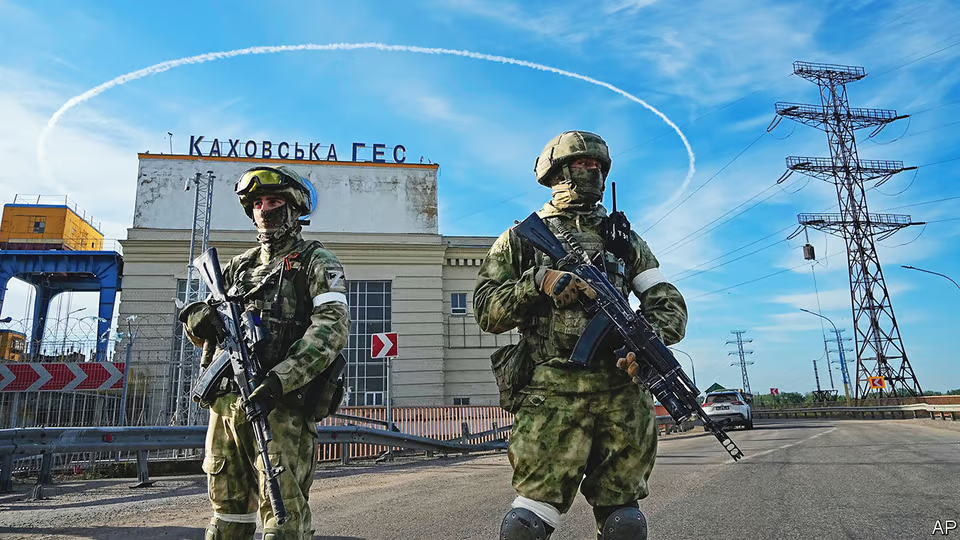
In the Russia–Ukraine case, internal determinants decisively shape Moscow’s aggression. Central to this is Vladimir Putin’s leadership psychology. His personalized, authoritarian rule has fused Russian foreign policy with his own political identity (Chkhaidze, 2023). Putin presents himself as the restorer of Russia’s lost greatness and protector of its civilization. The 2022 invasion of Ukraine served both geopolitical and domestic objectives — reinforcing his image as a decisive leader defending Russia from Western encirclement. The war became a performative act of national revival, appealing to public sentiment shaped by post-Soviet humiliation.
The search for regime legitimacy further explains why confrontation became politically useful. After two decades in power, the Kremlin’s authority relies on nationalism, propaganda, and controlled stability. As corruption and economic stagnation eroded public confidence, external conflict provided a unifying distraction. By framing the invasion as a defensive struggle against NATO and Western imperialism, Putin reactivated patriotic fervor while suppressing dissent. Ideological justifications such as protecting Russian-speaking minorities and preserving the “Russkiy Mir” (Russian World) presented the war as a moral duty which is defending Russian culture and Orthodox civilization (McFaul, 2020).
Economic and institutional factors reinforced this logic. Russia’s oligarchic elites and defense-industrial sectors benefit from sustained militarization, which strengthens state control. Western sanctions further centralized power under Putin, deepening reliance on the regime’s narrative of resilience and sovereignty. State-controlled media amplified patriotic rhetoric, insulating the public from alternative views. Consequently, the Ukraine war functions as both an external campaign and an internal mechanism of regime consolidation — preserving national identity, suppressing dissent, and maintaining elite dominance.
The India–Pakistan conflict reveals a similar interplay between domestic politics and external rivalry. While both countries differ in governance systems and historical context, they have institutionalized their hostility for political consolidation. In India, Prime Minister Narendra Modi’s leadership has infused foreign policy with Hindu nationalist ideology (Milan Vaishnav, 2024). The ruling Bharatiya Janata Party (BJP) presents regional assertiveness as a symbol of national pride and civilizational resurgence. Events like the 2019 Balakot airstrikes following the Pulwama attack reinforced Modi’s image as a strong protector of India. Such episodes often coincide with electoral cycles or domestic unrest, showing how foreign confrontation serves internal mobilization.
In Pakistan, the internal determinants of conflict are rooted in its political culture and ideological foundations. The state’s legitimacy has long been reinforced by a security-oriented national discourse portraying India as a constant threat. This narrative operates as both a unifying force and a mechanism of political continuity, enabling successive governments to justify policies and maintain internal coherence. Departures from this dominant framework are often viewed as compromising national integrity. Consequently, the India–Pakistan conflict functions as a stabilizing construct within Pakistan’s internal political order, perpetuating narratives of vigilance and resistance. The Kashmir issue, in particular, holds symbolic centrality — representing, for India, territorial integrity, and for Pakistan, the affirmation of its Islamic and historical identity.
Domestic politics further entrench this pattern. Leaders in both countries exploit border tensions and security rhetoric to rally popular support and deflect from internal crises. In India, aggressive stances against Pakistan often overshadow governance failures, economic challenges, or communal tensions. In Pakistan, invoking the Indian threat distracts from economic instability and political fragmentation. In both contexts, the external enemy becomes a political resource — transforming conflict into a tool for legitimacy and cohesion rather than genuine resolution.
Comparatively, both Russia and Pakistan depend on nationalism to sustain internal control, while in Russia and India, strong leadership personalizes foreign policy to reinforce domestic authority (Tabinda Siddiqu). In all cases, ideology and identity play crucial roles — whether through Russia’s civilizational mission or South Asia’s post-partition identity politics. Economic challenges intensify these tendencies, as leaders redirect public frustration outward. Despite their differences, these conflicts share a common logic: external confrontation serves internal political consolidation.
Ultimately, the Russia–Ukraine and India–Pakistan conflicts underscore a fundamental truth about modern statecraft: states often fight their own battles within before they fight abroad. In Russia, the war reflects the regime’s internal struggle for legitimacy and identity reconstruction. In South Asia, the India–Pakistan rivalry endures as a means of ideological affirmation and political survival (Schmidt, 2017). These confrontations are sustained not only by strategic calculations or historical grievances but by domestic imperatives that make conflict politically profitable and psychologically necessary. Recognizing these internal dynamics reveals that external wars often mirror internal crises — battles for legitimacy, identity, and cohesion that play out within the state long before they reach the battlefield.
MPhil student in IR dept Numl.
References
Chkhaidze, N. (2023). Internal and external determinants of Russian foreign policy. In The Russia-Ukraine war and its consequences on the geopolitics of the world (pp. 58–70). ResearchGate.
Morini, M. (2024, December 24). Internal and external factors of Putin’s war on Ukraine. De Europa, 7(2).
https://ojs.unito.it/index.php/deeuropa/article/view/11422
McFaul, M. (2020). Putin, Putinism, and the domestic determinants of Russian foreign policy. International Security, 45(2), 95–139.
McFaul, M. (2020). Putin, Putinism, and the domestic determinants of Russian foreign policy. International Security, 45(2), 95–139.
Siddiqui, T., & Mahmood, A. (2020). Perception and reality of Pakistan’s India-centric foreign policy.
https://pdfs.semanticscholar.org/52d6/4f6c15105292e7555cc03588ee8783c44c6b.pdf
Khan, H. U. (2020, August 24). Crucial factors and interests influencing foreign policy of Pakistan. Modern Diplomacy.
Schmidt, J. D. (2017). The internal and external constraints on foreign policy in India: Exploring culture and ethnic sensitivities. Third World Quarterly, 38(8), 1894-1908.
Wow the information given is superb🤩
Wow the information given is superb🤩.
Wow the information given is superb🤩.
Really like it