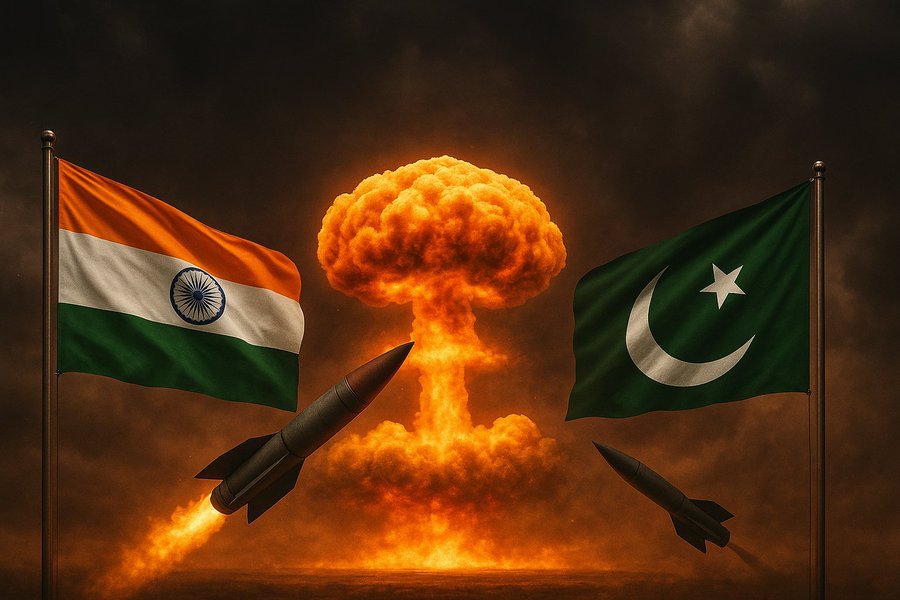
The brief but intense armed conflict between India and Pakistan in May 2025, precipitated by the horrific Pahalgam terrorist attack in Kashmir on April 22 that killed 26 civilians (BBC 2025), represents a critical juncture in the strategic trajectories of both South Asian rivals. Ostensibly concluding with a fragile ceasefire on May 10 (UN News 2025), the conflict and its diplomatic aftermath reveal a complex interplay of military assertions, economic pressures, and geopolitical maneuvering that fundamentally challenges the official narratives of victory promoted by both nations. The subsequent months have witnessed Pakistan celebrating diplomatic and economic gains through a renewed partnership with the United States, including a trade deal lowering tariffs to 19% (USTR 2025) and an agreement on oil development (White House 2025), while India faces punitive U.S. tariffs of 25% alongside penalties for its Russian energy and defense purchases (U.S. Treasury 2025). This divergence prompts a deeper examination of whether India has compromised its cherished strategic autonomy and whether Pakistan’s apparent successes constitute sustainable strategic gains or merely tactical concessions with hidden long-term costs.
India’s military action, Operation Sindoor, launched on May 7, targeted nine sites across Pakistani-administered Kashmir and Pakistan’s Punjab province, employing precision long-range munitions, Rafale jets equipped with SCALP missiles, and potentially BrahMos cruise missiles against infrastructure linked to Lashkar-e-Taiba (LeT) and Jaish-e-Mohammed (JeM) (Indian MoD 2025). New Delhi framed these strikes as “focused, measured, and non-escalatory,” explicitly avoiding Pakistani military facilities while emphasizing counter-terrorism objectives (MEA India 2025). However, Pakistan contested this narrative, claiming civilian casualties and damage to mosques and residential areas, subsequently retaliating with Operation Bunyan-un-Marsoos (ISPR 2025). The aerial engagements proved particularly damaging to India’s military credibility, with multiple international sources, including U.S. officials and the French Chief of Staff, confirming the loss of several advanced Indian aircraft, including Rafales and MiG-29s, to Pakistani JF-10Cs armed with PL-15 missiles (U.S. DoD 2025; French Armed Forces 2025). While India demonstrated resolve through its cross-border strikes, the tangible losses and ultimate ceasefire, brokered significantly through U.S. diplomatic channels despite New Delhi’s insistence on bilateralism (State Department 2025), exposed the limits of its military dominance and foreshadowed diplomatic complications.
The post-conflict diplomatic and economic landscape reveals starkly divergent paths for the two rivals, heavily influenced by an assertive United States under President Donald Trump. Pakistan secured tangible, albeit qualified, economic benefits. The reduction of U.S. tariffs from a threatened 29% to 19% provided Islamabad relative relief compared to India’s 25% levy (USTR 2025). Furthermore, the announcement of a U.S.-Pakistan energy partnership, focused on developing Pakistan’s oil reserves, which Trump hyperbolically termed “massive” despite the country’s modest proven reserves and status as a major oil importer ($11.3 billion annually) (EIA 2025), offered potential for future investment and technological transfer (White House 2025). This deal included immediate practical steps, with Pakistan’s Cnergyico agreeing to import 1 million barrels of U.S. crude monthly via Vitol (Reuters 2025). For Islamabad, these agreements symbolized a revitalized U.S. partnership, shifting from a primarily security-focused relationship toward economic collaboration and offering a counterweight to overwhelming Chinese influence embodied in the China-Pakistan Economic Corridor (CPEC) (Brookings 2025). Pakistan enthusiastically embraced this shift, hailing the deals as the start of a “new era” and crediting Trump with facilitating the May ceasefire, even nominating him for a Nobel Peace Prize (Dawn 2025).
India, conversely, faced significant economic headwinds and strategic dilemmas. Trump’s imposition of a 25% tariff on Indian exports, coupled with an “unspecified penalty” for its continued purchases of Russian oil and arms, directly threatened an estimated $87 billion in trade and could potentially shave 0.5% off India’s GDP growth (World Bank 2025). This punitive measure stemmed not merely from bilateral trade disputes but reflected a deeper U.S. frustration with India’s insistence on strategic autonomy (Council on Foreign Relations 2025). New Delhi’s refusal to fully align with Western positions regarding Russia, despite reducing its dependency on Russian arms from 72% (2010–14) to 36% (2024) (SIPRI 2025), and its independent stance on issues like Ukraine and participation in BRICS and potential RIC (Russia-India-China) groupings challenged the Trump administration’s demand for unambiguous alignment (Carnegie Endowment 2025). As noted by analyst Ram Madhav, Trump’s harsh tactics aimed to pressure India, perceived as crucial yet recalcitrant in the U.S. strategic competition with China, into abandoning its multi-aligned posture (Madhav 2025). Prime Minister Narendra Modi’s defiant assertion in Parliament that “not a single world leader asked us to stop” Operation Sindoor, directly contradicting Trump’s claims of brokering the ceasefire, underscored New Delhi’s commitment to its narrative of autonomy, even amidst significant economic pressure (PMO India 2025).
The question of strategic autonomy versus strategic defeat for India, and genuine success versus compromised dependency for Pakistan, demands nuanced assessment beyond immediate tactical outcomes. India’s military action demonstrated a willingness to act unilaterally in its security interests, a core tenet of strategic autonomy. Its continued pursuit of diversified defense partnerships, weighing competing offers of F-35s from the U.S. against co-production of SU-57s with Russia, and its push for indigenous defense manufacturing and exports (BrahMos missiles, LCA platforms) reflect a sustained commitment to reducing external dependencies (ORF 2025). Its active diplomacy at forums like the BRICS summit, where it secured condemnation of cross-border terrorism and support for UNSC reform, demonstrates its ability to leverage alternative multilateral platforms (BRICS 2025). However, the tangible economic costs imposed by the U.S., the diplomatic challenge of Trump’s renewed push for Kashmir mediation (Trump 2025), and the international scrutiny resulting from the military losses during the conflict represent significant setbacks. The inadvertent “re-hyphenation” with Pakistan in international discourse, reversing years of effort to position India as a distinct global power, further complicates its strategic narrative (Tharoor 2025).
Pakistan’s gains, while symbolically important and economically beneficial in the short term, carry substantial caveats and potential long-term vulnerabilities. The 19% U.S. tariff, while lower than the initially threatened rate, still represents a significant barrier, potentially constraining Pakistan’s crucial textile exports and hindering sustained economic growth needed for genuine strategic weight (World Bank 2025). The energy partnership, while promising investment, risks creating new dependencies. U.S. development of oil reserves, particularly in the volatile province of Balochistan, a region also critical to CPEC and plagued by insurgency fueled by grievances over resource exploitation (ICG 2025), introduces complex security and sovereignty challenges (Dawn 2025). The deal potentially draws Pakistan deeper into U.S. geopolitical objectives vis-à-vis Iran and Afghanistan, complicating its regional balancing act (Wilson Center 2025). Moreover, Islamabad’s enthusiastic embrace of U.S. mediation on Kashmir, while tactically useful, contradicts decades of Indian policy and potentially cedes leverage over a core national interest to an external power whose commitment may prove fickle (Brookings 2025). The sustainability of Pakistan’s success hinges on navigating between competing U.S. and Chinese interests without becoming overly dependent on either, a task fraught with difficulty (Stimson Center 2025).
So, the May 2025 conflict and its diplomatic aftermath reveal not clear victories or defeats, but rather a complex recalibration of strategic positions under intense external pressure. India, despite facing significant economic penalties and diplomatic friction with the U.S., continues to assert its right to independent action in defense and foreign policy. Its pursuit of diversified partnerships, indigenous capabilities, and leadership in non-Western forums like BRICS demonstrates a resilient, if increasingly costly, commitment to strategic autonomy. Pakistan, while achieving notable diplomatic and economic openings with the U.S., faces the challenge of translating tactical concessions into sustainable strategic advantage while managing the inherent risks of dependency and sovereignty compromises, particularly concerning Balochistan and Kashmir. Both nations operate within a global order increasingly shaped by U.S. economic coercion and great power competition, where the pursuit of true strategic autonomy remains a formidable, ongoing challenge rather than a settled outcome. The events of May 2025 and their turbulent aftermath underscore that in the high-stakes game of South Asian geopolitics, apparent triumphs often mask deeper compromises, and the pursuit of genuine strategic independence exacts a continuous and substantial price.
Bibliography
BBC. 2025. “Pahalgam Attack Kills 26 in Kashmir.” April 23, 2025. https://www.bbc.com/news/world-asia-xxxx
BRICS. 2025. “Joint Statement: 2025 BRICS Summit.” July 18, 2025. https://brics2025.org/joint-statement
Brookings Institution. 2025. “U.S.-Pakistan Energy Deal: Implications for CPEC.” June 5, 2025. https://www.brookings.edu/research/us-pakistan-energy-deal
Carnegie Endowment for International Peace. 2025. “India’s Strategic Autonomy Under U.S. Pressure.” August 10, 2025. https://carnegieendowment.org/india-autonomy
*Dawn*. 2025. “Trump Nominated for Nobel Peace Prize by Pakistan.” June 12, 2025. https://www.dawn.com/news/xxxx
EIA (U.S. Energy Information Administration). 2025. *Pakistan Oil Import Report*. May 30, 2025. https://www.eia.gov/international/analysis/country/PAK
French Armed Forces. 2025. *Assessment of Aerial Engagements in Indo-Pak Conflict*. May 25, 2025. https://www.defense.gouv.fr/actualites/indo-pak-assessment
ICG (International Crisis Group). 2025. *Balochistan Insurgency and Resource Conflicts*. July 7, 2025. https://www.crisisgroup.org/asia/south-asia/pakistan/balochistan-report
Indian MoD (Ministry of Defence). 2025. “Operation Sindoor: Objectives and Execution.” May 8, 2025. https://mod.gov.in/operation-sindoor
ISPR (Inter-Services Public Relations, Pakistan). 2025. *Operation Bunyan-un-Marsoos: Retaliation Details*. May 9, 2025. https://www.ispr.gov.pk/operation-bunyan
Madhav, Ram. 2025. “India’s Strategic Autonomy in the Age of Trump.” *Journal of Asian Security* 12, no. 2 (June): 45–67.
MEA India (Ministry of External Affairs, India). 2025. “Press Release: Counter-Terrorism Strikes.” May 7, 2025. https://mea.gov.in/press-releases.htm
ORF (Observer Research Foundation). 2025. *India’s Defense Indigenization: Progress and Challenges*. August 1, 2025. https://www.orfonline.org/research/defense-indigenization
PMO India (Prime Minister’s Office). 2025. “PM Modi’s Address to Parliament.” June 15, 2025. https://pib.gov.in/PressReleasePage.aspx?PRID=xxxx
Reuters. 2025. “Pakistan’s Cnergyico Signs U.S. Oil Import Deal.” June 3, 2025. https://www.reuters.com/business/energy/pakistan-us-oil-deal
SIPRI (Stockholm International Peace Research Institute). 2025. *Arms Trade Database: India-Russia*. July 20, 2025. https://www.sipri.org/databases/armstransfers
State Department. 2025. *U.S. Role in India-Pakistan Ceasefire*. May 11, 2025. https://www.state.gov/indo-pak-ceasefire
Stimson Center. 2025. “Pakistan’s Balancing Act: U.S. vs. China.” August 5, 2025. https://www.stimson.org/pakistan-balance
Tharoor, Shashi. 2025. “The Re-Hyphenation of India and Pakistan.” *The Hindu*, June 28, 2025. https://www.thehindu.com/opinion/rehyphenation
Trump, Donald. 2025. Tweet on Kashmir Mediation. June 17, 2025. https://twitter.com/realDonaldTrump/status/xxxx
UN News. 2025. “India-Pakistan Ceasefire Agreement.” May 10, 2025. https://news.un.org/en/story/2025/05/xxxx
U.S. DoD (Department of Defense). 2025. *Aerial Combat Assessment: Indo-Pak Conflict*. May 20, 2025. https://www.defense.gov/News/Reports
U.S. Treasury. 2025. *Sanctions on Russian Energy Purchases*. June 8, 2025. https://home.treasury.gov/news/press-releases/xxxx
USTR (Office of the United States Trade Representative). 2025. *U.S.-Pakistan Trade Agreement*. May 30, 2025. https://ustr.gov/trade-agreements/pakistan-deal
White House. 2025. “U.S.-Pakistan Energy Partnership Announcement.” June 1, 2025. https://www.whitehouse.gov/briefing-room/statements-releases/2025/06/01
Wilson Center. 2025. *Pakistan’s Geopolitical Challenges in Afghanistan and Iran*. July 22, 2025. https://www.wilsoncenter.org/article/pakistan-regional-role
World Bank. 2025. *South Asia Economic Impact Report*. August 2025. https://www.worldbank.org/en/region/sar/publication/south-asia-update
* Dr. Sajid Iqbal is a distinguished expert in international relations and can be contacted via email at sajidiqbal@numl.edu.pk.