
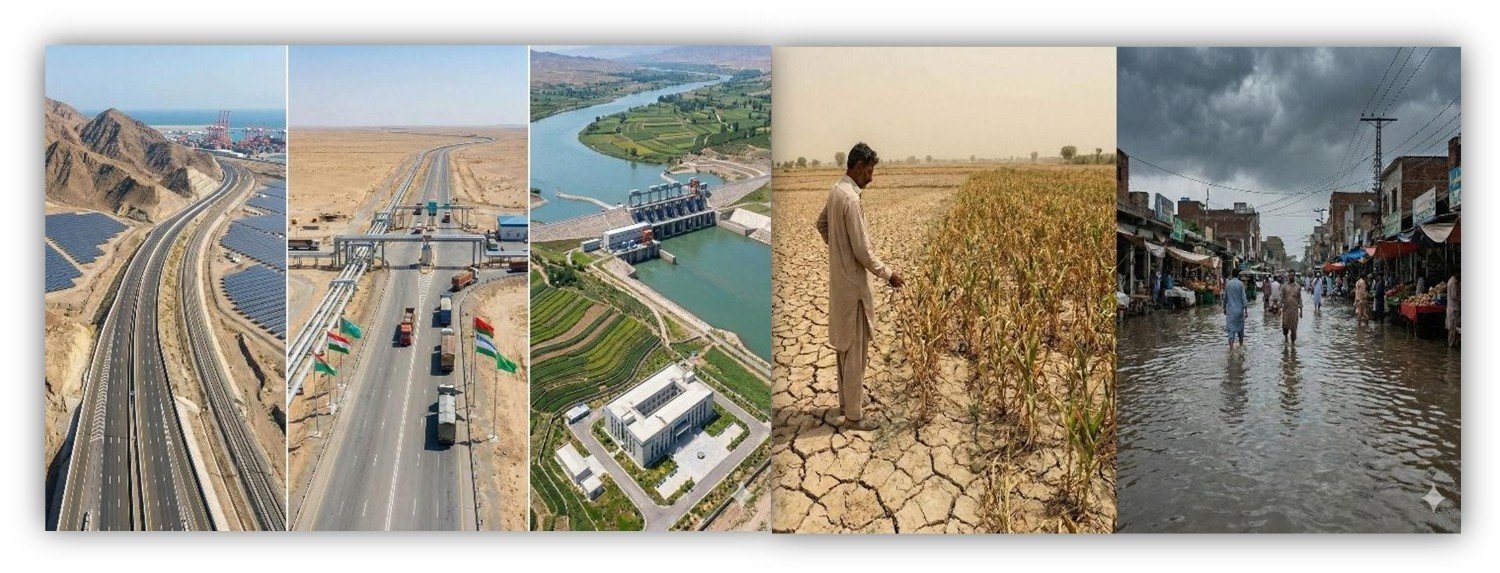
“Climate change is the defining issue of our time.”
António Guterres
António Guterres, the Secretary-General of the United Nations, uses this statement to highlight how climate change shapes security, economics, development, and human survival. In the context of Pakistan, his message reflects how climate impacts have moved beyond environmental concerns and now threaten national stability, food systems, and long-term economic planning. The quote supports your article’s argument that climate change must be treated as a strategic and geoeconomics priority. Pakistan is experiencing a degree of climatic stress which is redefining its economy, its security perspective and the lives of millions of people. Floods, heatwaves and changing rain patterns are no longer a rare occurrence. They have already turned out to be a constant development burden. Since the nation struggles to revive itself after the frequent tragedies, the same question pops up every now and then: how can Pakistan establish long-term stability in the climate-prone area? An emergent thinking of policy is to consider climate resilience by the lens of connectivity. Connections between the energy systems, transportation networks, water management, and regional collaboration will make Pakistan convert climate risk into an economic regeneration opportunity. This is a geoeconomics prism that provides a viable path ahead when the price of not doing is increasing.
Key Points
- Pakistan is facing growing climatic strains that are threatening its economic, food, and sociopolitical balance.
- A geoeconomics framework based on connectivity can help to make the nation less reliant on crisis management and more reliant on sustainable climate resilience.
- The potential to reduce the susceptibility of climate vulnerability and open new economic corridors has interregional synergies in energy, water, trade and technologies.
- Examples of instruments that enable long-term adaption include projects like the China Pakistan Economic Corridor (CPEC), Economic Cooperation Organization (ECO) corridors and transboundary climate planning.
- Climate-wise connectivity is a necessity strategy and not a choice of policy
Climate Change: The Domestic Security and Economic Menace, Stability in the Region as a Convenience of Connection
Climate change has emerged to be one of the most influential factors that determine the security and economic path of Pakistan. Floods, heat waves, glacial melt and water scarcity now cut across each of the major sectors of the country. The magnitude of the damage caused by the 2022 floods showed that climate shocks can slow growth, increase inequality, and cause long-term instability. Pakistan cannot longer afford a reactive agenda; it needs a vision of strategy which combines climate adaptation with economic opportunity. This synthesis is exactly what is provided in a geoeconomics, connectivity-oriented framework. Connection is no longer about transit routes or trade flow; it has now become an instrument of regional stability and long-term stability. Energy system, infrastructure, water networks, and digital corridors create interdependence when they are transnational.
The result of this interdependence is narrowing of space of conflict and increasing incentives to cooperation. To a climate-sensitive country such as Pakistan, this is a practical and progressive way of reducing the risk and expanding new opportunities. The climatic problems faced by Pakistan are so structural. Glaciers are melting quicker than one could have possibly expected, summers are stretching and getting more severe, agriculture, with its huge portion of the population, is being challenged by unpredictable rainfall, and water stress is rising with the demand. These pressures are not confined to national boundaries and they influence India, Afghanistan, Iran and China.
A Geoeconomics Response of Climate Adaptation and CPEC as a Platform of Climate-resilient Development
This mutual exposure provides a platform on which to find collaborative solutions. A geoeconomics approach redefines the crisis in the proactive planning. Pakistan does not need to think of climate change as a threat only, but the connectivity can be used as an opportunity to make adaptation an economic driver. Energy corridors have the potential to support a shift to clean and stable energy, and regional energy systems can also reduce the cost and the intensity of carbon, as well as transport routes designed with climate risk in mind can reduce the losses in disasters. Cooperation in water may prevent mismanagement and eliminate water pressure on riverine systems. The digital connectivity has the potential to create early-warning mechanisms, climate-observation, and smart farming. CPEC, however, is still one of the most important forums that Pakistan can use in this regard. Provided that future CPEC steps include climate-adapted roads, renewable energy systems, water storage facilities, and climate-smart agricultural areas, the corridor is not just an infrastructure project, but an adaptive support center. This alignment would also make Pakistan in a position to align domestic policy with regional investment trends especially as China focuses more on green development.
The ECO as an example of a regional institution:
In addition to CPEC, regional organizations like the Economic Cooperation Organization (ECO) may also play a positive role. Trade and connectivity are already taking place with the help of the ECO. As the climate risks continue to increase in Central and South Asia, its mandate can be expanded to include joint climate financing, coordinating disaster-response efforts, and sharing technology across borders. The ECO climate-risk platform would neutralize the vulnerability of all member states. The benefits of this strategy are clear in the case of Pakistan. Climate-resilient connectivity has the potential to protect the physical infrastructure, minimize losses during disasters, and form the basis of economic stability. It can contribute to the shift towards renewable energy of the country, deter the economic effects of climate shocks, and draw climate finance.
Recommendation: Resilience, Creation of Resilience by Linking Climate to the Present
Furthermore, it would be able to mitigate internal inequalities by connecting remote regions to climate-resilient transport and energy systems. This point requires a change in the way Pakistan views its climate policy conceptualization. Reaction after the disaster is no longer enough. The nation needs a durable model that will treat climate adaptation as a geoeconomics priority. Connectivity offers a realistic platform towards this shift, which empowers nationally and encourages regional collaboration. It serves also to stabilize a region where the common issue is often obscured by politics.
The future of South Asia will be climate changed. The ability to adapt at a rapid pace will determine the stability of Pakistan. A geoeconomics approach that is based on connectivity provides a realistic and grounded path that ultimately integrates resilience with opportunity so that the country can face future climate shocks with a stronger and more confident approach.
Fizza Akhtar is a non-traditional researcher with academic background in Peace and Conflict Studies, currently pursuing her MPhil in International Relation at NUML, where she continues to explore how climate change and international governance shape today’s policy challenges. Her work reflects her interest in international law, human rights, climate security, and diplomacy. She gained practical research experience through her internship with the UN Division as climate change researcher at the Ministry of Foreign Affairs.
References:
- World Pakistan: Country Climate and Development Report (2022).
- Pakistan Water Sector Assessment (2023).
- Sixth Assessment Report (2022).
- UNDP Water Governance and Climate Resilience (2023).
- Mustafa, Hydro politics in Pakistan (Oxford University Press).
- Diammonium Connectivity as the New Peace: A Geoeconomic Vision for a Stable South Asia. (Your provided partner source)
Ministry of Climate Change and Environmental Coordination. (2023). National climate change policy: Progress and review. Government of Pakistan.
Wow Amazing
This is a powerful and timely piece! You’ve explained so clearly how climate change is reshaping weather patterns around the world from extreme heat waves to unpredictable storms. I really appreciate how you connected global trends with everyday impacts that people can relate to. Articles like this help raise awareness and remind us why collective action is so important. Great job keep sharing your insights!