
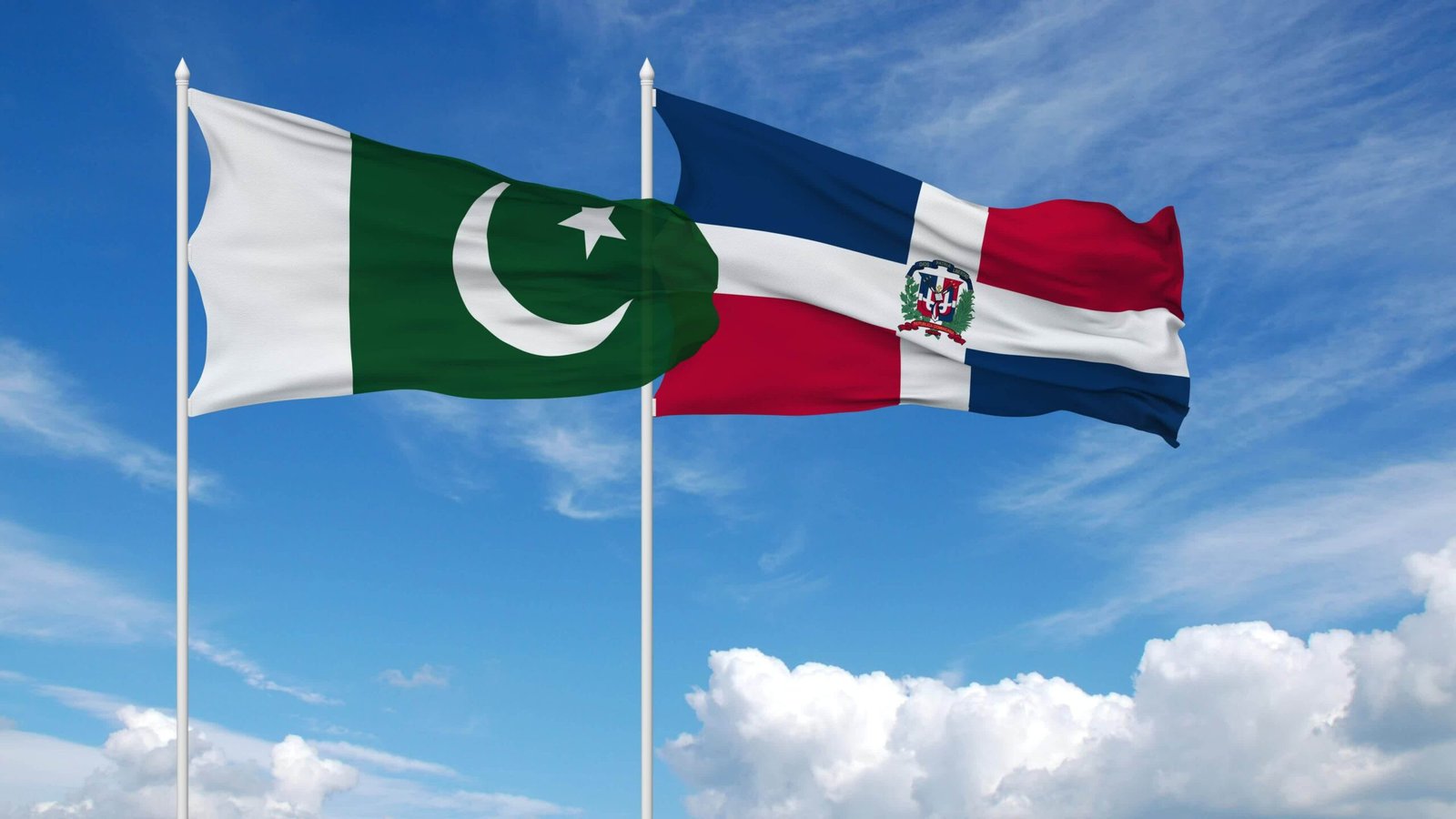
In a connected world, the Dominican Republic and Pakistan are building geo-economic bridges post-2022 diplomatic ties, with 2024 trade at $15.45 million, eyeing growth in textiles, pharmaceuticals, agriculture, and climate initiatives for shared sustainability and prosperity.
Key Points
- For Policymakers: Capitalize on 2022 diplomatic establishment to forge trade agreements, align with CAFTA-DR and CPEC for tariff reductions, and prioritize climate and sustainable development pacts, fostering balanced relations and regional connectivity.
- For Investors: Explore DR’s free zones with tax incentives and Pakistan’s SEZs offering high returns in pharma and textiles, amid DR’s 5.1% GDP growth in 2024 and projected $23.5 billion FDI inflows.
- For Academics: Investigate trade growth from $3.63 million DR exports in 2023 to evolving balances, analyzing South-South models for research on emerging market synergies and climate cooperation impacts.
- For the General Public: Access affordable Pakistani rice and textiles in DR markets, while job opportunities in agro-processing and skills exchanges enhance livelihoods, promoting cultural ties and economic stability.
The Dominican Republic (DR) and Pakistan, as vibrant emerging economies, are poised to deepen geo-economic ties following the establishment of formal diplomatic relations in November 2022. This milestone, marked by a joint communiqué signed at the United Nations, opens avenues for collaboration in trade, climate resilience, and sustainable development. With DR’s GDP reaching $121.4 billion in 2024 (5.1% growth) and Pakistan’s at $372 billion (projected 3.2% growth in 2026), both nations offer complementary strengths—DR in free zone manufacturing and tourism, Pakistan in textiles and pharmaceuticals. Recent data and analysis highlight promotional opportunities, benefiting policymakers through policy alignment, investors via incentives, academics in trend studies, and the public with everyday gains.
The 2022 ties have spurred initial trade momentum, though volumes remain modest with potential for expansion. In 2024, bilateral trade totaled approximately $15.45 million, per UN COMTRADE. Pakistan’s exports to DR stood at $14.71 million, while DR’s to Pakistan were $0.74 million, creating a surplus for Pakistan. This builds on 2023 figures, where DR exported $3.63 million to Pakistan. Growth is evident: Pakistan’s exports rose from historical lows, driven by cereals and pharma demands in DR’s markets.
Key products underscore synergies. Pakistan supplies essentials like cereals ($7.45 million in 2024), pharmaceuticals ($2.21 million), and cotton ($1.25 million), supporting DR’s healthcare and textile needs amid its post-pandemic recovery. DR provides plastics ($0.25 million), manmade filaments ($0.20 million), and medical instruments, aiding Pakistan’s manufacturing. This exchange addresses shared challenges like food security and industrial inputs, with rational cooperation reducing global supply risks.
The table below details trade trends:
|
Year |
Total Bilateral Trade (US$ million) |
Pakistan Exports to DR (US$ million) |
DR Exports to Pakistan (US$ million) |
Trade Balance (Favoring Pakistan, US$ million) |
|
2022 |
~4.0 |
3.0 |
1.0 |
2.0 |
|
2023 |
18.34 |
14.71 |
3.63 |
11.08 |
|
2024 |
15.45 |
14.71 |
0.74 |
13.97 |
Rationally, this partnership can scale: DR’s free trade zones (contributing 67.5% of its 2023 exports) align with Pakistan’s SEZs, potentially boosting joint ventures. For instance, Pakistan’s rice expertise could enhance DR’s agriculture, while DR’s medical exports support Pakistan’s health sector. Climate cooperation, emphasized in 2022 dialogues, offers mutual benefits—both nations face vulnerabilities, with DR’s 2023 poverty reduction (from 26.7% in 2016 to 7%) and Pakistan’s reforms providing models for resilience.
Untapped potentials span sectors, promoting inclusive growth. Textiles promise integration: DR’s apparel manufacturing can leverage Pakistan’s $36 billion export base for CAFTA-DR access to the Americas. Pharmaceuticals and agriculture hold high promise; joint R&D could cut costs, with DR’s incentives attracting Pakistani FDI. Energy and tourism align with DR’s renewables push and Pakistan’s engineering, while remittances (DR receives $10 billion annually) could expand via formal channels.
The table below outlines cooperative sectors:
|
Sector |
DR’s Strengths |
Pakistan’s Strengths |
Cooperative Potentials |
Estimated Benefits |
|
Textiles |
Apparel, free zones |
Cotton, manufacturing |
Supply chains, CAFTA-DR exports |
10-15% trade growth, 8,000+ jobs |
|
Pharmaceuticals |
Medical instruments, incentives |
Generics, pharma exports |
R&D, local production |
$50M+ FDI, affordable healthcare |
|
Agriculture |
Tobacco, cocoa |
Rice, agro-tech |
Tech transfer, processing plants |
Food security, 20% yield increase |
|
Climate & Energy |
Renewables, tourism |
Engineering, CPEC expertise |
Resilience projects, green energy |
Sustainable development, FDI inflows |
|
Manufacturing |
Free zones, labor |
SEZs, textiles |
Joint ventures, regional hubs |
Diversified trade, economic stability |
For policymakers, these fit global frameworks like SDGs, using DR as a Caribbean gateway. Investors gain from DR’s $23.5 billion 2025 FDI commitments and Pakistan’s reforms. Academics can explore how ties reduce dependencies. The public benefits from affordable goods, skills, and stability, as seen in ongoing diplomatic engagements. This alliance champions South-South cooperation, transforming modest ties into vibrant prosperity.
Conclusion
The Dominican Republic and Pakistan’s geo-economic partnership, ignited by 2022 diplomatic ties and 2024 trade of $15.45 million, unlocks potentials in textiles, pharmaceuticals, agriculture, and climate sectors. This fosters investments, innovation, and balance amid DR’s 5.1% growth and Pakistan’s 3.2% projection for 2026. Policymakers should advance pacts, investors seize incentives, academics study trends, and the public enjoy gains. By linking the Caribbean and South Asia, both nations exemplify resilient collaboration, driving inclusive development and shared success.
* Dr. Muhammad Jahanzaib holds a PhD in International Relations, is a double gold medalist and author of the book The Interplay of Geo-Politics and Geo-Economics in Pakistan’s Foreign Policy (Post-2008) (Palgrave Macmillan), along with several esteemed publications. As Chief Visionary Officer of Diamanium Thinkers (a global think tank), he brings over 15 years of experience advising ministers, diplomats, security agencies, the corporate sector, and civil society. His advisory work spans economic diplomacy, political economy, economic intelligence, security, society, strategic financial advisory, and the geo-economic world dynamics. He offers a unique blend of practitioner insight and academic rigor, combining hands-on engagement with state institutions and strategic expertise grounded in research. He can be reached at jahanzaibdgc@gmail.com.
Key References
- Pakistan (PAK) and Dominican Republic (DOM) Trade – https://oec.world/en/profile/bilateral-country/pak/partner/dom
- Pakistan Exports to Dominican Republic – 2026 Data 2027 Forecast 2009-2024 Historical – https://tradingeconomics.com/pakistan/exports/dominican-republic
- Pakistan Imports from Dominican Republic – 2025 Data 2026 Forecast 2009-2024 Historical – https://tradingeconomics.com/pakistan/imports/dominican-republic
- Dominican Republic (DOM) and Pakistan (PAK) Trade – https://oec.world/en/profile/bilateral-country/dom/partner/pak
- Diplomatic ties set up with Dominican Republic – Pakistan – https://www.brecorder.com/news/40209801
- Pakistan, Dominican Republic formally establish diplomatic ties – https://www.nation.com.pk/19-Nov-2022/pakistan-dominican-republic-formally-establish-diplomatic-ties
- Pakistan, Dominican Republic establish formal diplomatic relations – https://www.app.com.pk/global/pakistan-dominican-republic-establish-formal-diplomatic-relations
- Country comparison Pakistan vs Dominican Republic 2026 – https://countryeconomy.com/countries/compare/pakistan/dominican-republic
- 2025 Investment Climate Statements: Pakistan – https://www.state.gov/reports/2025-investment-climate-statements/pakistan
- Dominican Republic Export Report 2025: Dominican Republic Exports by Country & Top Exported Goods – https://www.tradeimex.in/blogs/dominican-republic-export-report-2025-top-exports-by-country-goods
- Trade Profile – Dominican Republic – International Trade Portal – https://www.lloydsbanktrade.com/en/market-potential/dominican-republic/trade-profile
- Dominican Republic economic report 2023 – https://www.tradecommissioner.gc.ca/en/market-industry-info/search-country-region/country/canada-dominican-republic-export/dominican-republic-economic-report-2023.html