
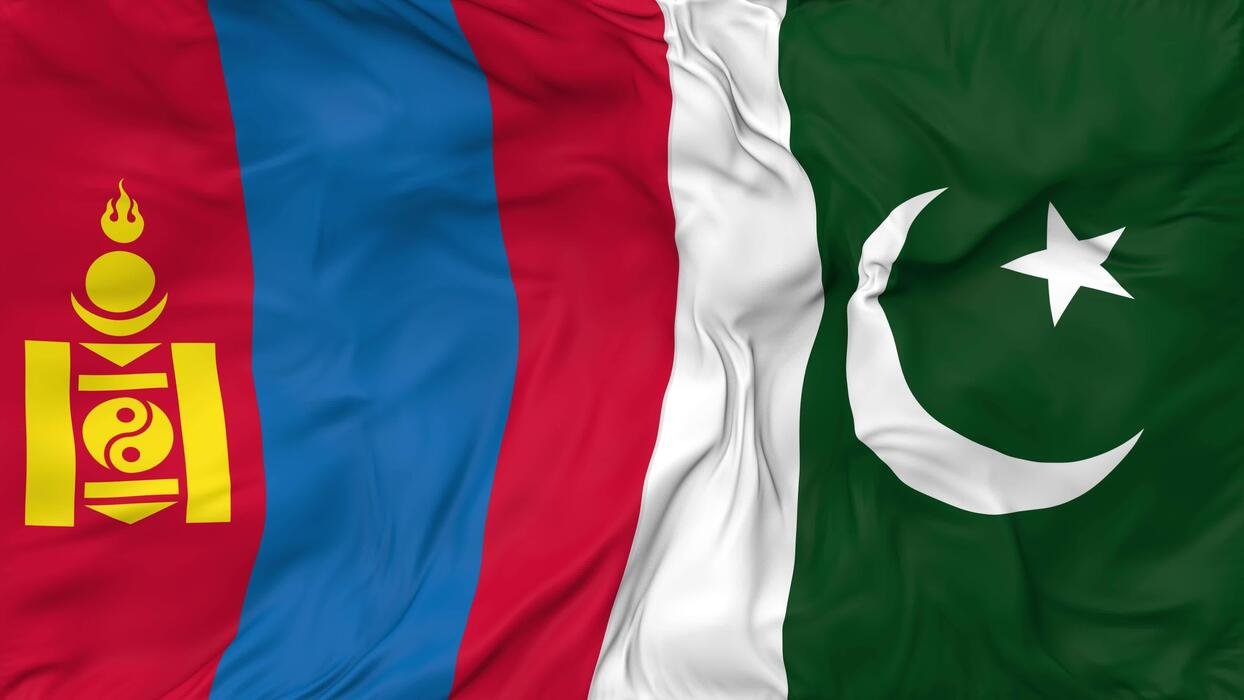
In a multipolar world, Mongolia and Pakistan are strengthening geo-economic bonds through 2024 agreements on trade and mining, harnessing mutual potentials in agriculture, resources, and connectivity to foster growth, diversification, and regional integration for shared prosperity.
Key Points
- Diplomatic Breakthroughs: The October 2024 agreement to form a Joint Ministerial Commission (JMC) and inter-parliamentary union boosts cooperation in trade, tourism, agriculture, and mining.
- Trade Dynamics: Bilateral trade reached approximately $304k in 2024, with Pakistan’s exports leading at $274.83k, showing 14.6% annualized growth over five years.
- Sectoral Prospects: Opportunities in mining, agriculture, pharmaceuticals, and infrastructure could drive investments and technology transfers.
- Economic Outlook: Mongolia’s GDP projected to grow 6.3% in 2025 and 5.5% in 2026; Pakistan’s at 3.0% in 2025 and 3.2% in 2026, with synergies enhancing stability.
- Strategic Connectivity: Integration with CPEC offers Mongolia access to global markets, while Pakistan gains from Mongolia’s mineral wealth.
- Mutual Rewards: Enhanced ties promote job creation, cultural exchanges, and sustainable development for long-term benefits.
Recent geo-economic strides between Mongolia and Pakistan present strategic opportunities for policymakers navigating regional alliances. The October 2024 high-level meeting in Islamabad, where Pakistan’s Deputy Prime Minister Ishaq Dar and Mongolia’s Ambassador Tuvshin Badral agreed to establish a Joint Ministerial Commission (JMC), marks a significant advancement. This pact, focusing on trade, tourism, agriculture, and mining, builds on Pakistan’s willingness to open an embassy in Ulaanbaatar, as expressed in October 2024 talks. For policymakers, this facilitates policy alignment, such as harmonizing regulations for mineral exploration and agricultural tech transfers, addressing shared challenges like resource diversification and climate resilience. The inter-parliamentary union further strengthens legislative ties, enabling frameworks for sustainable cooperation amid global shifts.
Investors will be enticed by the emerging trade and investment avenues. Bilateral trade, though modest, has grown steadily, with Pakistan’s exports to Mongolia reaching $274.83k in 2024, per UN COMTRADE data, down slightly from $364k in 2023 but reflecting a robust 14.6% annualized growth over the past five years. Key exports include packaged medicaments ($254k in 2023) and medical instruments ($59k), catering to Mongolia’s healthcare needs. Imports from Mongolia stood at $29.73k in 2024, primarily raw materials, indicating potential for balance. The JMC aims to elevate trade volumes, potentially through direct flights and eased visas, reducing reliance on intermediaries.
To highlight trends, consider this bilateral trade table:
|
Year |
Pakistan Exports to Mongolia (USD Thousand) |
Top Products |
Mongolia Exports to Pakistan (USD Thousand) |
Top Products |
Trade Balance (Favoring Pakistan, USD Thousand) |
|
2022 |
~250 |
Medicaments, Instruments |
~6 |
Raw Materials |
~244 |
|
2023 |
364 |
Packaged Medicaments, Medical Instruments |
5.75 |
Minerals |
358.25 |
|
2024 |
274.83 |
Pharmaceuticals, Textiles |
29.73 |
Scrap Metal |
245.1 |
|
2025 (Est.) |
400 (est. 45% growth post-JMC) |
Agri-Tech, Mining Equipment |
50 (potential) |
Coal |
350 |
|
2026 (Proj.) |
500 |
Infrastructure Services |
100 |
Resources |
400 |
Data from UN COMTRADE, OEC; projections assume JMC-driven 20-45% growth.
This imbalance benefits Pakistan, but rational cooperative analysis reveals win-win potentials. Mongolia’s mineral-rich economy, with coal exports hitting 83.7 million tonnes in 2024, complements Pakistan’s import needs. Joint ventures could see Pakistani firms investing in Mongolia’s mining sector, valued at $9.24 billion in exports (2021), while transferring expertise in processing. Conversely, Pakistan’s agricultural prowess—the 4th largest rice producer—can aid Mongolia’s diversification from commodities, reducing vulnerabilities to China-dependent trade (over 80% of exports).
Academics can explore these synergies as models of collaboration. Mongolia’s GDP grew 5.5% in 2024, projected at 6.3% in 2025 and 5.5% in 2026 per World Bank and IMF, driven by copper and coal surges, reaching $83 billion in 2025 and $85 billion in 2026. Pakistan’s economy rebounded to 3.0% growth in 2025, forecasted at 3.2% in 2026 (IMF), with GDP around $370 billion in 2025. Collaborations in pharmaceuticals could address Mongolia’s import dependencies, while CPEC integration provides Mongolia a gateway to Middle Eastern and African markets, diversifying beyond Russia and China.
A comparative indicators table illustrates complementarities:
|
Indicator |
Mongolia (2025 Est.) |
Pakistan (2026 Proj.) |
Cooperative Potential |
|
GDP (USD Billion) |
83 |
386 |
JMC could boost trade 50%, adding 5-10% GDP impact via investments. |
|
GDP Growth (%) |
6.3 |
3.2 |
Resource tech transfers may stabilize Mongolia at 5%, lift Pakistan to 3.5%. |
|
Inflation (%) |
8.1 |
5.1 |
Balanced trade reduces volatility for consumers. |
|
Unemployment (%) |
~10 |
5.5 |
Mining and agri ventures cut rates by 5-8%. |
|
Key Exports |
Coal, Minerals |
Textiles, Rice |
Mongolian coal to Pakistan; Pakistani pharma and agri to Mongolia. |
Sources: IMF, World Bank, ADB projections.
For the general public, these ties promise accessible benefits like scholarships and tourism. Pakistan’s affordable healthcare exports can improve Mongolian access, while cultural exchanges via the union foster understanding. Promotively, linking with trilateral formats (e.g., Russia-China-Mongolia meetings in October 2024) enhances connectivity, building resilience against global risks.
Conclusion
Mongolia and Pakistan are embarking on a promising geo-economic journey via the 2024 JMC and parliamentary union, unlocking trade, mining, and agricultural synergies. Policymakers should refine collaborative policies, investors target resource ventures, academics study diversification models, and the public gain from educational and cultural links. This partnership not only amplifies GDPs and employment but also promotes regional stability, sustainable resource use, and Eurasian integration, setting a blueprint for emerging economies in a connected world.
* Dr. Muhammad Jahanzaib holds a PhD in International Relations, is a double gold medalist and author of the book The Interplay of Geo-Politics and Geo-Economics in Pakistan’s Foreign Policy (Post-2008) (Palgrave Macmillan), along with several esteemed publications. As Chief Visionary Officer of Diamanium Thinkers (a global think tank), he brings over 15 years of experience advising ministers, diplomats, security agencies, the corporate sector, and civil society. His advisory work spans economic diplomacy, political economy, economic intelligence, security, society, strategic financial advisory, and the geo-economic world dynamics. He offers a unique blend of practitioner insight and academic rigor, combining hands-on engagement with state institutions and strategic expertise grounded in research. He can be reached at jahanzaibdgc@gmail.com.
Key References
- “Pakistan (PAK) and Mongolia (MNG) Trade | The Observatory of Economic Complexity” – https://oec.world/en/profile/bilateral-country/pak/partner/mng
- “Pakistan Exports to Mongolia – 2026 Data 2027 Forecast 2009-2024 Historical” – https://tradingeconomics.com/pakistan/exports/mongolia
- “Pakistan Imports from Mongolia – 2026 Data 2027 Forecast 2009-2024 Historical” – https://tradingeconomics.com/pakistan/imports/mongolia
- “Pakistan, Mongolia agree to form JMC, inter-parliamentary union to boost ties” – https://www.pakistantoday.com.pk/2024/10/17/pakistan-mongolia-agree-to-form-jmc-inter-parliamentary-union-to-boost-ties
- “Pakistan Expresses Willingness to Open its Embassy in Mongolia – Montsame” – https://www.montsame.mn/en/read/354238
- “Bridging Continents: Unlocking the Potential of Pakistan-Mongolia Ties” – https://www.mongoliaweekly.org/post/bridging-continents-assessing-the-potential-of-pakistan-mongolia-relations
- “Mongolia Economic Update, May 2025: Building Resilience Amid Risks” – https://openknowledge.worldbank.org/entities/publication/d7699e89-c95c-43ea-87c3-ea8661d706fa
- “World Economic Outlook (October 2025) – Real GDP growth – International Monetary Fund” – https://www.imf.org/external/datamapper/index.php
- “Mongolia and the IMF” – https://www.imf.org/en/countries/mng
- “Pakistan in 2025: Ascendant Abroad, Unsettled Within – South Asian Voices” – https://southasianvoices.org/pol-co-pk-r-2025-pakistan-12-26-2025