
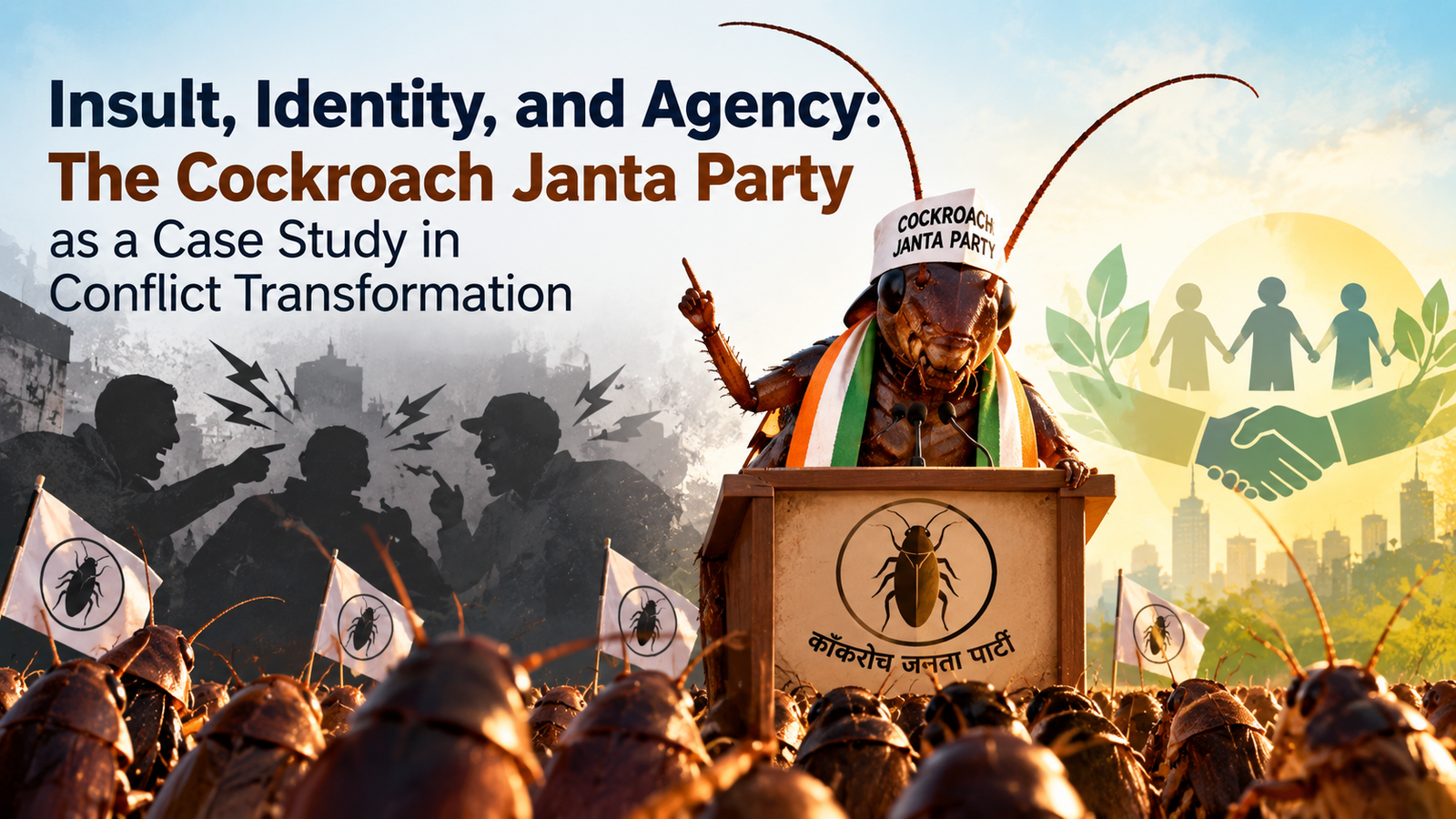
A dehumanising statement was made by India’s Chief Justice that compared unemployed youth to “cockroaches” in May 2026, leading to the rapid growth of the satirical Cockroach Janta Party (CJP), which grew to 20 million or more followers and organised nationwide protests. But instead of turning violent and radicalising, the movement’s complaints were redirected into non-violent, humorous civic activity that led to the resignation of a minister. The episode provides a unique, first-hand look at how dehumanising rhetoric can be utilised in the process of radicalisation, and how, under the right circumstances, the same can become a useful form of dissent.
Key Points
- A Supreme Court remark comparing jobless youth to “cockroaches” and “parasites” ignited the Cockroach Janta Party within 24 hours.
- The movement’s Instagram following surpassed both India’s ruling and opposition parties within days of launch.
- Underlying grievances included graduate unemployment, examination-paper leaks and perceived institutional corruption.
- Organisers enforced strict nonviolent discipline, using satire, roses and songs even as police used tear gas.
- The protests ended after the government met the movement’s core demand, illustrating conflict transformation in practice.
From Insult to Insurgent Satire
Chief Justice of India Surya Kant on 15 May 2026, while dispensing justice in a contempt case relating to bogus professional qualifications, said that there are “youngsters like cockroaches” that are “unemployed and will be involved in social media activism and will start attacking everybody.” Later, he stated that the statement was misquoted and that it was only directed toward people misusing credentials and not toward the youth of India in general.
By then, however, the comment had already exploded on the Internet. The following day, a young political communications student named Abhijeet Dipke founded the Cockroach Janta Party (CJP), which was billed as a satirical counterfeit of the ruling Bharatiya Janata Party and open to anyone “unemployed, lazy, chronically online and able to rant professionally.”
Within three days, it acquired three million followers, and within a few weeks it had more than twenty million followers, surpassing the figures of both India’s two largest political parties combined.
Table 1: Timeline of the Cockroach Janta Party
| Date (2026) | Development |
|---|---|
| 15 May | CJI Surya Kant, during a Supreme Court hearing, compares unemployed youth to “cockroaches” and “parasites of society” |
| 16 May | Abhijeet Dipke launches the Cockroach Janta Party (CJP) as satire, open to the “unemployed, lazy, chronically online” |
| 19 May | CJP passes 3 million Instagram followers within 78 hours of launch |
| 6 Jun | First public rally in New Delhi; CJP demands accountability over examination paper leaks |
| Jun–Jul | Protests spread to Pune, Bengaluru and Lucknow; Instagram following exceeds 20 million |
| 20 Jul | Delhi police use tear gas against marchers heading toward Parliament; CRPF companies deployed |
| 25 Jul | Government accepts CJP’s demands; Education Minister Dharmendra Pradhan resigns; protest called off |
Sources: Wikipedia; NPR; FairPlanet; Foreign Policy; World Politics Review (2026).
Why the Insult Landed
This was not simply a reaction to the wording of a judicial remark. Rather, it tapped into a pre-existing “well of grievance.” Before May 2026, there were already various sources of youth anger in India, including graduate unemployment, leaks in competitive-examination papers and a growing perception of unaccountable institutions.
The Chief Justice’s comment became a precipitating event — a symbolically charged occurrence that focused widespread discontent around a shared narrative and identity. Resisting the dehumanising slur while embracing the cockroach’s resilience and omnipresence created a powerful mechanism for reclaiming the word and transforming it into a source of collective pride and dark humour, much like other marginalised groups have historically done with derogatory terms.
The episode demonstrates that dehumanising language can have an unintended consequence. Instead of silencing the targeted population, it can provide a common identity around which dispersed grievances become organised. In this case, however, that identity was expressed through satire rather than violent mobilisation.
A Movement That Did Not Radicalise
The CJP is notable not simply because of its size, but because of its trajectory. When the movement was dehumanised by a state authority, a large and volatile group of young people became angry, while police responded with tear gas and the deployment of paramilitary forces in July. Yet the movement did not turn into prolonged violence.
The organisers explicitly incorporated nonviolent elements into the protests, encouraging participants to bring roses and books instead of weapons and making their intentions public beforehand to prepare for a possible police response. Songs, humour and satire became important mechanisms for maintaining collective identity while preventing anger from transforming into physical confrontation.
The principal demand of the protest — the resignation of the Education Minister over examination failures — was measurable and feasible. This provided the state with a clear off-ramp from confrontation. On 25 July 2026, the government accepted the movement’s core demands, the Education Minister resigned, and the protest was called off.
Rather than continuing after its immediate objective had been achieved, the movement dispersed. This is significant from a conflict-transformation perspective: a grievance-based mobilisation was provided with a concrete institutional response before it could evolve into a more diffuse anti-state campaign.
Table 2: Risk and Protective Factors in the CJP Case
| Risk Factors (toward radicalisation) | Protective Factors (toward transformation) |
|---|---|
| Dehumanising language from a state authority figure | Rapid reframing of the insult into satire and shared identity |
| Underlying grievances: unemployment, exam-paper leaks, corruption | Nonviolent discipline enforced by organisers (roses, books, songs) |
| Heavy-handed policing: tear gas, mass CRPF deployment | High-visibility media coverage sustaining accountability pressure |
| Anonymity and virality that can outpace organisers’ control | A concrete, responsive concession (ministerial resignation) |
Lessons for Preventing Radical Youth Outcomes
The CJP episode offers four lessons for policymakers seeking to prevent grievances from developing into radicalisation.
First, language used by state institutions is not insignificant. Dehumanising language directed toward any social group, whether unemployed youth or another population, can become a catalyst for radicalisation when combined with existing grievances. Public officials therefore require greater awareness of the consequences that such language can produce.
Second, there is an important distinction between diffuse anger and negotiable grievances. Specific demands are generally easier for institutions to address than broad anti-state narratives. Governments and institutions should therefore engage with concrete grievances before frustration develops into a generalised rejection of state authority.
Third, humour and restored identity can be remarkably effective forms of nonviolent political expression. Civil society organisations and educators should not dismiss satire as frivolous when it is helping channel youth frustration away from destructive forms of mobilisation. In the CJP case, humour transformed an insulting label into a collective identity while simultaneously maintaining political pressure.
Fourth, policing posture is critical. A heavy-handed reaction to nonviolent youth mobilisation can create the very confrontation that authorities are attempting to prevent. Conversely, restraint combined with institutional responsiveness can allow grievances to be negotiated without escalating into prolonged conflict.
Conclusion
The Cockroach Janta Party began as a response to an insult and, within weeks, became one of India’s most significant youth movements in years, precisely because its mobilisation centred on satire and negotiable demands rather than violence.
The case demonstrates that dehumanising rhetoric and youth grievance do not inevitably lead to radicalisation. Humour, disciplined nonviolence and responsive institutions can instead redirect anger toward constructive civic action. The movement also demonstrates the importance of providing credible institutional mechanisms through which grievances can be expressed and resolved.
South Asia’s youth continue to face unemployment, economic insecurity and declining trust in institutions. The CJP provides a rare and hopeful model: anger can be channelled into constructive, nonviolent forms of dissent, while genuine grievances can be addressed through institutional concessions and reform rather than confrontation.
* Sheikh Eilaf Tariq is a Research Intern at Diamanium Thinkers, working on Strategic Studies, Security and Geopolitics with a focus on South Asia and the Middle East. His research interests centre on conflict transformation and international relations.
References
- NBC News, “India’s ‘Cockroach Janta Party’ began as a joke. Then millions joined,” 25 May 2026.
- Channel 4 News, “Inside the rise of India’s Cockroach Janta Party movement.”
- World Politics Review, “India’s ‘Cockroach Party’ and the Politics of Youth Discontent,” 24 June 2026.
- Foreign Policy, “India’s Cockroach Movement Taps Into Youth Discontent,” 3 June 2026.
- NPR, “India’s Gen Z ‘Cockroach People’s Party’ started as satire but is serious about change,” 20 July 2026.
- NPR, “India’s ‘cockroach’ movement ousts minister, but can Modi calm youth?,” 25 July 2026.
- FairPlanet, “India’s Cockroach Revolution: How a Supreme Court Insult Sparked a Youth-Led Political Movement.”