
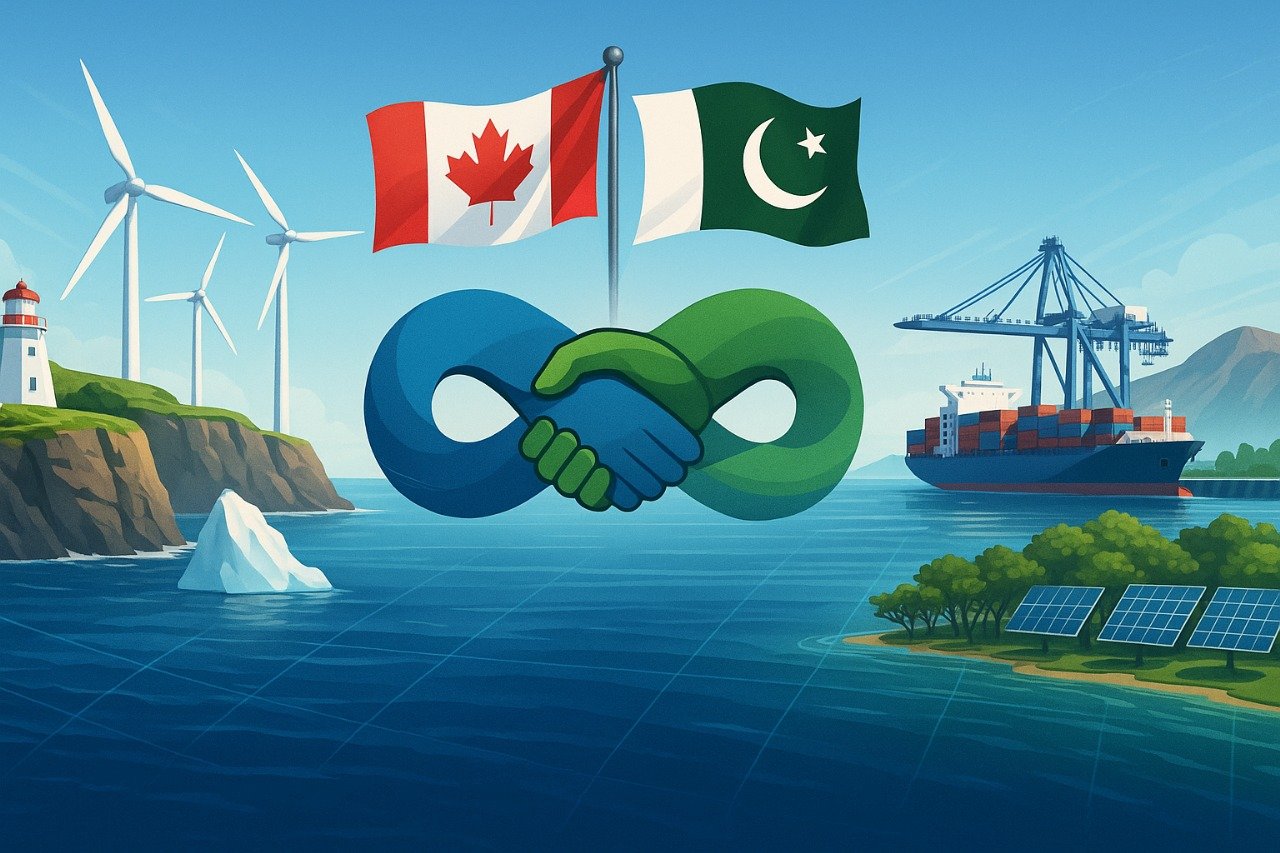
Canada-Pakistan business-to-business statecraft, powered by chambers like CPCoC, targeted trade delegations, and technical agencies, converts high-level diplomacy into tangible outcomes through B2B matchmaking, regulatory alignment, and institutional linkages, delivering predictable gains in agri-tech, mining, and energy.
Key Points
- Chambers of commerce, notably the Canada-Pakistan Chamber of Commerce (CPCoC), serve as primary platforms for identifying trade opportunities and enabling investment flows.
- Trade delegations, facilitated during the 6th round of Bilateral Political Consultations in February 2026, directly link private-sector leaders with policymakers for immediate B2B deals.
- Technical agencies like CFIA and MNFSR drive outcomes through phytosanitary approvals and standards harmonisation, as seen in the 2025 canola market reopening.
- Business-to-business linkages emphasised in 2025-2026 joint statements translate diplomatic commitments into actionable matchmaking and capacity-building initiatives.
- Institutional coordination reduces friction, accelerates market access, and builds investor confidence in priority sectors such as agri-tech, mining, and energy.
High-level diplomacy between Canada and Pakistan sets the stage, but the real engine of progress is the quiet, persistent work of business-to-business statecraft. Chambers of commerce, specialized trade delegations, and technical agencies turn policy commitments into contracts, shipments, and investments. In the absence of a full free-trade agreement, these institutional actors deliver the predictability and practical solutions that matter most to investors, policymakers, academics, and everyday citizens on both sides. Recent bilateral messaging—from the November 2025 joint statement to the February 2026 6th round of Bilateral Political Consultations—has repeatedly highlighted the need for stronger business-community support, facilitation of trade delegations, and enhanced institutional linkages. This focus is not rhetorical; it is operational.
The Canada-Pakistan Chamber of Commerce (CPCoC) exemplifies this institutional backbone. Operating as a dedicated forum, CPCoC identifies trade opportunities, organises networking events, and connects Canadian and Pakistani private-sector leaders with public officials. It has long hosted mining delegations, agri-tech roundtables, and investor briefings, ensuring that diplomatic openings translate into concrete business pipelines. Similarly, Pakistan’s Federation of Pakistan Chambers of Commerce and Industry (FPCCI) regularly coordinates inbound and outbound missions, creating sustained dialogue that moves beyond one-off visits. These chambers act as neutral conveners, reducing information asymmetries and building trust that governments alone cannot replicate.
Trade delegations provide the momentum. The February 2026 consultations explicitly stressed “greater support to business communities” and “facilitation of trade delegations.” In practice, this means structured B2B sessions where Canadian High Commissioner delegations meet Pakistani counterparts in sectors like agriculture, mining, and energy. Delegations include not only ministers but also chamber representatives, technical experts, and company executives who negotiate MoUs, pilot projects, and supply contracts on the spot. The result is measurable: the 2025 canola reopening, achieved through CFIA-MNFSR technical coordination, opened a market historically worth hundreds of millions in annual exports. Such outcomes are the direct product of delegation-led technical consultations rather than broad diplomatic declarations.
Technical agencies are the unsung heroes of implementation. Canada’s Canadian Food Inspection Agency (CFIA) and Pakistan’s Ministry of National Food Security and Research (MNFSR) exemplify how specialised bodies convert policy into practice. Through rigorous phytosanitary protocols and mutual recognition of testing, they enabled the November 2025 approval of Canadian canola imports, including GM varieties, after a three-year pause. This single regulatory decision demonstrates the power of agency-to-agency engagement: data sharing, joint audits, and streamlined WeBOC declarations cut clearance times dramatically. In mining, technical cooperation between Canada’s exploration-service providers and Pakistan’s regulatory bodies supports capacity-building workshops that prepare local firms for international standards. These agencies operate below the diplomatic radar yet deliver the predictability investors demand—clear rules, transparent timelines, and enforceable safeguards.
The February 2026 consultations reinforced this model by committing both sides to “technical and policy-level engagement” and “business-to-business linkages.” This institutional approach is especially effective because it is incremental and sector-specific. It allows progress without waiting for a comprehensive FTA, while laying the groundwork for deeper integration. For Canadian businesses, it means reliable access to Pakistan’s 240-million-consumer market; for Pakistani firms, it means access to Canadian capital, technology, and best practices. Academics studying North-South partnerships will note that such B2B statecraft often achieves more sustainable results than top-down agreements alone, because it embeds private-sector ownership from the outset.
A practical overview of how these actors deliver outcomes:
|
Institutional Actor |
Role in Statecraft |
Recent Example (2025-2026) |
Outcome Delivered |
|
Chambers (CPCoC, FPCCI) |
B2B matchmaking & networking |
Regular investor roundtables and mining delegations |
Pipeline of joint ventures in agri-tech and minerals |
|
Trade Delegations |
On-the-ground deal facilitation |
6th Bilateral Consultations emphasis on delegation support |
Faster market access for canola and energy projects |
|
Technical Agencies (CFIA, MNFSR) |
Standards harmonisation & certification |
Canola import reopening via phytosanitary alignment |
Hundreds of millions in predictable annual trade value |
This architecture works precisely because it is practical rather than aspirational. It converts diplomatic goodwill into contracts, shipments, and jobs. For policymakers, it offers a replicable template for other emerging partnerships; for investors, it lowers entry barriers; for academics, it illustrates how institutional density drives economic integration; and for the public, it means safer imports, more jobs, and stronger bilateral ties. As both governments continue FIPA negotiations and priorities business linkages, the real engine—chambers, delegations, and technical agencies—will keep delivering results that diplomacy alone cannot achieve.
Conclusion Canada-Pakistan business-to-business statecraft, driven by chambers, targeted delegations, and technical agencies, transforms diplomatic intent into concrete economic outcomes. By prioritising B2B linkages, regulatory alignment, and institutional coordination—as highlighted in the 2025 joint statement and February 2026 consultations—the two nations achieve predictable market access in agri-tech, mining, and energy without awaiting a full FTA. This approach reduces friction, builds investor confidence, and accelerates capital flows. Policymakers should sustain support for these actors; investors can engage directly through chamber platforms; academics will find a model worth studying; and the public gains from safer products, new jobs, and resilient supply chains. In the end, it is this quiet institutional work that turns bilateral goodwill into shared prosperity.
* Dr. Muhammad Jahanzaib holds a PhD in International Relations, is a double gold medalist and author of the book The Interplay of Geo-Politics and Geo-Economics in Pakistan’s Foreign Policy (Post-2008) (Palgrave Macmillan), along with several esteemed publications. As Chief Visionary Officer of Diamanium Thinkers (a global think tank), he brings over 15 years of experience advising ministries, diplomats, security agencies, the corporate sector, and civil society. His advisory work spans economic diplomacy, political economy, economic intelligence, security, society, strategic financial advisory, and the geo-economic world dynamics. He offers a unique blend of practitioner insight and academic rigor, combining hands-on engagement with state institutions and strategic expertise grounded in research. He can be reached at jahanzaibdgc@gmail.com.
Key References
- Pakistan–Canada Joint Statement: Reaffirming strong and enduring ties – https://mofa.gov.pk/press-releases/pakistan-canada-joint-statement-reaffirming-strong-and-enduring-ties-3rd-november-2025
- Pakistan, Canada emphasise boosting trade and investment ties in 6th round of bilateral consultations – https://humenglish.com/latest/pakistan-canada-emphasise-boosting-trade-and-investment-ties-in-6th-round-of-bilateral-consultations/
- Canada-Pakistan Chamber of Commerce: HOME – https://canadapakistan.org/
- Pakistan reopens its doors to Canadian canola – https://www.producer.com/news/pakistan-reopens-its-doors-to-canadian-canola/
- Saleem pledges full support to business community to boost Pakistan-Canada ties – https://www.radio.gov.pk/21-11-2025/saleem-pledges-full-support-to-business-community-to-boost-pakistan-canada-ties