
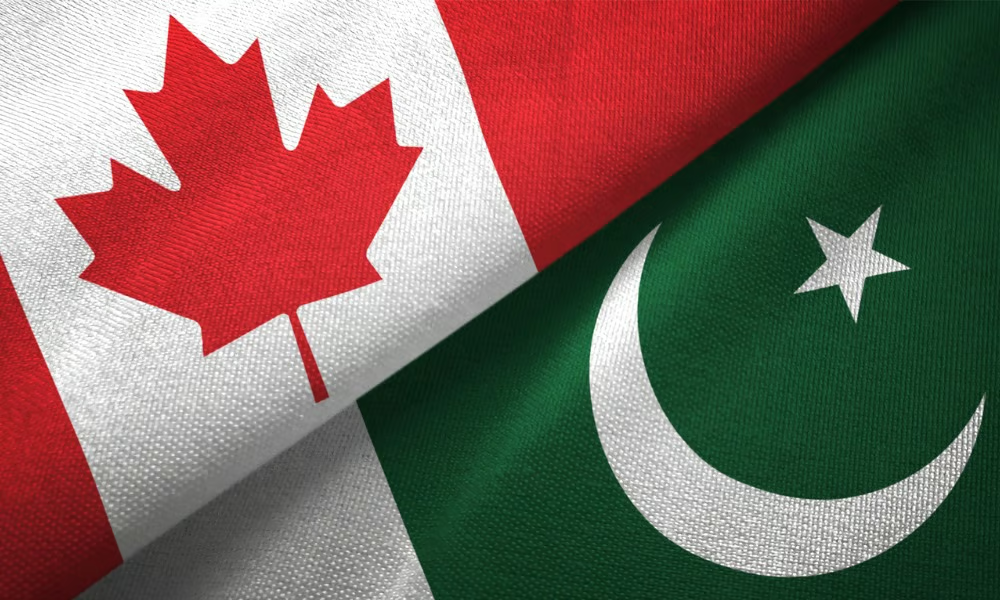
As middle powers, Canada and Pakistan are advancing minilateralism through flexible issue-based coalitions on climate finance, food security, migration governance, and AI ethics, bridging Global North-South divides via third platforms for networked influence and practical cooperation beyond traditional bilateral channels.
Key Points
- Canada and Pakistan co-lead or participate in climate clubs and finance coalitions, aligning on loss-and-damage funds and adaptation finance at COP and UN forums.
- Joint positioning in food-security minilaterals, including G20 and Commonwealth working groups, addresses supply-chain resilience and halal-trade standards.
- Migration governance coalitions under UN and IOM frameworks enable shared advocacy on skilled-labour mobility and diaspora rights.
- AI ethics and digital-governance minilaterals provide platforms for harmonising standards on data privacy and responsible innovation.
- This networked approach delivers predictability, reduces dependency on single partners, and creates multiplier effects for investors and policymakers.
Traditional bilateral diplomacy between Canada and Pakistan has delivered important wins—canola market reopening, FIPA negotiations, and trade surpassing $1 billion. Yet the real strategic evolution lies in middle-power minilateralism: flexible, issue-specific coalitions where both countries operate as bridges between Global North and Global South. This networked diplomacy leverages third platforms—climate clubs, G20 working groups, Commonwealth initiatives, and UN forums—to amplify influence, share best practices, and generate outcomes that pure bilateral channels cannot achieve alone. Policymakers gain scalable models for global engagement; investors discover de-risked opportunities in climate tech, food systems, and digital infrastructure; academics observe a replicable pattern of pragmatic multilateralism; and the public benefits from more resilient supply chains and ethical governance standards.
Climate finance represents a flagship arena. Canada and Pakistan co-shape positions in the Climate Finance Leadership Initiative and the Bridgetown Initiative’s successor coalitions, advocating for scaled-up adaptation grants and loss-and-damage mechanisms. At recent COP sessions and UN climate finance roundtables, their joint messaging has emphasised predictable funding flows for vulnerable states, directly supporting Pakistan’s renewable-energy targets and Canada’s green-export ambitions. This minilateral coordination creates investor certainty: Canadian capital gains access to bankable projects in Pakistan’s 30 GW renewable pipeline, while Pakistani firms tap Canadian expertise in project finance.
Food security offers another concrete platform. Within G20 agricultural working groups and Commonwealth food-resilience coalitions, the two countries collaborate on supply-chain traceability, halal standards harmonisation, and climate-smart agriculture. Pakistan’s expertise in high-value exports (mangoes, kinnow, dates, processed poultry) pairs with Canada’s advanced certification systems, producing joint proposals for WTO-compliant trade facilitation. The result is faster market access and reduced non-tariff barriers—outcomes that benefit Canadian processors seeking reliable halal inputs and Pakistani exporters commanding premium prices.
Migration governance and skilled mobility form a third minilateral thread. Through IOM and UN migration compacts, Canada and Pakistan co-chair informal working groups on ethical recruitment and diaspora rights. These platforms translate into practical outcomes: streamlined visa pathways for Pakistani IT professionals and health workers, and Canadian recognition of Pakistani credentials. Investors gain from expanded talent pools; families benefit from orderly mobility.
Digital governance and AI ethics round out the picture. In OECD-adjacent and UN Internet Governance Forum coalitions, the two middle powers advocate for inclusive standards on data sovereignty, AI transparency, and ethical deployment. Pakistan brings Global South perspectives on digital inclusion, while Canada contributes regulatory maturity—producing balanced frameworks that attract ethical tech investment.
The following table captures the architecture in action:
|
Issue Area |
Minilateral Platform |
Joint Positioning |
Practical Outcome for Both Countries |
|
Climate Finance |
Climate Clubs & Bridgetown Coalition |
Scaled adaptation grants & loss-and-damage |
Bankable renewable projects & Canadian green exports |
|
Food Security |
G20 Agriculture & Commonwealth Groups |
Traceability & halal standards |
Faster premium exports & diversified Canadian supply |
|
Migration Governance |
IOM/UN Migration Compacts |
Ethical recruitment & credential recognition |
Expanded talent pipelines & orderly labour mobility |
|
AI & Digital Ethics |
UN IGF & OECD-adjacent forums |
Inclusive standards on data & AI ethics |
Ethical tech investment & regulatory harmonisation |
This networked approach is deliberately issue-based and platform-agnostic. It avoids the rigidity of formal alliances while delivering the predictability investors demand. FIPPA negotiations and bilateral trade milestones provide the foundation, but minilateral coalitions supply the multiplier effect—turning diplomatic goodwill into actionable coalitions that span continents. For investors, the insight is clear: opportunities now emerge not only through direct Canada-Pakistan deals but through third-platform participation that de-risks entry and scales impact. Academics will note that this middle-power minilateralism offers a low-friction pathway for Global South-North collaboration in an era of fragmented global governance.
Conclusion Canada-Pakistan middle-power minilateralism redefines the relationship as networked cooperation across climate, food security, migration, and AI ethics coalitions. By operating through flexible third platforms rather than direct dependency, both nations bridge Global North-South divides, generate practical outcomes, and create multiplier effects for investors and policymakers. This fresh institutional angle—highlighted in recent joint statements and technical consultations—delivers predictability, reduces single-partner risk, and unlocks new growth stories in renewables, halal trade, skilled mobility, and ethical tech. Policymakers should sustain participation in these coalitions; investors can leverage them for de-risked opportunities; academics gain a model worth studying; and the public benefits from resilient supply chains and ethical global standards. In an era of complex challenges, Canada and Pakistan are proving that middle-power minilateralism is the smart path to shared influence and enduring prosperity.
* Dr. Muhammad Jahanzaib holds a PhD in International Relations, is a double gold medalist and author of the book The Interplay of Geo-Politics and Geo-Economics in Pakistan’s Foreign Policy (Post-2008) (Palgrave Macmillan), along with several esteemed publications. As Chief Visionary Officer of Diamanium Thinkers (a global think tank), he brings over 15 years of experience advising ministries, diplomats, security agencies, the corporate sector, and civil society. His advisory work spans economic diplomacy, political economy, economic intelligence, security, society, strategic financial advisory, and the geo-economic world dynamics. He offers a unique blend of practitioner insight and academic rigor, combining hands-on engagement with state institutions and strategic expertise grounded in research. He can be reached at jahanzaibdgc@gmail.com.
Key References
- Pakistan–Canada Joint Statement: Reaffirming strong and enduring ties – https://mofa.gov.pk/press-releases/pakistan-canada-joint-statement-reaffirming-strong-and-enduring-ties-3rd-november-2025
- 6th Round of Pakistan-Canada Bilateral Political Consultations – https://mofa.gov.pk/press-releases/6th-round-of-pakistan-canada-bilateral-political-consultations
- Canada-Pakistan Chamber of Commerce – Minilateral Initiatives – https://canadapakistan.org/
- Bridgetown Initiative & Climate Finance Coalitions – https://www.un.org/en/climatechange/bridgetown-initiative