
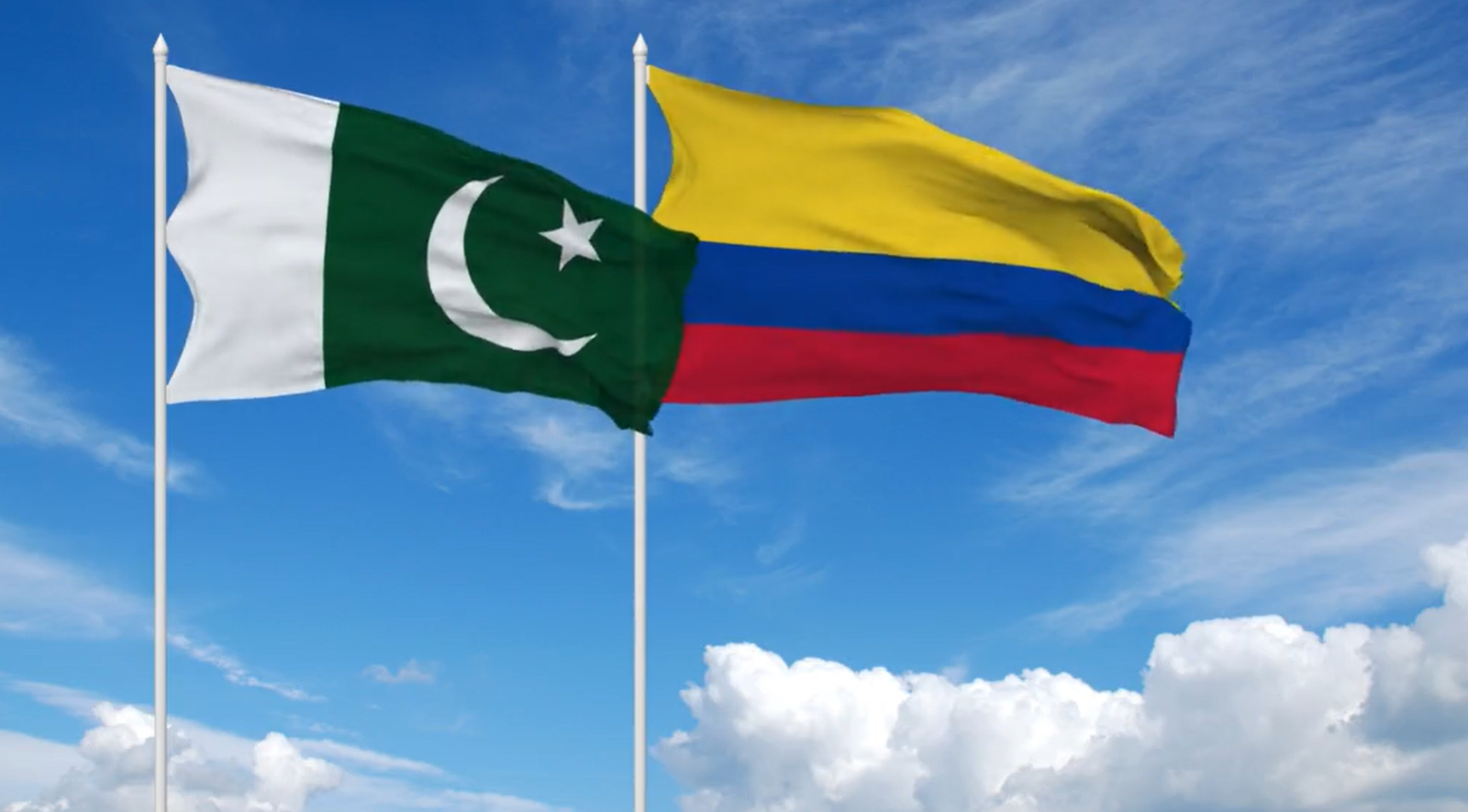
Colombia and Pakistan, as dynamic emerging economies, are poised for enhanced geo-economic ties through trade, investment, and multilateral cooperation, leveraging recent global shifts like BRI and NDB to drive mutual growth and prosperity.
Key Points
- Policy Alignment in Multilateral Forums: Both nations actively participate in groups like G77, fostering coordinated approaches to global economic challenges and sustainable development.
- Trade Expansion Opportunities: Bilateral trade, though modest at under $2.5 million in 2024, holds potential in complementary sectors such as Pakistan’s textiles and pharmaceuticals with Colombia’s energy and agriculture.
- Investment Synergies: Colombia’s infrastructure push via BRI and NDB aligns with Pakistan’s need for diversified funding, opening doors for joint ventures in renewables and mining.
- Economic Resilience and Growth: With similar GDP scales (Colombia ~$460B PPP, Pakistan ~$465B PPP in recent estimates), shared focus on diversification can mitigate security and inequality issues.
- Mutual Benefits for Stakeholders: Policymakers gain strategic alliances; investors access untapped markets; academics explore comparative analyses; the public benefits from job creation and affordable goods.
In an era of shifting global alliances, Colombia and Pakistan stand at the cusp of a transformative geo-economic partnership. Recent geo-economic developments underscore a foundation for collaboration. Diplomatic relations, established in 1980, have evolved modestly but gained momentum through multilateral engagements. In February 2024, Pakistan handed over the chairpersonship of the G77 and China Vienna Chapter to Colombia during a ceremony at the United Nations Office in Vienna. This symbolic transition, attended by key UN officials, reinforced their shared commitment to advancing developing nations’ economic interests amid global challenges like climate change and inequality. Ambassador Aftab Ahmad Khokher of Pakistan emphasized consensus-building, while assuring support for Colombia’s tenure under Ambassador Laura Gil. Such interactions signal potential for aligned advocacy in international forums, where both nations can amplify voices on trade reforms and South-South cooperation.
A pivotal shift occurred in 2025 when Colombia joined China’s Belt and Road Initiative (BRI) on May 14, aligning with over 20 Latin American countries. President Gustavo Petro’s announcement aims to boost infrastructure, including highways, ports, and rail systems, with investments potentially exceeding billions. Pakistan, a longstanding BRI participant since 2013, has seen over $25 billion in projects, enhancing connectivity via the China-Pakistan Economic Corridor (CPEC). This common BRI affiliation opens avenues for trilateral cooperation, such as joint infrastructure ventures linking Asian and Latin American supply chains. Analysis suggests that Pakistan’s expertise in BRI-funded energy projects could complement Colombia’s renewable energy push, reducing dependency on traditional partners and fostering diversified trade routes.
Further bolstering this momentum, Colombia became the first South American nation to join the BRICS-backed New Development Bank (NDB) in June 2025, committing $512 million initially. This move, under Petro’s administration, seeks to fund strategic projects in transportation, clean energy, and sanitation, diminishing reliance on Western institutions like the IMF. While Pakistan is not yet an NDB member, its interest in BRICS expansion (as discussed in 2025 forums) aligns with Colombia’s diversification strategy. Both countries face similar fiscal pressures—Colombia’s 2024 pension reform and Pakistan’s tax stabilization efforts in 2025—making NDB-like platforms ideal for low-conditionality financing. For policymakers, this presents a blueprint for bilateral MOUs on investment protection, echoing Pakistan’s recent $500 million critical minerals pact with the US in September 2025, which could extend to Colombian mining collaborations.
Bilateral trade remains underdeveloped but shows promising growth trajectories. According to the Observatory of Economic Complexity (OEC) and Trading Economics data, Colombia’s exports to Pakistan reached $1.4 million in 2024, up from approximately $1 million in 2023, primarily in chemicals, plastics, and machinery. Conversely, Pakistan’s exports to Colombia totaled $943,940 in 2024, focusing on textiles, rice, and pharmaceuticals—a slight increase from $900,000 in 2023. These figures, though small compared to Colombia’s $52.4 billion global exports and Pakistan’s $35.9 billion in 2023, indicate a 20-30% year-on-year growth potential if barriers like tariffs and logistics are addressed.
|
Year |
Colombia Exports to Pakistan (USD) |
Pakistan Exports to Colombia (USD) |
Key Products (Col to Pak) |
Key Products (Pak to Col) |
|
2023 |
1,000,000 |
900,000 |
Chemicals, Plastics |
Textiles, Rice |
|
2024 |
1,400,000 |
943,940 |
Machinery, Fruits |
Pharmaceuticals, Apparel |
This table illustrates the nascent but upward trend, supported by rational projections based on global commodity prices and demand. For investors, this low base offers high returns; Pakistan’s PSX emerged as the third-best performing emerging market in 2025 with 45% YTD returns, outpacing Brazil and Poland, while Colombia’s infrastructure modernization attracts FDI exceeding $1.9 billion in renewables alone from January 2023 to June 2024.
Potentials abound in complementary sectors. Colombia’s strengths in oil, coal, coffee, and emeralds align with Pakistan’s needs for energy imports and agricultural diversification. Pakistan, conversely, excels in textiles (exporting $3.93 billion in rice alone in FY 2023-24), pharmaceuticals, and IT, which could penetrate Colombia’s growing markets. Joint ventures in renewables—Colombia targeting OECD norms for green energy, Pakistan advancing solar under BRI—could yield shared technologies. In mining, Colombia’s critical minerals and Pakistan’s frontier resources (as in the 2025 US pact) suggest cooperative extraction models.
|
Sector |
Colombia Strengths |
Pakistan Strengths |
Cooperation Potential |
|
Energy & Renewables |
Oil exports, BRI infrastructure |
CPEC projects |
Joint green energy initiatives, tech transfer for sustainable power grids |
|
Agriculture |
Coffee, fruits |
Rice, textiles from cotton |
Agri-trade swaps, R&D in climate-resilient crops |
|
Pharmaceuticals |
Biotech growth |
Generic drug manufacturing |
Co-production of affordable medicines, market access in emerging regions |
|
IT & Digital |
Digital economy push |
Growing IT exports ($3B+ in 2025) |
Software collaborations, e-commerce platforms linking South Asia and Latin America |
|
Mining & Minerals |
Emeralds, coal |
Frontier critical minerals |
Bilateral investments, supply chain diversification under NDB frameworks |
This table rationalizes synergies, drawing on 2025 economic outlooks: Colombia’s moderate growth despite inflation, per Deloitte, and Pakistan’s stabilization in exports amid high taxes, per Dawn News. Academics can delve into comparative studies on how both nations’ similar GDPs (~$460-465B PPP) and challenges like inequality (both rank low in quality-of-life indices) inform resilient policies. For the public, enhanced ties mean job creation—e.g., Pakistani textiles in Colombian markets—and affordable imports, promoting cultural exchanges.
Challenges like geographical distance and limited direct flights persist, but digital platforms and BRI logistics can bridge gaps. Promotional strategies, such as targeted trade missions, could elevate bilateral trade, benefiting all stakeholders through inclusive growth.
Conclusion
Colombia and Pakistan’s geo-economic partnership holds immense promise, blending recent multilateral advancements like BRI and NDB with sector-specific synergies to foster sustainable prosperity. By prioritizing cooperative policies, both nations can diversify economies, enhance security, and create inclusive opportunities. Policymakers should spearhead MOUs, investors seize emerging markets, academics advance research, and the public embrace shared benefits. This alliance not only bridges continents but unlocks a brighter, interconnected future for over 300 million people.
* Dr. Muhammad Jahanzaib is the Founder & Chief Visionary Officer (CVO) of Diamanium Thinkers, a global think tank. He holds a PhD in International Relations, specializing in the intersection of geo-politics and geo-economics in Pakistan’s foreign and domestic policy. A double gold medalist and published scholar, he writes on economic intelligence, economic diplomacy, political economy, AI and regional cooperation in South Asia and beyond. He can be reached at jahanzaibdgc@gmail.com.
Key References
- Colombia (COL) and Pakistan (PAK) Trade | The Observatory of Economic Complexity – https://oec.world/en/profile/bilateral-country/col/partner/pak
- Pakistan (PAK) and Colombia (COL) Trade | The Observatory of Economic Complexity – https://oec.world/en/profile/bilateral-country/pak/partner/col
- Colombia joins China’s Belt and Road Initiative – Profit by Pakistan Today – https://profit.pakistantoday.com.pk/2025/05/14/colombia-joins-chinas-belt-and-road-initiative
- Pakistan hands over chairpersonship of G77 & China to Colombia – The Diplomatic Insight – https://thediplomaticinsight.com/pakistan-hands-over-chairpersonship-of-g77-china-to-colombia
- Colombia joins BRICS-backed bank in shift toward new financial order – UPI.com – https://www.upi.com/Top_News/World-News/2025/06/20/colombia-BRICS-backed-affiliation/9091750444666
- Foreign relations of Colombia – Wikipedia – https://en.wikipedia.org/wiki/Foreign_relations_of_Colombia
- Colombia Exports to Pakistan – Trading Economics – https://tradingeconomics.com/colombia/exports/pakistan
- Pakistan Imports from Colombia – Trading Economics – https://tradingeconomics.com/pakistan/imports/colombia
- Latin America: An Untapped Market for Pakistan – ISSRA – https://www.issra.pk/insight/2025/Latin-America-An-Untapped-Market-for-Pakistan/insight.html
- Colombia economic outlook 2025 – Deloitte – https://www.deloitte.com/us/en/insights/topics/economy/americas/colombia-economic-outlook.html
- Pakistan’s Economy in 2025: What Stabilised, What Didn’t — And What Lies Ahead in 2026 | Dawn News – https://www.youtube.com/watch?v=uibB-pNeveE