
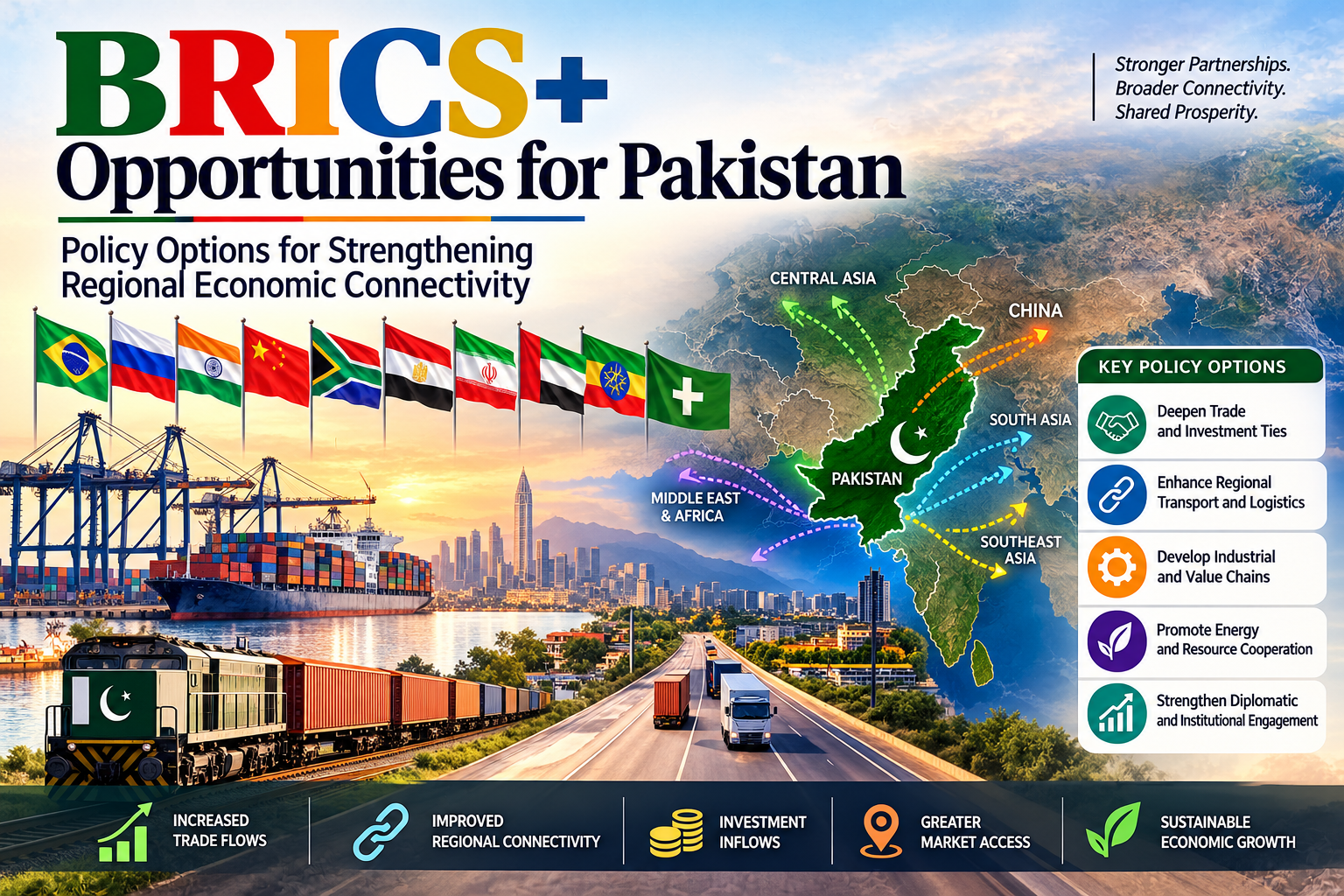
 Pakistan should adopt a Dual-Track Approach that prioritizes economic engagement with BRICS+ economies. It can be exercised through New Development Bank financing, economic diversification, and new Chinese-led initiatives, while maintaining diplomatic efforts for longer-term institutional options. It underpinned by targeted improvements in the domestic security environment that currently puts constraints on foreign investment projects.
Executive Summary:
Pakistan was not admitted to BRICS at the 18th Summit in New Delhi (12-13 September 2026), even though it applied in 2023 to join. India’s objection falls under the bloc’s consensus rule and remains a barrier to Pakistan’s economic development. At the same time, Pakistan already directs approximately 22.5% of its exports to BRICS+ markets and has a government-approved New Development Bank share subscription of roughly $582 million. New Chinese initiatives, announced at the summit, involve an open-source AI cooperation platform, digital industry and intelligent manufacturing programs, BRICS Special Economic Zone (SEZ) partnerships and BRICS Services Trade forum in 2027, create opportunities for non-member states to engage with BRICS economies.
The central policy question is how Pakistan can convert existing geo-economic opportunities into stronger regional connectivity and investment despite exclusion from formal BRICS membership and an active militancy in Baluchistan and KPK that continues to undermine the security environment of Pakistan. This policy brief recommends a Dual-Track Approach that combines non-membership economic engagement (NDB projects, critical minerals, and economic diversification) with low-profile diplomatic positioning. Benefits of this approach include an expansion in project financing, trade diversification, technology access, and greater strategic flexibility. The main risk in implementation is that continuous security conditions in Baluchistan and KP may delay or deter investment projects, undermining project delivery and credibility.
Problem Statement:
Pakistan faces a dual reality. It is already economically linked to BRICS+ economies through trade and the NDB, yet formal membership is blocked. Regional economic connectivity via trade, the NDB financing, CPEC-related projects, and critical minerals offers a realistic path for growth and reduced external vulnerability. Progress is constrained by limited export diversification, over-dependence on a narrow set of trade partners, and internal security conditions that affect the long-term capital flows and project timelines. The 2026 summit clarified that, while membership is unlikely in the near term, practical economic cooperation continues to expand and remains accessible to non-members, demonstrating delivery capacity.
Analysis of the Challenge:
Three interconnected factors shape Pakistan’s position. First, the institutional barrier remains firm. BRICS expansion requires full consensus, and India’s objection continues to prevent Pakistani membership. This objection is structural, reflecting bilateral rivalry and New Delhi’s preference for limiting Islamabad’s institutional space within the grouping. Other members, particularly China, have shown more willingness to cooperate with non-members, creating asymmetric interests within the bloc.
Second, economic exposure is already significant. Roughly 22.5% of Pakistan’s exports go to BRICS+ markets, and the NDB share subscription provides a potential financing channel. Although is not directly linked to BRICS, albeit the Reko Diq copper-gold project constitutes a strategically important mineral asset for Pakistan, yet its development timeline has been extended due to deteriorating security conditions. These economic linkages create interdependencies: successful project delivery would strengthen Pakistan’s credibility as a connectivity hub and investment partner, while repeated delays reinforce perceptions of high risk.
Third, security functions as an economic variable. Geopolitics and geo-economics are intertwined. Investor confidence, project timelines and Pakistan’s credibility as a regional connectivity hub are directly affected by internal security conditions. It is unclear how non-member countries access new China-led platforms, and there’s no clear timeline for when NDB funding will start to be operationalized. These uncertainties, combined with the linkages between security conditions and investment, define the core policy challenge.
Policy Options
Pakistan has three distinct policy pathways, differentiated principally by the priority assigned to formal BRICS engagement relative to immediate economic opportunities.
1. Membership-First Approach
Pakistan could prioritize diplomatic efforts to advance its case for formal BRICS inclusion while maintaining existing bilateral economic relationships and ongoing investment initiatives. This would require sustained engagement with BRICS members, diplomatic efforts to build wider support for Pakistan’s candidature, and use of future BRICS chairmanships and institutional consultations to address obstacles to entry. The principal advantage is that it preserves institutional ambition and could, if successful, strengthen Pakistan’s longer-term position within an increasingly important grouping of emerging economies. However, the approach carries significant uncertainty because membership depends on political consensus beyond Pakistan’s control. Concentrating diplomatic capital on membership could therefore produce limited near-term economic returns and divert attention from opportunities that do not require formal BRICS entry.
2. Economics-First Approach
Pakistan could deprioritize the formal membership campaign in the near term and concentrate government resources on economic opportunities that can be pursued irrespective of BRICS membership. Priorities would include operationalizing NDB financing, diversifying trade with major emerging economies, developing a pipeline of bankable infrastructure and connectivity projects, attracting investment into priority sectors, and participating selectively in BRICS-related or member-led initiatives that are accessible to non-members. The advantage of this approach is its emphasis on measurable economic outcomes rather than uncertain institutional status. It could also reduce the diplomatic cost associated with repeated membership efforts. The trade-off is that Pakistan would derive economic benefits without actively strengthening its longer-term institutional position within BRICS.
3. Dual-Track Approach
Pakistan could pursue an economics-first agenda while simultaneously maintaining calibrated, low-profile diplomacy to preserve future institutional options. The economic track would prioritize NDB financing, trade diversification, investment and bankable connectivity projects, together with participation in relevant economic platforms accessible to Pakistan. In parallel, the diplomatic track would maintain consultations with BRICS members, build support for Pakistan’s longer-term institutional engagement, and utilize favourable diplomatic windows without making membership the immediate measure of success. This approach offers the greatest strategic flexibility by separating near-term economic delivery from the uncertain timetable of formal inclusion. Its principal costs are greater inter-agency coordination requirements, the need for disciplined public messaging, and the risk that diplomatic objectives could distract from economic implementation if the two tracks are not clearly managed.
| Criteria | Membership First Approach | Economics First Approach | Dual-Track Approach |
| Economic opportunity | Moderate (existing partners) | High (NDB, tech, trade, SEZs) | High |
| Diversification potential | Low | High | High |
| Political/diplomatic feasibility | High | High | Moderate-High |
| Implementation burden | Low | Moderate | Higher (coordination required) |
| Strategic flexibility | Low | Moderate | High |
Recommended Course of Action:
Pakistan should adopt the Dual-Track Approach. This path allows the country to capture available economic gains now while preserving future institutional options and avoids making a binary policy choice between aggressive membership and withdrawal from the BRICS economic space.
Immediate (0-12 months)
Confirm and operationalize Pakistan’s NDB participation so that project financing can begin. Designate and select other bankable projects as delivery benchmarks. Initiate technical engagement with Chinese-led platforms on open-source AI, digital industry, and SEZ cooperation. Responsible institutions: Ministry of Finance/ Economic Affairs Division (EAD), Board of Investment and relevant provincial authorities (project facilitation), Ministry of Foreign Affairs (diplomatic signaling).
Medium-term (12-24 months)
Expand participation in relevant economic and technology platforms, advance trade diversification with BRICS+ partners, and strengthen inter-agency coordination mechanism linking economic, diplomatic and security institutions. Responsible institutions: Ministry of Commerce (trade), Ministry of Science & Technology/ relevant digital authorities (technology platforms), National Security apparatus in coordination with economic ministries (project protection and investor-risk reduction).
Longer-term (beyond 24 months)
Maintain calibrated diplomatic engagement for potential institutional openings, particularly via continued lobbying through China, while embedding security performance as a standing condition for sustained economic activities.
Early Indicators of Progress:
| No. | Early Indicators of Progress |
| 1 | Operational progress on NDB-related financing and project pipeline development. |
| 2 | Measurable advancement on bankable projects |
| 3 | Participation in at least two new Chinese-led economic or technology platforms |
| 4 | Observable trade diversification toward BRICS+ markets |
| 5 | Demonstrable improvement in project-delivery conditions linked to security (investor-risk reduction, continuity of major investments, and inter-agency coordination) |
Risks, Trade-offs, and Contingencies:
As we move towards the risk elements involved in these approaches, several points stand out.
| Risks | Monitoring Trigger | Contingency Action |
| Mixed messaging | Divergence between public statements and resource allocation | Disciplined messaging focused on delivery; single coordinating authority |
| Persistent security constraints in Balochistan | Project delays or declining investor engagement | Stronger inter-agency security coordination; security as binding condition for new projects |
| Trade & partnership balance | Pushback from traditional partners | Calibrated engagement; avoid strategic-realignment framing |
| India-Pakistan deterioration | Sharp escalation affecting multilateral forums | Pivot toward bilateral China/Gulf cooperation + project-level |
Conclusion:
Pakistan’s most realistic approach to stronger regional economic connectivity does not depend on formal institutional status. It depends on effective implementation and project delivery. Even without formal membership in BRICS, Pakistan can secure meaningful gains from the BRICS+ economic space (via states’ relations) by prioritizing NDB financing, bankable projects, economic diversification and targeted improvements in the security conditions that affect economic activities, all while keeping longer-term diplomatic options open through calibrated engagement. In the next 12-24 months, implementation will be more important than summit diplomacy.
* Dr. Muhammad Jahanzaib holds a PhD in International Relations, is a double gold medalist and author of the book The Interplay of Geo-Politics and Geo-Economics in Pakistan’s Foreign Policy (Post-2008) (Palgrave Macmillan, 2026), along with several esteemed publications. As Chief Visionary Officer of Diamanium Thinkers (a global think tank), he brings over 15 years of experience advising ministries, diplomats, security agencies, the corporate sector, and civil society. His advisory work spans economic diplomacy, political economy, economic intelligence, strategic financial advisory, security, society and the geo-economic world dynamics. He offers a unique blend of practitioner insight and academic rigor, combining hands-on engagement with state institutions and strategic expertise grounded in research. He can be reached at jahanzaibdgc@gmail.com.
** Tayyaba Naseer is a BS International Relations graduate from Government College University, Lahore, and a Diamanium Thinkers Research Internship alumna who completed the programme with Distinction in 2026. Her internship engagement spanned geo-economics, political economy, strategic studies, policy-oriented research, strategic intelligence, and research communication. Her undergraduate thesis examined Pakistan’s prioritization of geo-economics, reinforcing her interest in South Asian affairs and Pakistan’s foreign policy.
Reference List
- Reporting on the 18th BRICS Summit, New Delhi, 12-13 September 2026
- Trade data on Pakistan’s exports to BRICS+ economies (approximately 22.5%)
- Reporting on Pakistan’s New Development Bank share subscription (5,882 shares, approx. $582 M) – also see BRICS Info
- China’s initiatives at the 2026 BRICS Summit