
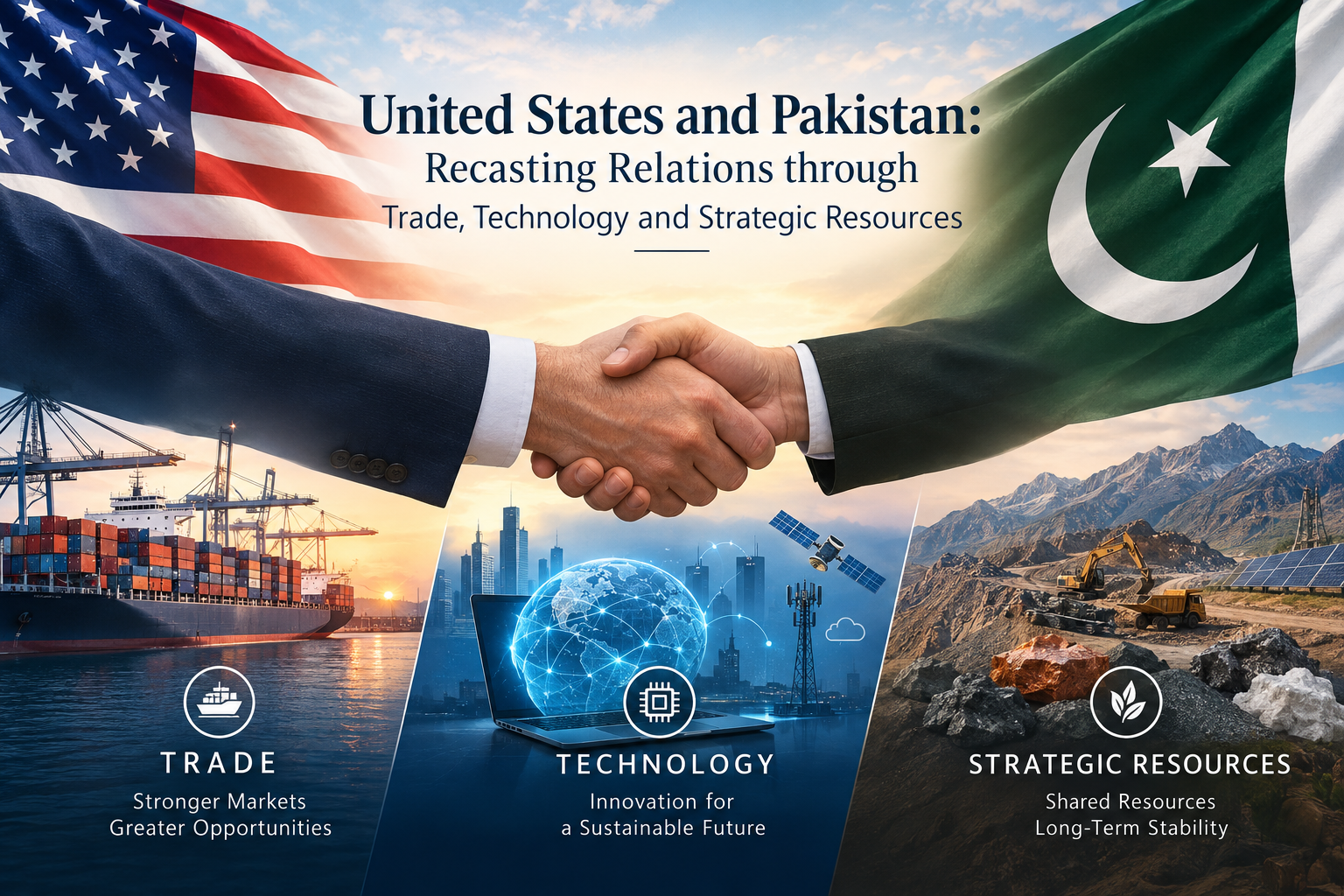
Pakistan–United States relations are entering a phase in which trade, technology, minerals, energy and investment can increasingly complement the traditional security relationship. The United States is Pakistan’s largest export market, while recent tariff, minerals and investment diplomacy creates both opportunities and compliance challenges. Pakistan must convert renewed political engagement into durable commercial interdependence.
Key Points
- The United States absorbed 19.9 percent of Pakistan’s merchandise exports during July–March FY2026, making it Pakistan’s largest export destination.
- U.S.–Pakistan goods trade reached approximately $8.55 billion in 2025, an increase of about 18 percent over 2024.
- Minerals, information technology, energy and higher-value manufacturing offer pathways for moving the relationship beyond its traditional textile-heavy commercial structure.
- U.S. tariff changes in 2025–26 make labor compliance, traceability, competitiveness and continued trade diplomacy increasingly important for Pakistani exporters.
Geo-Economic Landscape and Policy Priorities
From geopolitics to geo-economics
For much of their history, Pakistan and the United States viewed one another primarily through strategic and security considerations. The contemporary economic relationship provides an opportunity to broaden that framework. Pakistan needs export markets, productive foreign investment, technology and access to sophisticated supply chains; the United States is simultaneously seeking diversified sources of minerals, manufactured goods, digital services and commercially reliable partners. This creates space for a more transactional but potentially more sustainable geo-economic relationship.
The starting point is already substantial. Pakistan’s Economic Survey 2025–26 identifies the United States as its largest merchandise export destination. During July–March FY2026, Pakistan exported $4.634 billion of goods to the United States, equal to 19.9 percent of Pakistan’s exports, while imports from the United States were $2.133 billion, producing a Pakistani merchandise surplus of approximately $2.50 billion.
U.S. Census statistics provide another perspective. On the U.S. reporting basis, bilateral goods trade rose from approximately $7.23 billion in 2024 to $8.55 billion in 2025. U.S. exports to Pakistan reached $3.13 billion and U.S. imports from Pakistan $5.42 billion. During January–July 2026, two-way goods trade had already reached approximately $5.03 billion.
| Indicator | Period | Value |
| Pakistan exports to United States | Jul–Mar FY2026 | $4.634 bn |
| Pakistan imports from United States | Jul–Mar FY2026 | $2.133 bn |
| Pakistan merchandise surplus | Jul–Mar FY2026 | $2.501 bn |
| U.S.–Pakistan total goods trade | CY2024 | $7.226 bn |
| U.S.–Pakistan total goods trade | CY2025 | $8.546 bn |
| U.S.–Pakistan total goods trade | Jan–Jul 2026 | $5.026 bn |
Sources: Pakistan Economic Survey 2025–26 and U.S. Census Bureau. Pakistani customs and U.S. Census figures use different reporting periods and valuation methodologies and should therefore not be directly reconciled.
Trade remains strong, but concentrated
Pakistan’s principal strength in the American market remains textiles and apparel. More broadly, textiles represented 59.6 percent of Pakistan’s total merchandise exports during July–March FY2026, generating about $13.5 billion. Readymade garments reached $3.2 billion, bedwear $2.4 billion and knitwear $3.7 billion globally during that period.
This dependence is simultaneously an asset and a vulnerability. Pakistan has an established manufacturing ecosystem and market recognition, but excessive concentration exposes exports to demand shifts, tariffs and competition from Vietnam, Bangladesh and other suppliers. The next stage should therefore emphasize technical textiles, sports goods, surgical products, pharmaceuticals, engineering goods and branded consumer products alongside traditional apparel. Pakistan’s sports-goods exports, for example, rose 13 percent during July–March FY2026, demonstrating the potential of specialized manufacturing.
The tariff environment has become more complicated
Trade policy changed significantly during 2025–26. The July 2025 U.S.–Pakistan trade understanding was followed by a 19 percent U.S. reciprocal tariff rate for Pakistan under the Trump administration’s 2025 framework. That framework was subsequently overtaken by U.S. legal and policy developments in 2026. Following the U.S. Supreme Court’s February 2026 ruling against the IEEPA-based reciprocal tariff mechanism, USTR concluded a separate Section 301 investigation concerning foreign restrictions on imports made with forced labor.
Under USTR’s July 2026 final action, Pakistan was placed in the 10 percent additional-duty tier for covered, non-exempt goods, effective July 24, because of its status within the U.S. forced-labor import-policy investigation. USTR subsequently recognized Pakistan among economies taking measures to prohibit goods produced with forced labor.
This creates an important geo-economic lesson. Market access now depends not merely on price but increasingly on supply-chain traceability, labor standards and regulatory credibility. Pakistan’s textile industry can turn compliance into a competitive advantage by strengthening factory-level documentation, cotton traceability, occupational safety and internationally credible labor enforcement.
Technology and digitally delivered services
Pakistan’s fastest-growing opportunity may be services rather than goods. IT services exports increased 19.8 percent to $3.4 billion during July–March FY2026 and represented 46.1 percent of Pakistan’s total services exports. Pakistan’s Economic Survey notes growth across computer and information services, software consultancy and freelance digital work.
The United States offers scale in cloud services, software engineering, artificial intelligence, cybersecurity, fintech and business-process outsourcing. Pakistan should therefore seek American technology investment rather than relying exclusively on freelance exports. Joint innovation centers, venture-capital links, university partnerships, data centers and U.S. corporate sourcing from Pakistani firms could raise both export value and worker productivity.
Critical minerals can reshape the relationship
Minerals create perhaps the most strategically significant new pillar. Pakistan has actively sought American investment and financing in mining, including discussions around the Reko Diq copper-gold project and possible U.S. financing participation. In 2025 Pakistan also offered mining-related concessions during trade negotiations with Washington as it sought investment in critical resources and associated infrastructure.
The real opportunity is not simply mineral extraction. Pakistan should pursue a value-chain model encompassing geological surveying, mine development, processing, transport infrastructure, environmental management and eventually downstream mineral industries. Such cooperation would provide American firms with diversified supply opportunities while giving Pakistan capital, technology and export capacity.
Energy, agriculture and investment
The 2025 bilateral trade negotiations also discussed energy, agriculture and possible U.S. crude purchases, reflecting efforts to broaden commercial relations beyond established products. Pakistan’s underlying challenge is to make these initiatives private-sector driven and commercially sustainable rather than dependent upon occasional diplomatic breakthroughs.
The existing Trade and Investment Framework Agreement, or TIFA, gives both governments an institutional channel for resolving commercial issues. The next logical step is a regular economic dialogue focused on market access, minerals, technology, agriculture, intellectual property, standards and investment facilitation. Pakistan should seek a relationship in which American firms regard the country not merely as a large consumer market but as a location for production and regional connectivity.
Strategically, this need not be presented as choosing the United States over Chna. Pakistan’s economic interests are better served through diversification: Chinese infrastructure and industrial cooperation, American markets and technology, Gulf capital, European market access and regional connectivity can coexist in a multi-vector geo-economic strategy. Pakistan’s trade patterns themselves demonstrate the logic of such diversification.
Conclusion
The future of Pakistan–United States relations can be stronger when commercial interests reinforce rather than depend upon security convergence. The United States already constitutes Pakistan’s largest export market, but the relationship remains below its potential in investment, technology, minerals and high-value services. Pakistan should protect textile access while diversifying exports, institutionalizing labor and supply-chain compliance, inviting long-term U.S. capital into mineral processing and manufacturing, and connecting its expanding IT workforce with American firms. Washington, meanwhile, can benefit from another commercially viable partner across South and Central Asia. A durable geo-economic partnership requires moving from episodic deals toward institutionalized, private-sector-led economic interdependence.
Author Bio
* Dr. Muhammad Jahanzaib holds a PhD in International Relations, is a double gold medalist and author of the book The Interplay of Geo-Politics and Geo-Economics in Pakistan’s Foreign Policy (Post-2008) (Palgrave Macmillan, 2026), along with several esteemed publications. As Chief Visionary Officer of Diamanium Thinkers (a global think tank), he brings over 15 years of experience advising ministries, diplomats, security agencies, the corporate sector, and civil society. His advisory work spans economic diplomacy, political economy, economic intelligence, strategic financial advisory, security, society and the geo-economic world dynamics. He offers a unique blend of practitioner insight and academic rigor, combining hands-on engagement with state institutions and strategic expertise grounded in research. He can be reached at jahanzaibdgc@gmail.com.
Key References
- Government of Pakistan, Pakistan Economic Survey 2025–26, Chapter: Trade and Payments. URL: https://www.finance.gov.pk/survey/chapter_26/8_Trade%20and%20Payments.pdf
- U.S. Census Bureau, Trade in Goods with Pakistan. URL: https://www.census.gov/foreign-trade/balance/c5350.html
- Office of the United States Trade Representative, Pakistan / South and Central Asia. URL: https://ustr.gov/countries-regions/south-central-asia/pakistan
- Office of the United States Trade Representative, Section 301 Investigations. URL: https://ustr.gov/issue-areas/enforcement/section-301-investigations
- State Bank of Pakistan, Economic Data — External Sector. URL: https://www.sbp.org.pk/economic-data