
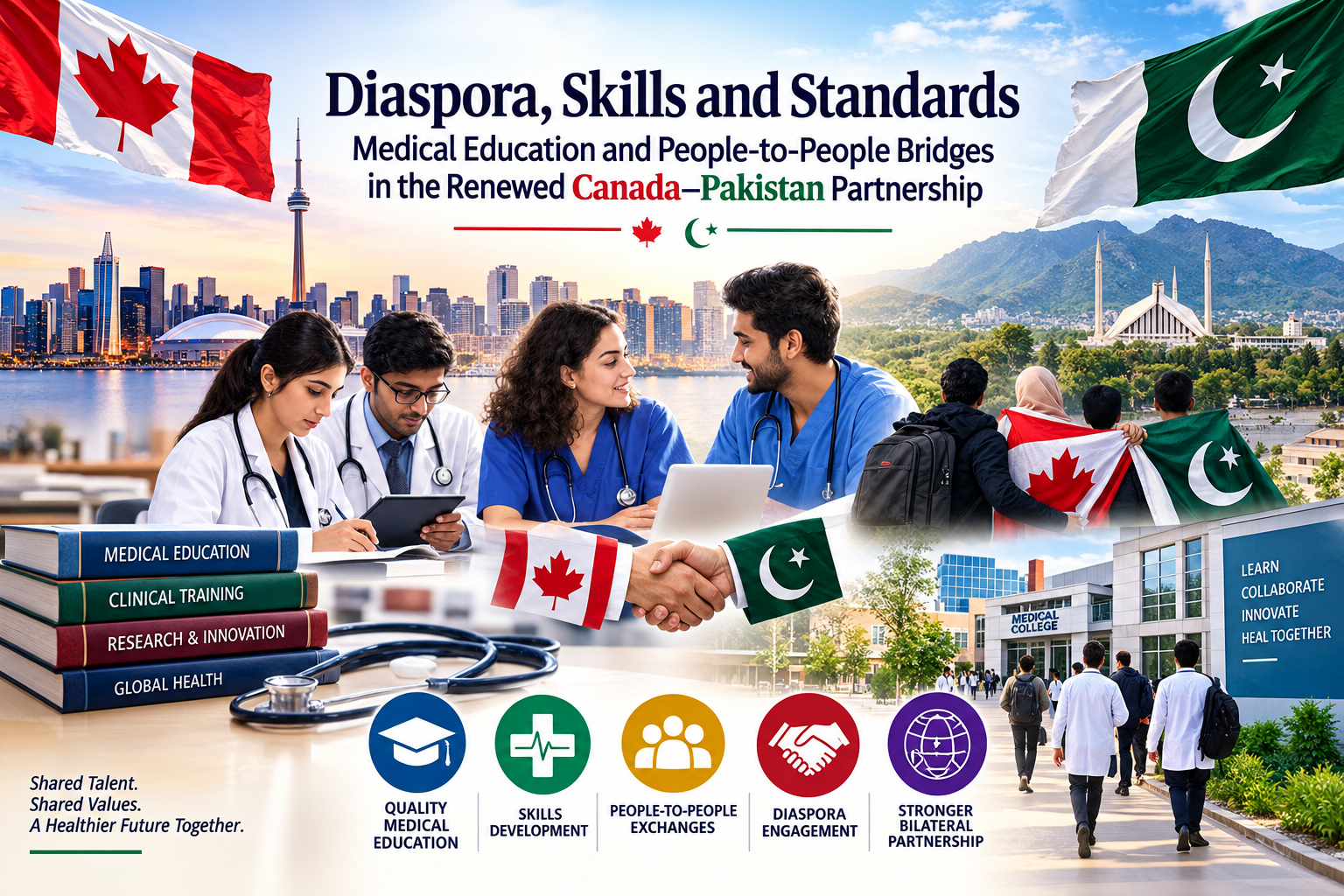
The most durable Canada–Pakistan bridge could be merchandise trade but also human capital. A Pakistani-origin community exceeding 300,000 in Canada, thousands of Pakistani students, emerging cooperation between specialist medical institutions and Canada’s demand for internationally trained health professionals create an opportunity to build a standards-based partnership in education, skills and mobility.
Key Points
- More than 300,000 people of Pakistani origin live in Canada, giving bilateral relations a substantial societal foundation.
- More than 9,000 Pakistani students were studying in Canada according to the July 2026 Canada–Pakistan joint statement.
- Pakistan’s CPSP and Canada’s Royal College have explored cooperation in postgraduate education, accreditation, capacity building and specialist training.
- Canada reports that 31 percent of family physicians were internationally trained in 2024, highlighting the importance of global medical talent.
- Mobility must be built around credential recognition and professional standards; immigration eligibility does not itself constitute authorization to practice medicine in Canada.
The renewed Canada–Pakistan relationship is commonly discussed through trade and investment, yet its most deeply rooted asset is human connectivity. The July 2026 bilateral joint statement identified more than 300,000 Canadians of Pakistani origin and over 9,000 Pakistani students in Canada, while both governments committed to stronger academic, institutional, cultural, tourism and people-to-people linkages. Canada separately estimates that around 20,000 Canadians are in Pakistan.
These numbers make the relationship qualitatively different from a conventional bilateral partnership. The diaspora contains professionals, physicians, academics, entrepreneurs and families able to transfer knowledge, investment, networks and institutional practices in both directions. The policy challenge is to convert this social capital from an informal bridge into organized cooperation.
Medical education has emerged as one of the most promising examples. On January 14, 2026, Pakistan’s High Commissioner Muhammad Saleem met Craig Ceppetelli, Executive Director and Chief Operating Officer of the Royal College of Physicians and Surgeons of Canada (RCPSC) in Ottawa. Their discussions focused specifically on professional training, healthcare capacity building, postgraduate medical education, accreditation and specialist training, while exploring linkages between the RCPSC and Pakistan’s College of Physicians and Surgeons Pakistan (CPSP).
By March, CPSP leadership was publicly reporting recent collaboration with the Canadian Royal College alongside its other international institutional relationships. Pakistan’s federal health minister emphasized CPSP’s role in postgraduate specialist training and medical quality. These developments suggest that medical cooperation is beginning to move from diplomatic conversation toward institution-to-institution engagement.
| People-to-people indicator / initiative | Latest evidence | Strategic significance |
| Pakistani-origin community in Canada | >300,000 | Diaspora bridge for skills, capital and institutions |
| Pakistani students in Canada | >9,000 | Educational and long-term professional connectivity |
| Canadians in Pakistan | ~20,000 | Two-way societal relationship |
| RCPSC–CPSP engagement | Active in 2026 | Postgraduate training and standards cooperation |
| Internationally trained Canadian family physicians | 31% in 2024 | Demonstrates importance of international medical talent |
| Canadian PNP spaces reserved for doctors | 5,000 | Supports physician recruitment pathways |
| Provincial-nominee physician work permits | 14-day processing target | Faster entry for qualifying nominated doctors |
| Direct Pakistan–Toronto aviation link | Existing PIA service | Physical connectivity for diaspora and professionals |
Sources: Global Affairs Canada, Immigration, Refugees and Citizenship Canada, and Government of Pakistan.
Canada’s healthcare labor market gives this cooperation additional relevance. Immigration, Refugees and Citizenship Canada reports that 31 percent of family physicians in Canada were internationally trained in 2024. It also notes that immigrants constitute roughly one in four healthcare workers, while more than 11,000 healthcare workers arrived through economic immigration programs in 2024.
Canada has subsequently introduced measures intended to make physician immigration more responsive to workforce requirements. These include an Express Entry category for medical doctors with at least one year of full-time Canadian medical work experience during the preceding three years, 5,000 federal spaces through the Provincial Nominee Program for doctors with qualifying employment support, and a stated 14-day work-permit processing pathway for provincially nominated physicians while their permanent-residence applications are processed.
But this is precisely where the word standards become more important than the word migration.
A Pakistani medical degree or postgraduate qualification does not automatically confer the right to practice medicine in Canada. Canada explicitly requires foreign credentials to be assessed and physicians to obtain licensing through the appropriate provincial or territorial regulatory authority. Immigration permission and professional licensure are separate processes. Any serious Canada–Pakistan health partnership should therefore avoid creating unrealistic expectations of automatic recognition.
The more strategic opportunity lies in reducing gaps before migration occurs. RCPSC–CPSP engagement can potentially support faculty development, competency-based postgraduate education, assessment methodology, quality assurance, specialist curricula, medical leadership, continuing professional development and accreditation practice. Cooperation of this nature benefits physicians who eventually work abroad but can also improve the quality of specialist training for doctors who remain in Pakistan.
That distinction matters because a skills partnership should not simply become a one-way mechanism for transferring trained Pakistani physicians to Canada. Pakistan itself faces significant healthcare needs. A sustainable arrangement would therefore prioritize circulation of knowledge rather than permanent extraction of talent: visiting faculty, joint training modules, short fellowships, tele-education, research collaboration, reciprocal conferences and institutional accreditation assistance can allow knowledge to move without requiring every professional to relocate.
The diaspora can support such a model. Pakistani-origin Canadian physicians and academics can function as institutional intermediaries – connecting hospitals, universities and specialist colleges, mentoring researchers and facilitating joint programs. Diaspora networks possess a comparative advantage because they understand professional systems in Canada while retaining linguistic, cultural and family familiarity with Pakistan.
Students form the second pillar. More than 9,000 Pakistani students in Canada constitute not only an education statistic but a potential long-term network spanning science, technology, medicine, business and public policy. The July joint statement accordingly called for stronger academic and institutional linkages rather than viewing educational mobility solely through visa issuance.
That approach is increasingly important because the quality of mobility matters more than raw student numbers. A mature partnership should encourage university-to-university agreements, research supervision, credit recognition where appropriate, joint seminars, visiting scholars and programs aligned with labor-market and development needs. In healthcare, the emphasis should be particularly rigorous because professional competence directly affects patient safety.
Physical connectivity reinforces these ties. During bilateral discussions, officials highlighted Pakistan International Airlines’ Toronto service as the only direct air connection between Pakistan and North America, noting the role of the large diaspora. Such transport links reduce the practical distance separating families, businesses, students and professionals and therefore function as part of the broader geo-economic infrastructure of the relationship.
People-to-people relations also now intersect with development cooperation. During Anand’s July visit, Canada announced significant new support across education, climate resilience and reproductive health. These programs broaden the bilateral human-development agenda beyond migration and provide additional avenues through which Canadian institutions and Pakistani communities can interact.
The next stage should institutionalize these connections. A Canada–Pakistan Health and Skills Dialogue, potentially involving health ministries, CPSP, RCPSC, universities, regulators and diaspora medical associations, could map accreditation gaps and identify areas suited to joint training. Universities could similarly create a regular Canada–Pakistan academic forum focused on research, postgraduate education and emerging technologies.
Such mechanisms would give people-to-people diplomacy a measurable purpose. Success would not merely mean more visas or migration. It would mean stronger Pakistani institutions, Canadian access to appropriately qualified global talent, more joint research, higher professional standards and a diaspora increasingly engaged as a two-way knowledge network.
Conclusion
Canada and Pakistan possess a human foundation that many bilateral relationships spend decades trying to build. More than 300,000 Canadians of Pakistani origin, thousands of students and growing professional connections provide an exceptional platform for cooperation. Medical education demonstrates how that platform can mature: the emerging RCPSC–CPSP connection places standards, accreditation and specialist training at the center of mobility rather than treating migration as an end in itself. The next objective should be a structured health-and-skills partnership that promotes credential quality, faculty collaboration, research and knowledge circulation. Done carefully, people-to-people ties can become not the softer side of Canada–Pakistan relations, but one of their strongest strategic pillars.
Author Bio
* Dr. Muhammad Jahanzaib holds a PhD in International Relations, is a double gold medalist and author of the book The Interplay of Geo-Politics and Geo-Economics in Pakistan’s Foreign Policy (Post-2008) (Palgrave Macmillan, 2026), along with several esteemed publications. As Chief Visionary Officer of Diamanium Thinkers (a global think tank), he brings over 15 years of experience advising ministries, diplomats, security agencies, the corporate sector, and civil society. His advisory work spans economic diplomacy, political economy, economic intelligence, strategic financial advisory, security, society and the geo-economic world dynamics. He offers a unique blend of practitioner insight and academic rigor, combining hands-on engagement with state institutions and strategic expertise grounded in research. He can be reached at jahanzaibdgc@gmail.com.
References
- Global Affairs Canada, Canada-Pakistan Joint Statement: Strengthening Bilateral and Trade Relations, July 20, 2026.
- Global Affairs Canada, Minister Anand Advances Canada’s Bilateral Relations with Pakistan, July 20, 2026.
- Government of Pakistan, Press Information Department, High Commissioner Muhammad Saleem Held Meeting with Mr. Craig Ceppetelli, Executive Director and COO, Royal College of Physicians and Surgeons of Canada, January 14, 2026.
- Government of Pakistan, Press Information Department, Meeting of the Federal Minister of Health with Delegation of the College of Physicians and Surgeons Pakistan, March 12, 2026.
- Immigration, Refugees and Citizenship Canada, Live and Work as a Medical Doctor in Canada, updated January 14, 2026.
- Government of Canada, Study in Canada as an International Student.
- Global Affairs Canada, Canada–Pakistan Relations.