
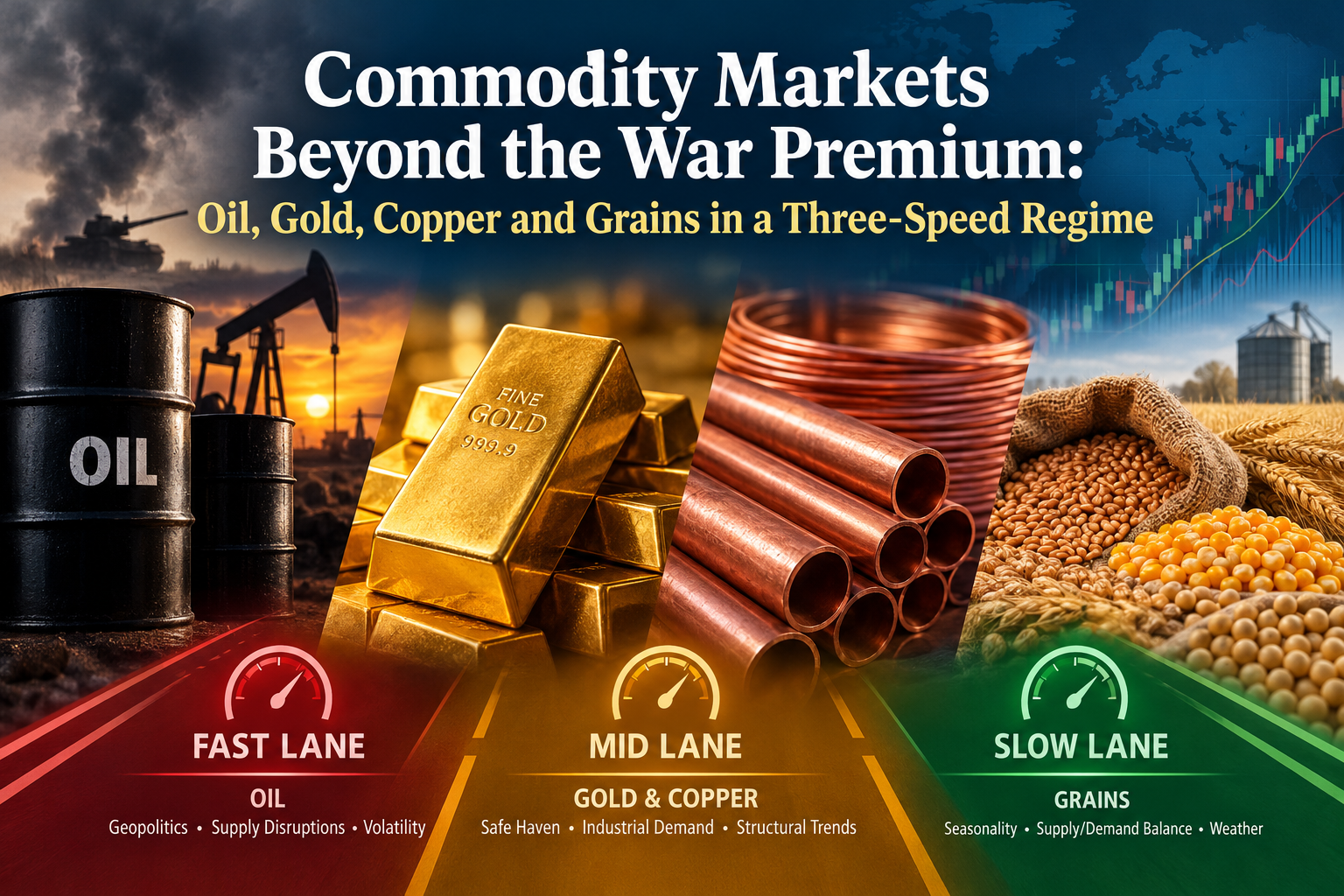
Commodity markets in 2026 should no longer be treated as one inflation trade. Oil reflects immediate supply disruption; gold increasingly responds to monetary and sovereign-risk hedging; copper embodies long-term electrification and infrastructure scarcity; agriculture remains governed by crop-specific inventories and weather. Investors can benefit by matching each commodity to its distinct time horizon.
Key Points
- Oil is tactically tight: Large inventory withdrawals and disrupted production support prices, but supply normalization could rapidly remove geopolitical premiums.
- Gold has structural sponsorship: Central-bank accumulation remains important even as historically high bond yields create unusually strong opportunity-cost competition.
- Copper is the structural story: Electrification, grids and digital infrastructure point toward persistent supply challenges extending well beyond today’s business cycle.
- Agriculture demands differentiation: U.S. corn inventories are abundant while wheat supply indicators are tighter, arguing against indiscriminate commodity positioning.
Commodities have separated into different investment regimes
Commodity investors frequently make one analytical mistake: assuming that crude oil, gold, copper and agricultural futures rise for essentially the same reasons. In late 2026, the opposite is increasingly true.
Energy prices are being dominated by short-run physical availability and geopolitical disruption. Gold is balancing safe-haven demand against very high interest rates. Copper reflects both current industrial conditions and a multi-year electricity-infrastructure shortage. Agricultural markets depend on inventories, weather, harvests and export logistics. Treating these exposures as a homogeneous “commodity allocation” risks missing the actual source of return.
| Commodity / fundamental | Latest relevant marker | Dominant investor question |
| Brent crude | Around $100/bbl in early October | How much disruption premium survives normalization? |
| Global oil demand | Forecast to fall 2.5 mb/d in 2026 | Is current tightness temporary or structural? |
| Global oil inventories | Down about 507 million barrels since February | How rapidly can buffers be rebuilt? |
| Gold | About $4,165/oz on October 5 | Can reserve demand offset high real/nominal yields? |
| Q2 central-bank gold buying | 289 tonnes | Is official-sector diversification becoming structural? |
| Copper | Projected 2035 supply gap around 25% | Can mine and refining investment catch future demand? |
| U.S. corn stocks | 2.10 billion bushels, +35% YoY | Does ample supply cap rallies? |
| U.S. wheat stocks | 1.85 billion bushels, about -14% YoY | Can tighter supply sustain relative strength? |
Sources: IEA, World Gold Council, USDA NASS and Reuters.
Oil: high prices do not automatically mean a long-term bull market
The International Energy Agency’s September Oil Market Report illustrates the extraordinary physical tightening experienced in 2026. The IEA estimated August world oil production at 100.1 million barrels per day, down 1.6 mb/d from July, and projected full-year supply at 100.7 mb/d—around 5.7 mb/d below 2025. Global inventories had declined approximately 507 million barrels since February, while North Sea Dated crude surged as high as $113.48 per barrel on September 9.
Yet there is an equally important counterpoint. The IEA expects world oil demand to decline by around 2.5 mb/d in 2026 before rebounding by 2.6 mb/d in 2027. By October 5, Reuters reported Brent hovering near the psychologically important $100 level as higher Middle Eastern exports and releases from G7 reserves began easing some immediate supply concerns.
For investors, oil is therefore better understood as a high-convexity tactical market than as proof of permanently higher equilibrium prices. Disruption can still create violent upside moves, but normalization can remove the premium just as quickly. Long-term investors should distinguish between producers able to generate cash flow at materially lower oil prices and securities whose valuation implicitly requires triple-digit crude.
Gold: a strategic hedge facing an unusually powerful competitor
Gold’s behavior is arguably more revealing. Spot bullion traded around $4,165 per ounce on October 5 even while ten-year Treasury yields were approximately 5.28 percent. Normally, high yields and a strong dollar increase the opportunity cost of owning a non-interest-bearing asset. Gold’s ability to remain above $4,000 suggests that fiscal, geopolitical and reserve-diversification demand has become an important offsetting force.
World Gold Council data reinforce that interpretation. Total first-half 2026 gold demand reached 2,522 tonnes, about two percent higher year on year, with demand valued at a record $380 billion. Central banks purchased 289 tonnes during the second quarter, five times the revised first-quarter amount, although first-half official-sector buying remained below the exceptional pace of some recent years.
That does not mean investors should chase every gold rally. Gold’s strongest portfolio role remains diversification against monetary, sovereign, inflation and geopolitical tail risk. When yields themselves exceed five percent, position sizing becomes especially important: an investor holding excessive bullion gives up considerable income, whereas a disciplined strategic allocation can provide portfolio insurance without requiring a permanent bullish forecast.
Copper: the structural investment case is longer than the economic cycle
Copper deserves a different lens. The IEA’s Global Critical Minerals Outlook 2026 expects copper to contribute the largest absolute increase in critical-mineral demand, requiring roughly seven million additional tonnes by 2040. Even after incorporating announced projects, the IEA’s outlook indicates a potential copper supply deficit of roughly 25 percent by 2035 under current policy settings.
The investment logic is straightforward: electricity grids, renewable generation, electric vehicles, data centres and industrial electrification are copper-intensive, while major mines require long development timelines. At the same time, the IEA notes continued concentration in processing and refining, creating geo-political as well as geological supply risk.
However, structural scarcity does not eliminate cyclical drawdowns. Copper remains sensitive to China, construction, manufacturing and global investment. The more prudent thesis is therefore long-term constructive, short-term price-sensitive. Investors evaluating miners should focus not merely on copper exposure but on reserve quality, operating cost, jurisdiction, project execution, balance-sheet leverage and future capital requirements.
Agriculture: perhaps the clearest argument against a single commodity trade
USDA’s September 30 Grain Stocks report showed 2.10 billion bushels of U.S. corn stocks as of September 1, up 35 percent year on year. In contrast, all-wheat inventories were approximately 1.85 billion bushels, down about 14 percent, while 2026 wheat production was estimated at 1.53 billion bushels, 23 percent below the revised 2025 total.
This divergence matters. A broad commodity narrative based exclusively on inflation or geopolitics would miss the opposing supply conditions within agriculture itself.
| Investment horizon | Commodity focus | Principal driver | Main risk |
| Tactical | Oil | Physical disruption, inventories, shipping | Fast geopolitical normalization |
| Strategic hedge | Gold | Fiscal/monetary risk, central-bank demand | High yields and stronger dollar |
| Multi-year structural | Copper | Grids, electrification, AI infrastructure | China slowdown; new mine supply |
| Seasonal / relative-value | Grains | Harvests, weather, inventories, exports | Forecast errors and weather reversals |
The implication is not to forecast every commodity correctly. It is to know why each position exists. Oil can hedge near-term geopolitical inflation; gold can hedge financial-system and sovereign risk; copper can express an infrastructure thesis; grains can offer crop-specific opportunities. Combining them without identifying those different functions can create hidden rather than genuine diversification.
Conclusion
The strongest commodity strategy for late 2026-2027 is differentiation. Oil’s scarcity is immediate but potentially reversible; gold enjoys powerful reserve and safe-haven demand but competes with exceptionally attractive bond yields; copper offers arguably the clearest long-duration scarcity case; and agricultural markets demonstrate why individual supply balances matter more than generic inflation narratives. Investors should therefore separate tactical trades from strategic holdings, distinguish physical shortages from financial momentum, and use scenario-based position sizing rather than extrapolating recent price moves. Commodity intelligence is most valuable when it explains the source, durability and downside of a price signal – not simply whether that price is currently rising.
Author Bio
* Dr. Muhammad Jahanzaib holds a PhD in International Relations, is a double gold medalist and author of the book The Interplay of Geo-Politics and Geo-Economics in Pakistan’s Foreign Policy (Post-2008) (Palgrave Macmillan, 2026), along with several esteemed publications. As Chief Visionary Officer of Diamanium Thinkers (a global think tank), he brings over 15 years of experience advising ministries, diplomats, security agencies, the corporate sector, and civil society. His advisory work spans economic diplomacy, political economy, economic intelligence, strategic financial advisory, security, society and the geo-economic world dynamics. He offers a unique blend of practitioner insight and academic rigor, combining hands-on engagement with state institutions and strategic expertise grounded in research. He can be reached at jahanzaibdgc@gmail.com.
Investor-use note: These articles provide general economic and market research for analytical decision-making. They do not constitute individualized investment, legal or tax advice.
References
- International Energy Agency, “Oil Market Report — September 2026.”
- International Energy Agency, “Global Critical Minerals Outlook 2026 — Executive Summary.”
- World Gold Council, “Gold Demand Trends: Q2 2026.”
- World Gold Council, “Gold Demand Trends: Central Banks — Q2 2026.”
- U.S. Department of Agriculture, National Agricultural Statistics Service, “U.S. Corn Ending Stocks Up 35 Percent from Last Year,” September 30, 2026.
- USDA Economics, Statistics and Market Information System, “Grain Stocks,” September 30, 2026.
- Reuters, “Gold Edges Up as October Rate Hike Bets Ease, Stronger Dollar Caps Gains,” October 5, 2026.
- Reuters, “Euro Slides on France Worries; Fed Pause Hopes Support Stocks,” October 5, 2026.