
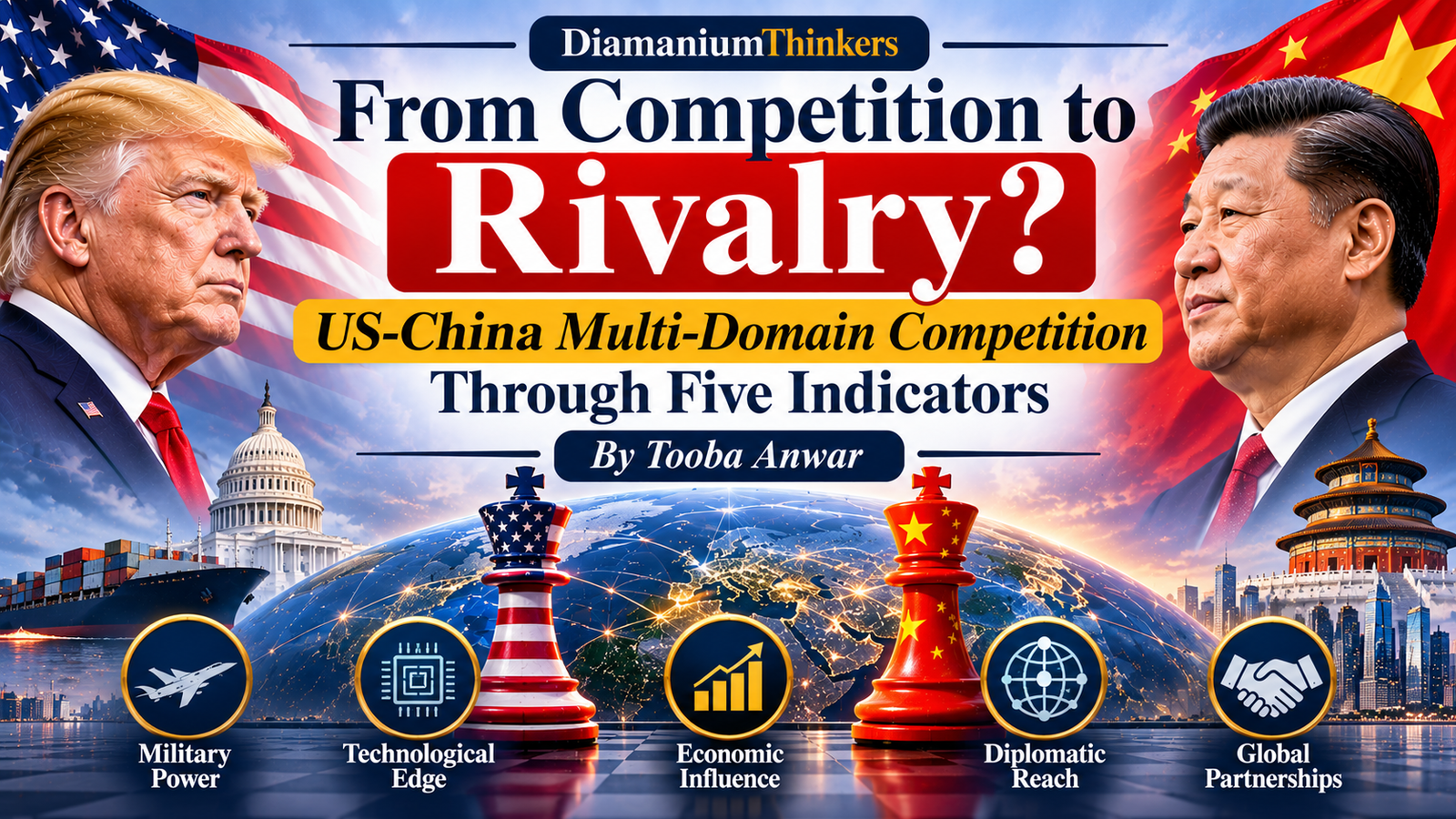
Global military spending reached $2,887 billion in 2025. After eleven consecutive years of growth, global expenditure increased by 2.9% in 2025, representing a cumulative rise of 41% over the decade and reaching its highest annual level since the 9.7% increase recorded in 2024. Washington still leads, but the gap is narrowing, while China’s military spending has grown by its largest margin in a decade. A narrowing gap alone does not make a rivalry. This article asks a narrower question: is US–China competition across the military, nuclear, economic, technological and diplomatic domains hardening into strategic rivalry, and if so, of what kind?
Key Points
- Competition is not yet rivalry. Competition involving the United States, China, Russia and other countries is the pursuit of advantages. In William Thompson’s (2001) terms, strategic rivalry requires each side to see the other as a competitor, a threat and an enemy, and to sustain that view over time.
- The numbers show a shrinking but real US lead. The recent decade has shown increasing military expenditure by China, Russia and the United States, although the US remains at the top. The US accounts for 33% of world military spending and China for 12%. China’s nuclear arsenal is estimated at about 620 warheads (January 2026), up from about 600 a year earlier. China’s nominal GDP is about 64% of the US figure, while its GDP by purchasing power parity (PPP) is larger: $44.3 trillion for China against $32.4 trillion for the United States.
- Indicators to test the shift. Multiple indicators can help establish which stage of competition states are entering: multi-domain competition, reciprocal balancing, strategic containment, adversarial partnership and contestation over international order. The first three are strong; the last two are weaker.
- The rivalry is managed, not frozen. A trade truce reached at Busan in October 2025 has been extended to 10 January 2027, but it leaves the underlying chokepoint contest intact.
- Verdict: This is an intensified and transformed rivalry rather than a replay of the Cold War, fought through chips, minerals and alliances more than through opposing blocs.
Competition versus rivalry
Competition between states occurs when they have conflicting interests and seek the same scarce resources, goods, technology, markets, influence or security advantages. Rivalry is a narrower and more durable stage of competition, in which rivals mutually perceive each other as competitors, sources of military risk and enemies (Thompson, 2001).
The formation of this mutual perception between major powers is explained by structural realists. Kenneth Waltz argues that anarchy and the distribution of power and capabilities push states to balance against one another, while John Mearsheimer argues that great powers fear each other’s intentions and therefore pursue a balance of power.
The real question for the United States and China is not simply whether they are competing, but whether their competition has become mutual, multi-issue and self-reinforcing.
Indicator 1: Multi-domain competition
The competition runs through at least four domains at once.
Military. China’s military spending has risen for 31 consecutive years, increasing by 62% between 2016 and 2025, although it has remained at a relatively steady 1.7% of GDP (SIPRI, 2026a).
Nuclear. SIPRI estimates China’s arsenal at about 620 warheads in January 2026, with about 34 deployed with operational forces, up from 24 (SIPRI, 2026b; SCMP, 2026).
Economic. The IMF’s 2026 estimates put US GDP at about $32.4 trillion and China’s at about $20.9 trillion in nominal terms. By PPP, China is larger, at about $44.3 trillion against $32.4 trillion (Beckley, 2018).
Technology and resources. Semiconductors and rare earths are the two major chokepoints discussed under Indicator 3.
Indicator 2: Reciprocal balancing
When each side builds its response with reference to the other’s capabilities and countermeasures, balancing becomes reciprocal. The US 2025 National Security Strategy identifies deterring China in the Indo-Pacific as a key goal, while US spending on nuclear modernization and advanced conventional programmes reflects this strategic priority (SIPRI, 2026a).
Indicator 3: Strategic containment
The sharpest evidence is the tit-for-tat competition over strategic chokepoints. The United States restricted China’s access to advanced semiconductors. China responded with licensing controls on critical minerals: tungsten and tellurium in February 2025, seven medium and heavy rare earths in April 2025, and a sweeping extraterritorial regime announced on 9 October 2025 (C3 Solutions, 2026).
This reflects the growing strategic importance of economic interdependence. Critical technologies and mineral supply chains are no longer treated solely as commercial assets; they are increasingly viewed as instruments of national security and geopolitical leverage.
Indicator 4: Adversarial partnership
Coalitions built around a named competitor, such as AUKUS and the Quad, would signal that rivalry has an alliance structure. The evidence is mixed.
Quad foreign ministers met in New Delhi in May 2026, but the Quad has held no leaders’ summit since 2024, and the joint statement did not mention Taiwan (The Star, 2026). AUKUS has also been placed under US review. These groupings exist, but they depend on US leadership attention and remain thinly institutionalized.
Indicator 5: Contestation over international order
During the SCO summit in Tianjin in September 2025, Xi Jinping proposed a Global Governance Initiative and called for opposition to “hegemonism and power politics” (Tribune, 2025). He also proposed a process of de-dollarisation through a new SCO development bank (StratNews Global, 2025).
Analysts note that the initiative extends China’s earlier development, security and civilization initiatives while remaining within the language of the United Nations (ORF, 2025). This indicates an emerging contest over the principles and institutions shaping international order, although it does not yet amount to a fully developed alternative global system.
A managed rivalry
The competitors are managing their rivalry through bargaining shaped by economic needs and interdependence. The United States reduced its tariffs on Chinese goods from 57% to 47%, a reduction of 10 percentage points, while China paused its sweeping rare-earth controls for a year (Down To Earth, 2025).
The Beijing summit in May 2026 produced agriculture and aircraft deals but no extension of the trade truce (China Briefing, 2026). During Xi’s state visit in September 2026, Washington and Beijing extended the truce to 10 January 2027 and agreed to establish an AI dialogue channel, while leaving rare earths unresolved (CNBC, 2026; Brookings, 2026).
US officials said export controls on advanced chips remained outside the talks (Epoch Times, 2026). China’s rare-earth suspension is due to expire on 10 November 2026, making it the next important test of the relationship (Modern Diplomacy, 2026).
This pattern illustrates a managed rivalry: both powers continue to compete over strategic resources and technological advantages while retaining incentives to negotiate and avoid an uncontrolled economic confrontation.
Conclusion
The evidence supports a qualified answer. Three indicators—multi-domain competition, reciprocal balancing and strategic containment—are strong, one—adversarial partnership—is moderate, and one—contestation over international order—is emerging.
Together, they describe competition that has intensified and changed: chips, minerals and alliance networks rather than two opposing blocs. The United States still leads in military spending and, in nominal terms, in GDP, so this is not a peer rivalry on every measure. The trade truce also demonstrates that both sides remain willing to bargain within limits.
Whether the pattern hardens further depends on the future of the chokepoint bargain and developments around Taiwan. These are the two questions that the coming year will test. The US–China relationship is therefore best understood as an intensified and transformed strategic rivalry—one in which competition, interdependence and selective cooperation continue to operate simultaneously.
Author Bio
Tooba Anwar is an MPhil student at the Department of Strategic Studies, National Defence University, Islamabad, Pakistan.
References
- Beckley, M. (2018). The Power of Nations: Measuring What Matters. International Security, 43(2).
- Brookings (2026). What Did the Trump-Xi Summit Actually Accomplish?
- C3 Solutions (2026). Assessing the Real China Critical-Minerals Threat.
- China Briefing (2026). The Xi-Trump Beijing Summit: What Was Agreed and What Was Not.
- CNBC (2026). U.S.-China Trade Truce Extended for Two Months, Bessent Says.
- Down To Earth (2025). China Pauses Rare Earth Export Controls after Trump-Xi Trade Truce.
- Epoch Times (2026). Key Takeaways From Trump-Xi Summit.
- Farrell, H. and Newman, A. (2019). Weaponized Interdependence. International Security, 44(1).
- Mearsheimer, J. (2001). The Tragedy of Great Power Politics. W. W. Norton.
- Modern Diplomacy (2026). The Shenzhen Auction.
- ORF (2025). China’s Global Initiatives and the Quest to Rewrite the World Order.
- SCMP (2026). China Adds Warheads as Nuclear Powers Walk Away from Disarmament: SIPRI.
- SIPRI (2026a). Trends in World Military Expenditure, 2025. Fact Sheet, April 2026.
- SIPRI (2026b). SIPRI Yearbook 2026.
- StratNews Global (2025). Xi Jinping Champions New Global Order, Flanked by Putin, Modi.
- The Star (2026). Quad Foreign Ministers Fight for Relevance in New Delhi.
- Thompson, W. (2001). Identifying Rivals and Rivalries in World Politics. International Studies Quarterly, 45(4).
- Tribune (2025). Xi Proposes Global Governance Initiative.