
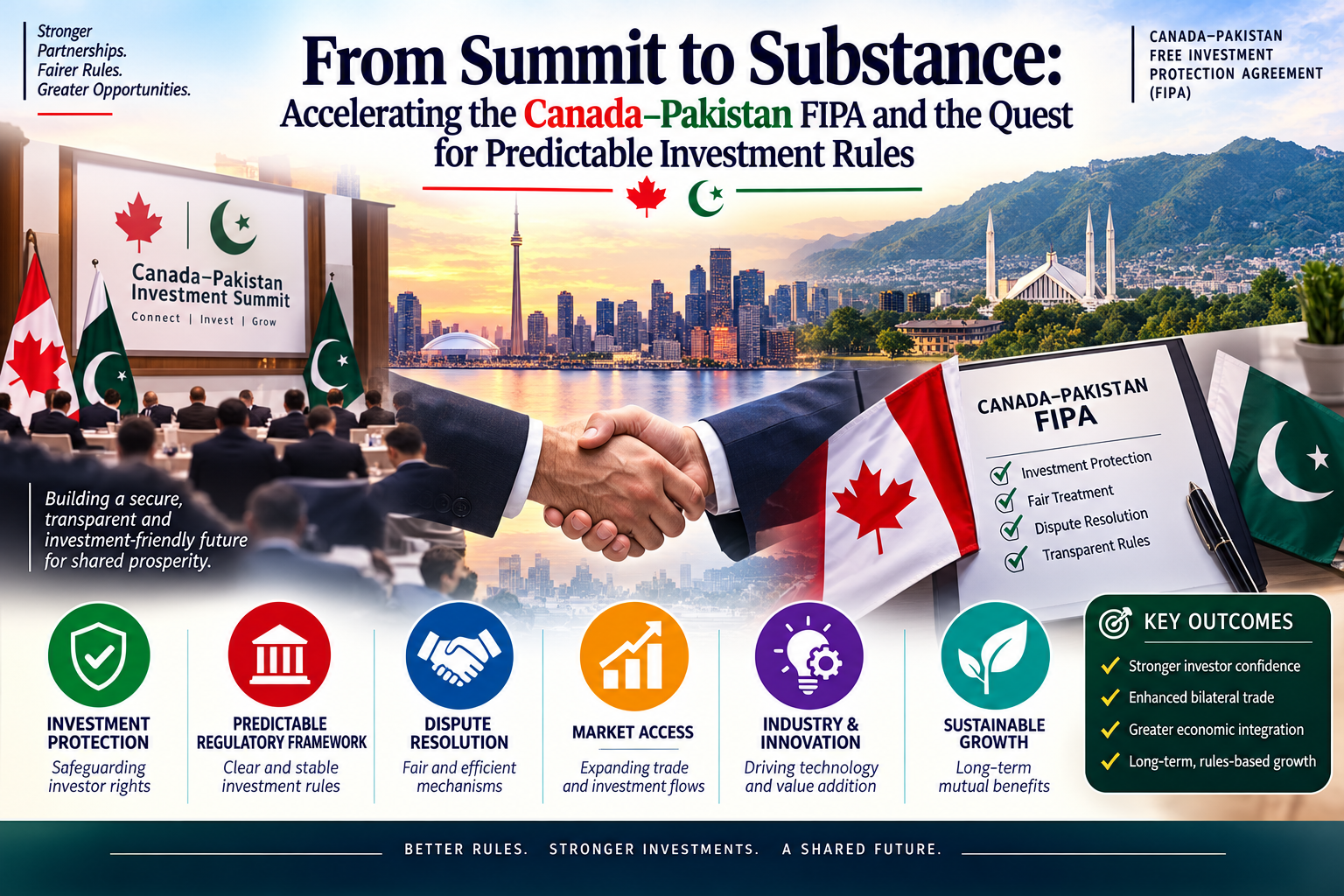
Canada and Pakistan have moved their long-discussed Foreign Investment Promotion and Protection Agreement from diplomatic aspiration toward substantive negotiation. The challenge now is converting political momentum after Foreign Minister Anita Anand’s July 2026 visit into predictable rules governing investment protection, regulation, transfers and disputes – without constraining Pakistan’s legitimate policy space.
Key Points
- The second FIPA negotiating round was held in Canada in June 2026, followed by ministerial-level political endorsement in July.
- In September, both governments identified the next round as an opportunity to resolve outstanding issues and accelerate conclusion.
- Bilateral merchandise trade reached approximately C$1.2 billion in 2025, creating a stronger commercial base for investment expansion.
- Canada’s modern FIPA model combines investor protections with transparency, responsible business conduct, sustainable development and governments’ right to regulate.
- A treaty can reduce regulatory uncertainty, but Pakistan’s domestic reforms ultimately determine whether legal confidence translates into durable investment.
The July 20, 2026 visit of Canadian Foreign Minister Anita Anand to Islamabad – the first visit by a Canadian foreign minister to Pakistan in almost two decades – marked a decisive political reset in bilateral relations. Canada and Pakistan explicitly welcomed progress in FIPA negotiations, agreed on regular engagement to conclude the agreement at the earliest opportunity, and decided to revive their Joint Working Group on Trade and Investment. The joint statement identified clean energy, mining and critical minerals, infrastructure, agriculture, emerging technologies and sustainability as priority areas.
The economics increasingly justify this diplomatic attention. Canadian official data put 2025 bilateral merchandise trade at approximately C$1.2 billion, comprising C$499.7 million of Canadian exports to Pakistan and C$696 million of Canadian imports from Pakistan. Canadian exports had risen about 65 percent from 2024. The renewed flow of Canadian canola is particularly significant: following the resumption of exports in late 2025, Canada reported approximately C$426 million in canola exports by the time of Anand’s July visit.
| Indicator / milestone | Latest position | Geo-economic significance |
| Bilateral merchandise trade | ~C$1.2 billion, 2025 | Commercial base already substantial |
| Canadian exports to Pakistan | C$499.7 million | Up about 65% from 2024 |
| Canadian imports from Pakistan | C$696.0 million | Pakistan maintains strong market presence |
| Second FIPA round | June 2026 | Negotiations moved into active technical phase |
| Anand visit | July 20, 2026 | High-level political endorsement |
| Latest announced next round | First week of October 2026 | Intended to address outstanding issues |
| Pakistan FIPA status | In negotiation | Treaty not yet in force |
Sources: Global Affairs Canada and Government of Pakistan.
The September 15 meeting between Commerce Minister Jam Kamal Khan and Canadian High Commissioner Tarik Ali Khan made the investor-confidence rationale unusually explicit. The High Commissioner described FIPA as foundational for expanding Canadian investment and emphasized legal protection, arbitration and dispute-resolution mechanisms. He also noted that Canadian companies increasingly recognize Pakistan’s large-market potential but require a predictable and secure framework. Both sides expected the forthcoming negotiating round to narrow differences and deliver substantive progress.
What might such a treaty contain? Canada’s 2021 Model FIPA provides the most useful benchmark, although the final Pakistan agreement will be negotiated rather than copied mechanically. The model provides national and most-favoured-nation treatment, minimum standards of treatment, rules concerning expropriation and transfer of funds, transparency provisions and investor–state dispute settlement. Importantly, the modern Canadian approach simultaneously safeguards the state’s right to regulate for legitimate objectives such as public health, environmental protection, climate policy, safety and social protection. It also incorporates responsible business conduct and sustainable-development considerations.
That balance matters for Pakistan. Investors seek protection against arbitrary administrative action, discriminatory treatment, uncertain contractual enforcement and obstacles to moving legitimate investment proceeds. Yet Islamabad cannot sensibly bargain away its ability to regulate mining, environmental standards, taxation, energy, financial stability or public health. A well-designed FIPA should therefore reduce arbitrariness, not prevent regulation.
Pakistan’s broader investment climate explains why this distinction is essential. Investors have historically cited complex and inconsistent regulations, tax uncertainty, contract-enforcement problems, intellectual-property concerns and administrative red tape. More recently, Pakistan’s IMF-supported reform program has emphasized SOE reform, greater competition, energy-sector viability, anti-corruption measures and the removal of unnecessary regulatory distortions to attract high-quality private investment.
The FIPA should complement these domestic reforms rather than substitute for them. Treaty protection cannot compensate indefinitely for unpredictable taxation, lengthy approvals, inconsistent provincial and federal implementation, inefficient dispute resolution or energy-sector weaknesses. Conversely, regulatory reform without treaty certainty may still leave foreign boards concerned about long-horizon political and sovereign risk.
Canada’s own treaty practice offers useful lessons.
| Canadian investment framework | Status / milestone | Lesson for Pakistan |
| Canada–UAE FIPA | In force May 19, 2026 | Modern protection can coexist with regulatory policy space |
| Canada 2021 Model FIPA | Current negotiating benchmark | Greater emphasis on transparency, sustainability and right to regulate |
| Older Canadian FIPAs | Numerous agreements remain in force | Pakistan should seek a modern rather than legacy-style treaty |
| Canada–Pakistan FIPA | Negotiations ongoing | Opportunity to incorporate newest treaty architecture |
The Canada–UAE experience is especially instructive. Negotiations were launched in 2016, the agreement was signed in November 2025, and it entered into force on May 19, 2026. Canada characterizes it as a comprehensive modern agreement providing legally binding protections and greater predictability. The lesson is twofold: sophisticated investment agreements can require sustained negotiation, but once political priorities align, they can become foundations for broader commercial integration. Canada and the UAE subsequently concluded CEPA negotiations in July 2026, with investment facilitation complementing their FIPA.
For Canada and Pakistan, the near-term opportunity lies in sectors where commercial interest already exists. The July joint statement highlighted Canadian firm JCM Power’s successful bid for a 240 MW hybrid wind-solar project at Dhabeji, subject to regulatory approvals. September discussions added exploration and mining services, agricultural processing, renewable energy, aircraft leasing and aerospace. Pakistan also sees potential in using Canadian capital and technology to develop value-added agricultural and mineral supply chains rather than remaining principally a commodity market.
The expected impact should nonetheless be described realistically. FIPA will not automatically produce billions of dollars in FDI. Its more plausible first-order effect is to lower perceived institutional risk, make investment proposals easier to defend before corporate boards and lenders, provide structured dispute-resolution channels and signal that both states intend to protect long-term capital. The second-order effect could be stronger joint ventures and diversification beyond established trade.
The most productive negotiating strategy would therefore focus on five practical outcomes: transparent authorization procedures; clearly defined protection against arbitrary treatment and uncompensated expropriation; workable transfer-of-funds provisions; credible but carefully bounded dispute settlement; and strong preservation of legitimate regulatory powers. Canada’s 2021 model already demonstrates that investor protection and sovereign policy space need not be mutually exclusive.
Conclusion
Canada–Pakistan relations have reached a point where political goodwill must become institutional certainty. FIPA is important not because a treaty itself creates investment, but because it can establish a predictable legal floor beneath increasingly diversified commercial ties. Pakistan should use the negotiations simultaneously to strengthen domestic regulatory consistency, contract enforcement and investor facilitation, while Canada should recognize Pakistan’s need for legitimate development and regulatory space. With bilateral trade already near C$1.2 billion and opportunities emerging in mining, clean energy, agriculture and aviation, a balanced modern FIPA could shift the relationship from transaction-based trade toward long-term productive investment. The priority now is quality and timely conclusion.
Author Bio
* Dr. Muhammad Jahanzaib holds a PhD in International Relations, is a double gold medalist and author of the book The Interplay of Geo-Politics and Geo-Economics in Pakistan’s Foreign Policy (Post-2008) (Palgrave Macmillan, 2026), along with several esteemed publications. As Chief Visionary Officer of Diamanium Thinkers (a global think tank), he brings over 15 years of experience advising ministries, diplomats, security agencies, the corporate sector, and civil society. His advisory work spans economic diplomacy, political economy, economic intelligence, strategic financial advisory, security, society and the geo-economic world dynamics. He offers a unique blend of practitioner insight and academic rigor, combining hands-on engagement with state institutions and strategic expertise grounded in research. He can be reached at jahanzaibdgc@gmail.com.
References
- Global Affairs Canada, Canada-Pakistan Joint Statement: Strengthening Bilateral and Trade Relations, July 20, 2026.
- Global Affairs Canada, Minister Anand Advances Canada’s Bilateral Relations with Pakistan, July 20, 2026.
- Government of Pakistan, Press Information Department, Pakistan, Canada Agree to Accelerate Investment Pact and Expand Trade Cooperation, September 15, 2026.
- Government of Canada, 2021 Model Foreign Investment Promotion and Protection Agreement.
- Government of Canada, Canada’s International Trade and Investment Agreements.
- Global Affairs Canada, Canada–United Arab Emirates Foreign Investment Promotion and Protection Agreement.
- International Monetary Fund, Executive Board Completes Third Review of Pakistan’s EFF and Second RSF Review, May 8, 2026.
- U.S. Department of State, 2024 Investment Climate Statements: Pakistan.