
Great-power rivalry has returned, and the numbers provide compelling evidence of its resurgence. However, this is not simply a second Cold War. Today’s major rivals remain deeply connected through a shared global economy, nuclear arms-control safeguards have weakened, and an expanding group of middle powers is helping shape the international order. Great-power competition refers to the contest among the world’s most influential states for security, political influence, and control over the rules of the international system. It becomes strategic rivalry when it begins to shape military expenditure, alliances, technological competition, and arms-control arrangements.
Key Points:
- Rising Global Military Spending: Global military expenditure reached $2.9 trillion in 2025, with some of the sharpest increases occurring in Europe and Asia, extending the arms buildup beyond the traditional major powers.
- Declining Nuclear Safeguards: The New START Treaty expired in February 2026, leaving the United States and Russia without legally binding limits on their strategic nuclear arsenals.
- The Growing Role of Middle Powers: Countries increasingly hedge rather than align exclusively with Washington or Beijing. Their independent strategies make a simple two-bloc Cold War framework inadequate for understanding the emerging international order.
The Arms Race Nobody Declared
Global military spending reached $2.9 trillion in 2025, equivalent to 2.5 per cent of global GDP, according to the Stockholm International Peace Research Institute (SIPRI). This represented the eleventh consecutive annual increase and the highest level recorded by the institute. The United States, with $954 billion (33 per cent of the global total), China with $336 billion (12 per cent), and Russia with $190 billion (6.6 per cent), remained the world’s three largest military spenders. Collectively, the fifteen biggest spenders accounted for approximately 80 per cent of global military expenditure.
The burden is particularly heavy for countries directly involved in warfare. Russia, continuing its war in Ukraine, allocated approximately 7.5 per cent of its GDP to defence, while Ukraine’s military expenditure reached an extraordinary 40 per cent of its GDP.
Allied countries are also accelerating their military preparations. At the June 2025 NATO summit, members agreed to a new defence and security investment target of 5 per cent of GDP by 2035, replacing the earlier 2 per cent benchmark established in 2014. Germany increased its military expenditure by 24 per cent to $114 billion, exceeding 2 per cent of GDP for the first time since 1994.
Asia Rearms Too
Asia and Oceania recorded military expenditure of $681 billion in 2025, representing an 8.1 per cent increase and the region’s largest annual rise since 2009. India, with spending of $92.1 billion, became the world’s fifth-largest military spender.
SIPRI researcher Diego Lopes da Silva associates the increase in military expenditure among America’s Asian allies with longstanding regional tensions and growing uncertainty about the reliability of U.S. security commitments. In other words, even America’s partners are increasingly investing in their own defence capabilities, seeking protection against regional competitors while also preparing for uncertainty surrounding their principal security guarantor.
Figure 1 illustrates these regional changes in military expenditure alongside the decline in American spending.
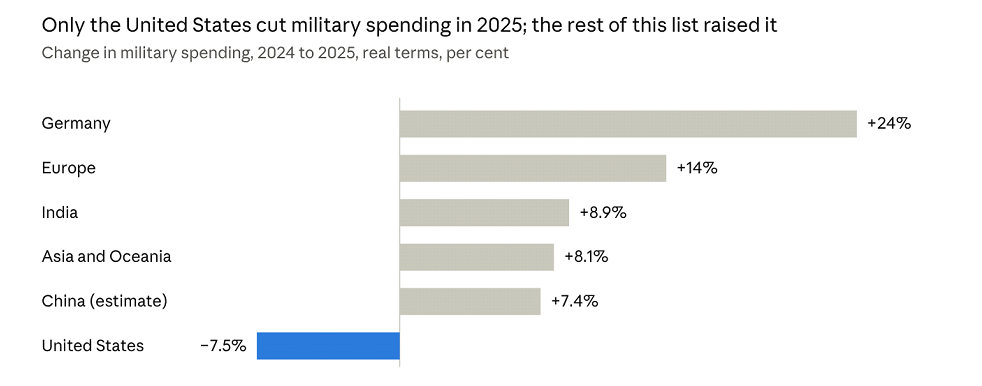
Figure 1: Change in Military Spending, 2024–2025 (Real Terms, Constant 2024 Prices)
Source: SIPRI, April 2026 (press release and fact sheet). China’s figure is an estimate.
The Heavyweight and the Challenger
The United States remains the dominant military power. Its military budget declined by 7.5 per cent in 2025, although SIPRI expects this reduction to be temporary, as congressional approvals for 2026 exceed $1 trillion.
According to World Bank figures, the U.S. economy stood at approximately $30.8 trillion, while China’s economy reached $19.5 trillion, against total global output of $118.4 trillion. Based on these figures, my calculations indicate that the United States accounts for approximately 26 per cent of global GDP but 33 per cent of worldwide military spending. China, by comparison, represents approximately 16 per cent of global GDP and an estimated 12 per cent of military expenditure.
These figures reveal an important distinction between the two powers. Washington carries a comparatively heavier military burden relative to its economic size, while Beijing’s growing strategic position is supported primarily by its expanding economic weight. Nevertheless, China’s estimated military expenditure increased by 7.4 per cent in 2025, while American spending declined, indicating that the challenger continues to narrow the gap at the margin.
Table 1: Military Spending and Economic Weight, 2025
| Country | Military Spending (USD Billion) | Share of World Military Spending | GDP (USD Trillion) | Share of World GDP |
|---|---|---|---|---|
| United States | 954 | 33% | 30.8 | 26% |
| China | 336 (SIPRI estimate) | 12% | 19.5 | 16% |
Sources: SIPRI for military expenditure and spending shares; World Bank for GDP figures (global total: $118.4 trillion). GDP shares are the author’s calculations.
The Referee Has Left
The expiration of the New START Treaty on 5 February 2026 represents a major setback for international arms control. The United States and Russia are no longer bound by the treaty’s legally established limits on their strategic nuclear arsenals.
United Nations Secretary-General António Guterres warned that the treaty’s dissolution “could not come at a worse time” and that the risk of nuclear weapons being used was at its highest level in decades. This development highlights a fundamental danger in contemporary great-power competition. Strategic rivals have always competed, but the current situation is particularly concerning because this competition is increasingly unfolding without mutually agreed nuclear limitations.
The weakening of arms-control arrangements removes an important mechanism for transparency, predictability, and restraint between the world’s two largest nuclear powers. Without renewed diplomatic engagement, the risk of miscalculation and an uncontrolled strategic arms buildup could increase significantly.
Everyone Else Has a Say
In their 2026 book The Hedgers, Zaki Laïdi and Yves Tiberghien examine whether countries such as India, Indonesia, Vietnam, Saudi Arabia, the United Arab Emirates, Qatar, South Africa, and Brazil will be drawn into a two-camp international system or preserve their strategic autonomy through hedging. Their analysis suggests that the latter approach could contribute to a more multipolar international order.
The European Council on Foreign Relations presents a similar assessment. As American leadership becomes less predictable and no clear successor emerges, rising and middle powers are increasingly contributing to a fragmented international system. Rather than forming a coherent alternative bloc, these states are often pursuing flexible and opportunistic partnerships based on their individual interests.
This growing strategic autonomy challenges the assumption that global politics will inevitably divide into two opposing camps. Middle powers are not simply passive participants in great-power competition; they increasingly influence the direction and outcomes of international affairs.
Peaceful Change Is Possible, Not Guaranteed
Kai He, Anders Wivel, Markus Kornprobst, and T. V. Paul argue in The Chinese Journal of International Politics that peaceful change in the international system remains possible despite intensifying U.S.–China competition. Their analysis identifies several factors that could make contemporary power transitions less violent than those experienced in earlier historical periods.
These include nuclear deterrence, defensive military technologies, and the growing agency of states outside the traditional great-power category. Together, these factors may reduce incentives for direct military confrontation and create opportunities for more peaceful adjustments in the international order.
However, the authors also acknowledge significant risks arising from technological overreach and geopolitical conflict. Their optimism is therefore conditional rather than guaranteed. The disappearance of established arms-control limits makes peaceful strategic adjustment more difficult and reinforces the importance of renewed diplomatic engagement.
Conclusion and Way Forward
In my view, three steps are particularly important for managing the return of great-power rivalry.
- Restart Nuclear Arms-Control Negotiations: The United States and Russia should resume nuclear dialogue, as urged by UN Secretary-General António Guterres, while gradually broadening discussions to address emerging strategic technologies and other relevant nuclear powers.
- Recognize Middle Powers as Independent Actors: Major powers should engage middle powers as partners with their own strategic priorities, rather than treating them as prizes in a geopolitical loyalty contest. Their participation is essential to a more representative and stable international system.
- Keep Competition Within Agreed Rules: International cooperation and institutional safeguards must ensure that strategic competition remains focused on markets, technology, innovation, and economic influence rather than escalating military confrontation and uncontrolled arms races.
The world is not simply repeating the Cold War. It is experiencing a broader international transition shaped by economic interdependence, nuclear uncertainty, technological competition, and the growing influence of middle powers. The outcome remains open. The central question is not merely which great power will prevail, but who will help shape and write the rules of the emerging international order.
Author’s Bio
Janeeta Shah is an M.Phil. student in the Department of Strategic Studies at the National Defence University, Islamabad.
References
- SIPRI. Trends in World Military Expenditure, 2025 (Fact Sheet), April 2026. https://www.sipri.org/node/7926
- SIPRI. Press release on world military expenditure in 2025, April 2026. https://www.sipri.org/media/press-release/2026/global-military-spending-surges-2025
- World Bank. “GDP (Current US$),” World Development Indicators. https://data.worldbank.org/?locations=1W-US-CN
- The New Arab. “New START Treaty Expires, Removing Constraints on Russia and US Nuclear Arms,” February 5, 2026. https://www.newarab.com/news/new-start-treaty-expires-lifting-russian-us-nuclear-arms-curbs
- Laïdi, Zaki, and Yves Tiberghien. The Hedgers: How the Global South Navigates the Sino-American Competition. Cambridge University Press, 2026. https://www.cambridge.org/core/product/440ECB17B254E1B5837E1DA2A9024846/core-reader
- Dworkin, Anthony, Rafael Loss, and Jana Puglierin. After the Rupture: Middle Powers and the Construction of New Order. European Council on Foreign Relations, February 12, 2026. https://ecfr.eu/publication/after-the-rupture-middle-powers-and-the-construction-of-new-order/
- He, Kai, Anders Wivel, Markus Kornprobst, and T. V. Paul. “Understanding Change in Times of Crises: US–China Competition and the Prospects for Peaceful Change.” The Chinese Journal of International Politics 19, no. 2 (2026): 100–118 (summary page). https://cwp.sipa.columbia.edu/news/understanding-change-times-crises-us-china-competition-and-prospects-peaceful-change-cwp-alum