
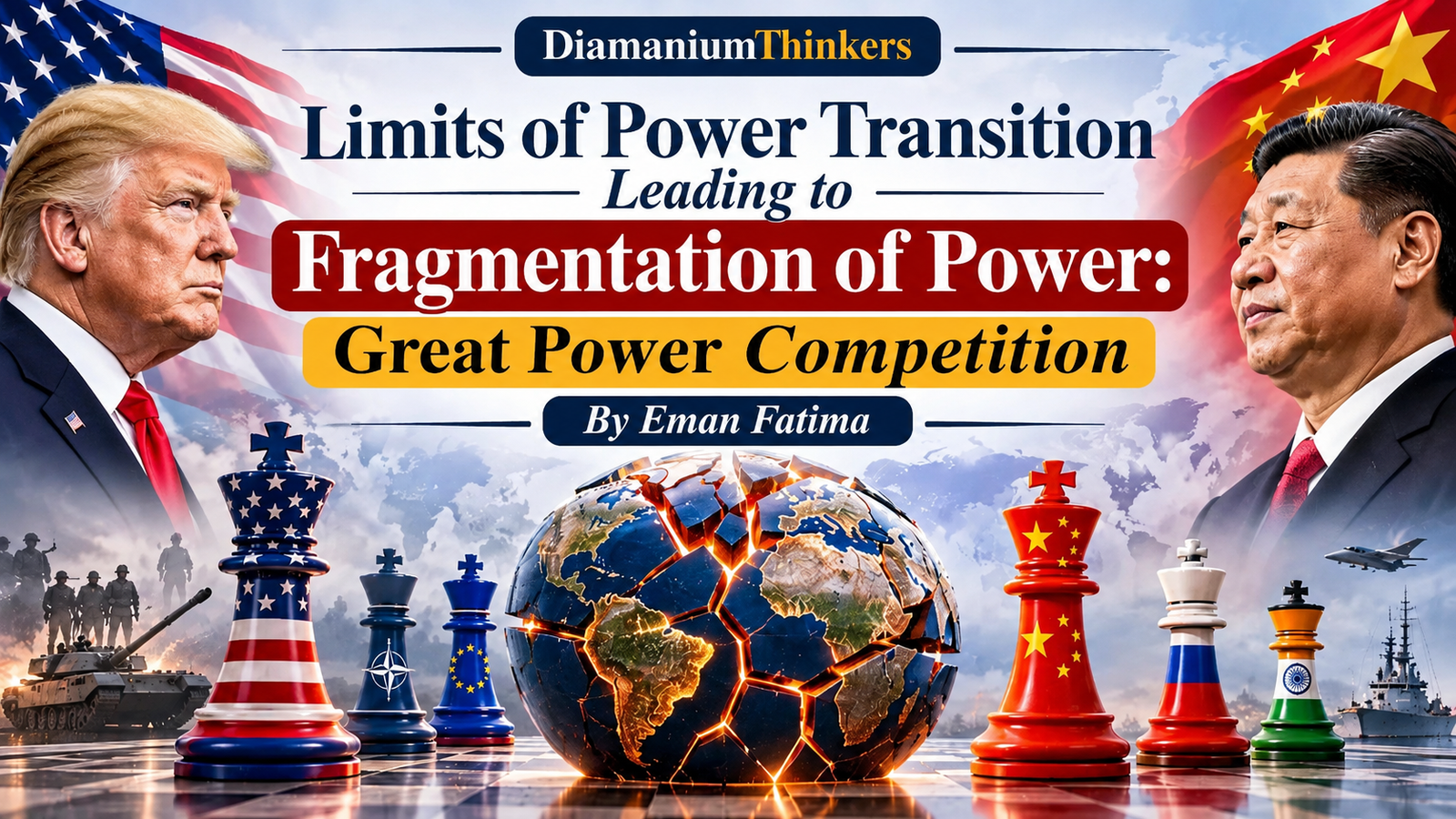
The continuous efforts by great powers to reshape the global order remain contested due to the limits they face on multiple fronts. To avoid the inevitability of war, the development of fragmented power emerges as a safer option for collectively managing global public goods while maintaining multilateralism.
Key Points
- The prominence of great-power competition among the US, China, and Russia raises a fundamental question about power transition and the threat of war, as explained through the Thucydides Trap.
- This transition remains contested due to gaps across economic, technological, and commercial frontiers. The US seeks to maintain its hegemony, China aspires to become a systemic global competitor, while Russia follows the legacy of achieving military dominance through its geographic and strategic spoilers.
- The Kindleberger Trap further highlights the limits of power transition and the emergence of fragmented power within a multipolar world order.
With the contestation of post-Cold War American unipolarity, the prominence of great-power competition raises a fundamental question about power transition. As the international system shifts towards multipolarity or a lopsided bipolarity between China and the United States, the phenomenon of power transition appears to be unfolding. However, the extent to which this transition will occur remains uncertain due to existing gaps across economic, technological, and commercial frontiers.
The limits of power transition can be further explained through the Kindleberger Trap, which highlights the limitations faced by both the hegemon and the rising power. The unfolding nature of great-power competition also reflects the prominence of a triad comprising Russia, the United States, and China. Among them, the US seeks to maintain its hegemony, China aspires to become a systemic global competitor, while Russia possesses geographic and strategic spoilers rooted in its legacy of pursuing military dominance.
The Economic Frontier: Financial Clout and Domestic Capacity
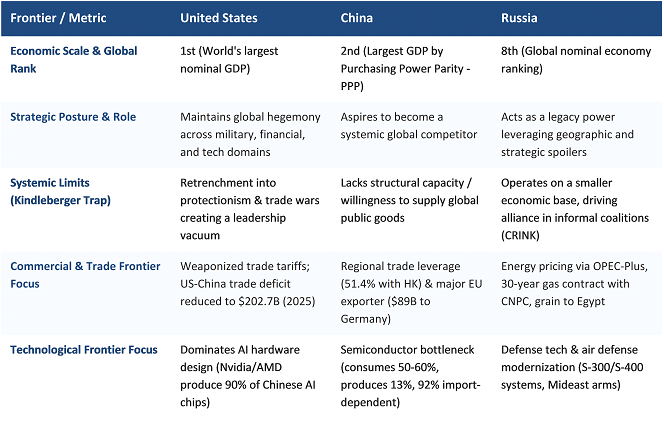
Competition on the economic frontier in the twenty-first century is measured through the scale of financial strength, or nominal power, and domestic economic capacity, reflected in purchasing power. While the United States maintains the world’s largest nominal defence budget of approximately $1.01 trillion, China has become the world’s second-largest economy and surpasses the United States in GDP when adjusted for Purchasing Power Parity (PPP).
The Forbes Global 2000 list indicates China’s continuous rise in the corporate sector. China held the top three positions among the world’s largest public companies in 2014, while splitting the top ten evenly with the United States. It retained the top four positions in 2015, again split the top ten evenly in 2018, and reached its numerical peak with 351 companies in 2022. In 2026, China maintained its competitive position with 340 companies, compared with 593 American companies.
Russia, meanwhile, operates according to a markedly different economic model. It maintains defence spending at approximately 10.5 per cent of its GDP while remaining the world’s eighth-largest economy.
The Commercial Frontier: Interdependence and Weaponized Trade
The commercial and trade frontier has also demonstrated how economic interdependence can become a tool of strategic influence. US-China bilateral trade expanded from $5 billion in 2000 to $231 billion by 2004, eventually peaking at approximately $582 billion in 2018. The US trade deficit with China climbed to $295.4 billion in 2024, while trade tensions and tariff measures contributed to its subsequent decline to $202.7 billion in 2025.
China has also leveraged its domestic market by binding key regional actors through trade interdependence. Hong Kong accounts for 51.4 per cent of the cited trade interdependence with China. China also consumes approximately 31 to 38 per cent of all Middle Eastern oil exports, while Germany remains China’s principal trading partner within the European Union, with exports surging to $89 billion by 2022.
Russia, on the other hand, sends an annual average of 5 to 7 per cent of its goods exports to the Middle East, mainly to Turkey, which stands as its second-largest overall trading partner after China. Egypt has also emerged as one of the largest purchasers of Russian grain.
Russia exercises significant influence over global energy pricing through the OPEC+ framework alongside Saudi Arabia. It has also secured a 30-year Power of Siberia gas pipeline agreement with China’s CNPC through its energy giant Gazprom. In Iraq, Russian companies actively manage oil and gas fields, including Lukoil’s operations at West Qurna-2 and Eridu.
In addition, Russia remains a leading actor in nuclear exports. It operates Bushehr-1 and is constructing Bushehr-2 and Bushehr-3 in Iran, while also developing the El Dabaa nuclear power station in Egypt.
The Technological Frontier: Artificial Intelligence, Semiconductors and Defence Modernization
On the technological frontier, competition centres on supremacy in artificial intelligence, 5G, and high-tech manufacturing. During this period of global technological competition, China faces a critical semiconductor bottleneck. It consumes approximately 50 to 53 per cent of global semiconductor output while producing only 13 per cent of the global supply.
Despite introducing a $150 billion, ten-year semiconductor initiative, China remains heavily dependent on foreign technology. Approximately 90 per cent of Chinese AI hardware uses chips made by US companies Nvidia and AMD, while Taiwan controls 92 per cent of global semiconductor manufacturing.
Russia’s technological expertise, meanwhile, is concentrated in defence modernization. From 2009 to 2018, its arms supplies to the Middle East averaged twelve times those of China. In 2017 alone, 35 per cent of Russian arms sales went to Egypt, 22 per cent to Iraq, and 22 per cent to Syria.
Russia’s S-300 and S-400 anti-aircraft missile defence systems remain among the most important assets of its air-defence capabilities. Turkey’s acquisition of the S-400 created a major rift with NATO, while China’s acquisition of the system was intended to enhance its regional defence capabilities. These developments further intensify the technological and military modernization competition among great powers.
Conclusion
While the Thucydides Trap explains the danger of war arising from the fear experienced by an established hegemon in response to a rising power, the Kindleberger Trap presents the idea of capacity limitations. Historically, these limitations contributed to the crisis of the 1930s, when Britain lacked the capacity to provide global public goods and the United States was unwilling to assume that responsibility.
Similarly, the rise of domestic protectionism in the United States and the emergence of global trade wars have begun creating a leadership vacuum. China, meanwhile, lacks the capacity to take over global systemic leadership. This situation contributes to the fragmentation of power and delays the process of power transition.
The making of a new multipolar world order—or a new form of anarchy—can also be observed through informal coalitions such as the CRINK grouping of China, Russia, Iran, and North Korea. In this evolving environment, ecological interdependencies demand a positive-sum approach that facilitates international cooperation, regional peace, and stability.
Integrating the economic, commercial, and technological expertise of different powers is essential for the collective management of global public goods. Such cooperation can help avoid catastrophic instability in the pursuit of power transition and provide a more sustainable foundation for the emerging international order.
Author’s Bio
Eman Fatima is a student of M.Phil. Strategic Studies at the National Defence University, Islamabad.
References
- International Monetary Fund (IMF). 2026 Data. Access here.
- Forbes. Global 2000 List. Access here.
- Stockholm International Peace Research Institute (SIPRI). “Military Spending: Russia’s Draft Federal Budget 2027–2029.” Read here.
- Encyclopaedia Britannica. “US-China Trade War.” Read here.
- Aurangzeb, Muneeb, et al. “Great Power Rivalry and the Shifting World Order Since 2001: A Realist Study of US-China Competition.” Journal of Political Stability Archive 3, no. 3 (September 2025): 1601–11. https://doi.org/10.63468/jpsa.3.3.107.
- Wasser, Becca, et al. Crossroads of Competition: China, Russia, and the United States in the Middle East. RAND Corporation, 2022. Read here.
- National Bureau of Statistics of China. Official website.