
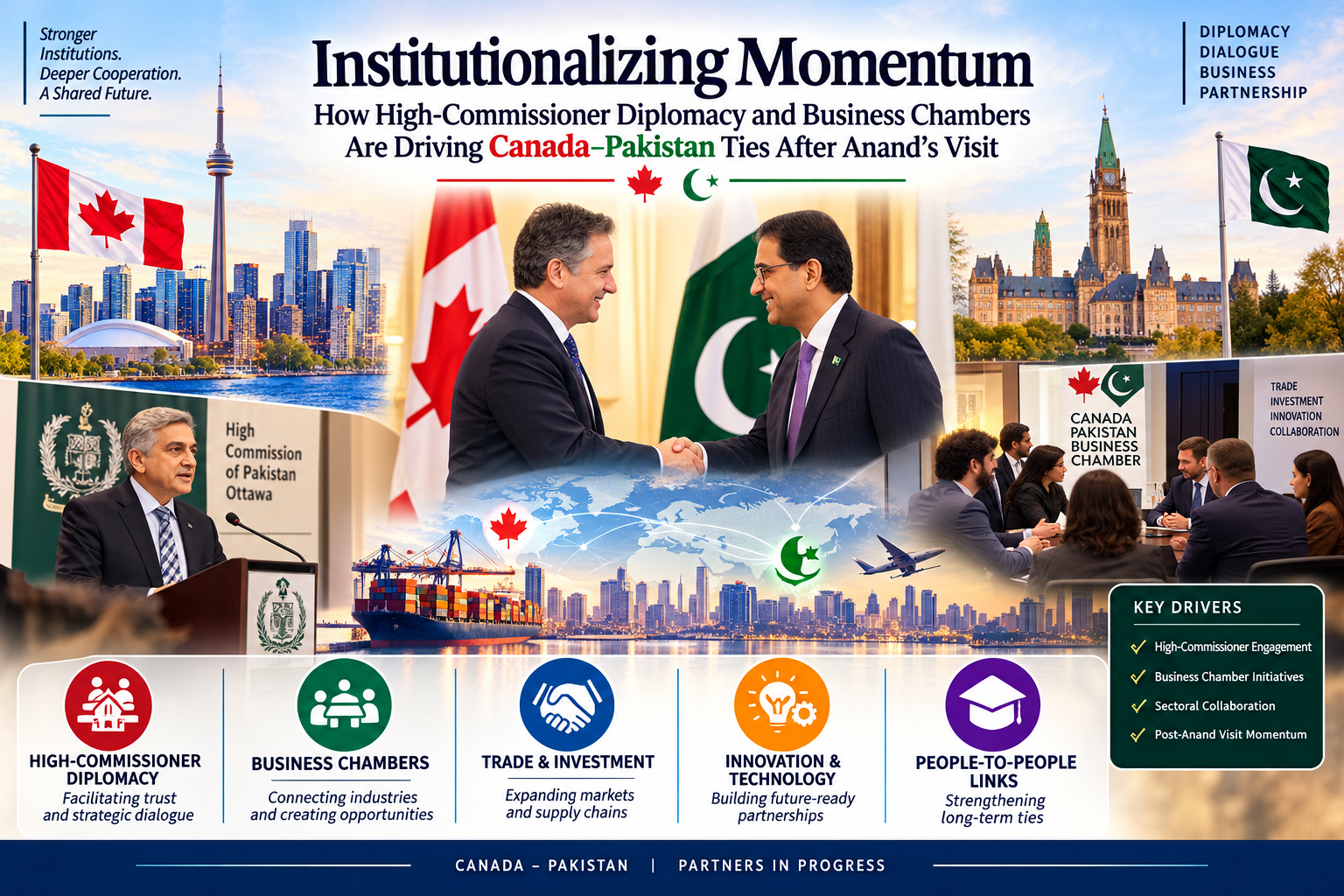
 Anita Anand’s July visit reopened high-level political space between Canada and Pakistan, but the durability of the rapprochement increasingly depends on institutions below ministerial level. High-commission diplomacy, trade officials, chambers of commerce, business councils and revived bilateral mechanisms are now responsible for turning diplomatic momentum into projects, investment and recurring commercial engagement.
Key Points
- Anand’s July 2026 visit created a high-level political mandate for deeper trade, investment, academic and institutional relationships.
- Canada and Pakistan agreed to revive the Joint Working Group on Trade and Investment and maintain regular high-level engagement.
- Canadian High Commissioner Tarik Ali Khan has subsequently pushed FIPA, sectoral investment and business matchmaking at operational level.
- His September visit to the Sialkot Chamber shows diplomacy moving beyond Islamabad toward Pakistan’s export-producing industrial clusters.
- Institutional continuity, rather than episodic VIP visits, will determine whether the current political thaw produces sustained economic gains.
Foreign Minister Anita Anand’s July 20, 2026 visit to Pakistan was important partly because of its rarity. Yet successful economic diplomacy cannot depend on occasional ministerial visits. Its real test is whether diplomatic missions and business organizations create mechanisms capable of continuing once the summit moment passes.
Signs of precisely that transition have emerged. The July joint statement committed the two countries to stronger economic, academic and institutional linkages; welcomed FIPA progress; called for regular engagement toward its early conclusion; and, crucially, agreed to revive the Pakistan–Canada Joint Working Group on Trade and Investment. The parties also agreed to review implementation of their understandings annually. That combination of working-level machinery and political review is what can convert diplomatic goodwill into institutional memory.
| Institutional channel | Recent milestone | Function in the relationship |
| Foreign ministers | Anand visit, July 20 | Political direction and sector prioritization |
| Joint Working Group on Trade & Investment | Revival agreed in July | Continuous government-to-government commercial agenda |
| Canadian High Commission | Active post-visit follow-up | Investment advocacy, business matchmaking, FIPA diplomacy |
| Sialkot Chamber of Commerce | High Commissioner visit, Sept. 1 | Direct engagement with export-oriented firms |
| Commerce Ministry–High Commission | Sept. 15 meeting | FIPA, mining, energy, agriculture, aviation |
| Business councils/chambers | Expanding bilateral interface | Firm-level contacts, delegations and joint ventures |
| Annual bilateral review | Agreed in July | Accountability for implementation |
Sources: Global Affairs Canada, Government of Pakistan and Associated Press of Pakistan.
Canadian High Commissioner Tarik Ali Khan has become a key actor in this institutionalization. On September 1, accompanied by Trade Commissioner Zohaib Khan, he visited the Sialkot Chamber of Commerce and Industry. The significance extends beyond protocol. Sialkot is one of Pakistan’s most internationally connected manufacturing clusters, and engagement there takes bilateral diplomacy directly to firms capable of exporting, entering supply agreements and building partnerships with Canadian distributors and investors.
Only two weeks later, on September 15, the High Commissioner met Commerce Minister Jam Kamal Khan in Islamabad. Their agenda illustrated how broad the emerging commercial relationship has become: FIPA negotiations, renewable energy, mining, agricultural processing, aviation and aerospace all featured. They also discussed matchmaking between Pakistani companies, Canadian investors and buyers in third-country markets, while agreeing to facilitate business delegations and pursue concrete results from forthcoming investment negotiations.
This is an important evolution in Canada–Pakistan diplomacy. Traditional bilateral engagement has often been viewed through security, development assistance, immigration and diaspora issues. The present phase increasingly treats the diplomatic mission as a commercial connector: identifying investible projects, transmitting business concerns to policymakers, organizing delegations and reducing information asymmetries between firms unfamiliar with each other’s markets.
The July meeting had already supplied a sectoral roadmap. Canada and Pakistan highlighted clean energy, mining and critical minerals, infrastructure, agriculture, emerging technologies and sustainability. They also agreed to promote trade and investment delegations.
Agriculture offers another illustration of institution-building. Instead of treating canola trade as a simple buyer-seller transaction, the two governments signed a phytosanitary protocol during Anand’s visit. Such arrangements matter because modern trade is frequently constrained not only by tariffs but by plant-health rules, technical standards, certification and regulatory compatibility. Institutional economic diplomacy therefore increasingly involves regulators and technical agencies alongside foreign ministries and chambers.
The same logic applies to mining. Pakistan is seeking foreign technology, finance, exploration capability and mining services, while Canada possesses globally significant expertise across mining finance, engineering and equipment. Anand invited Deputy Prime Minister Ishaq Dar to attend the Prospectors & Developers Association of Canada convention in 2027, while subsequent discussions anticipated Canadian mining-sector participation in Pakistan. This creates a potential institutional cycle: government diplomacy opens the door, industry forums create contacts, chambers and trade commissioners conduct matchmaking, and the FIPA reduces legal risk surrounding resulting investments.
Business chambers are particularly important because official diplomacy cannot identify every commercially viable counterpart. Their comparative advantage is firm-level information. A chamber can determine whether a Pakistani surgical-instrument exporter needs a Canadian distributor, whether a Canadian agrifood company seeks a Pakistani processing partner, or whether a technology company needs assistance understanding local regulatory requirements. Embassies and ministries can then address government-level obstacles.
This suggests that Canada–Pakistan economic diplomacy should evolve from events toward an institutional pipeline. Chamber meetings should produce sector-specific company lists; company lists should produce B2B sessions; B2B contacts should be tracked for six to twelve months; regulatory problems should be escalated to the Joint Working Group; and high-level annual reviews should examine measurable results rather than merely the number of meetings held.
A practical scorecard might therefore track new joint ventures, investment leads converted into projects, business delegations exchanged, regulatory bottlenecks resolved, value-added exports generated and diaspora entrepreneurs brought into bilateral ventures. Such metrics would give substance to the annual review promised in July.
There is also value in widening diplomacy geographically. Islamabad manages policy, but much of Pakistan’s productive economy is concentrated in Karachi, Lahore, Sialkot, Faisalabad and other industrial centers. Similarly, Canadian engagement should extend beyond Ottawa toward Toronto, Vancouver, Calgary, Montreal and provincial business ecosystems. This is where chamber-to-chamber cooperation can make bilateral relations more resilient than central-government diplomacy alone.
The emerging architecture thus has three levels: political leadership provides direction; high commissions and ministries maintain continuity; and chambers, trade commissioners and firms generate transactions. The closer these layers interact; the less likely bilateral relations are to lose momentum when political attention shifts elsewhere.
Conclusion
Anand’s visit should be understood not as the culmination of Canada–Pakistan rapprochement but as its institutional starting point. The post-visit activity of High Commissioner Tarik Ali Khan, renewed FIPA engagement, direct outreach to Sialkot’s business community, planned sectoral delegations and revival of the Joint Working Group demonstrate a shift from ceremonial diplomacy toward economic implementation. The next requirement is disciplined follow-through: recurring chamber dialogues, tracked B2B outcomes, sector-specific investment pipelines and annual government review. If institutions maintain momentum after personalities and visits change, Canada and Pakistan can transform a politically renewed relationship into a durable geo-economic partnership driven increasingly by firms, investors and commercial networks.
Author Bio
* Dr. Muhammad Jahanzaib holds a PhD in International Relations, is a double gold medalist and author of the book The Interplay of Geo-Politics and Geo-Economics in Pakistan’s Foreign Policy (Post-2008) (Palgrave Macmillan, 2026), along with several esteemed publications. As Chief Visionary Officer of Diamanium Thinkers (a global think tank), he brings over 15 years of experience advising ministries, diplomats, security agencies, the corporate sector, and civil society. His advisory work spans economic diplomacy, political economy, economic intelligence, strategic financial advisory, security, society and the geo-economic world dynamics. He offers a unique blend of practitioner insight and academic rigor, combining hands-on engagement with state institutions and strategic expertise grounded in research. He can be reached at jahanzaibdgc@gmail.com.
References
- Global Affairs Canada, Canada-Pakistan Joint Statement: Strengthening Bilateral and Trade Relations, July 20, 2026.
- Global Affairs Canada, Minister Anand Advances Canada’s Bilateral Relations with Pakistan, July 20, 2026.
- Global Affairs Canada, Canada–Pakistan Relations.
- Government of Pakistan, Press Information Department, Pakistan, Canada Agree to Accelerate Investment Pact and Expand Trade Cooperation, September 15, 2026.
- Associated Press of Pakistan, Canadian High Commissioner Visits SCCI, September 1, 2026.
- Government of Canada, Canada’s International Trade and Investment Agreements.
- Government of Canada, 2021 Model Foreign Investment Promotion and Protection Agreement.