
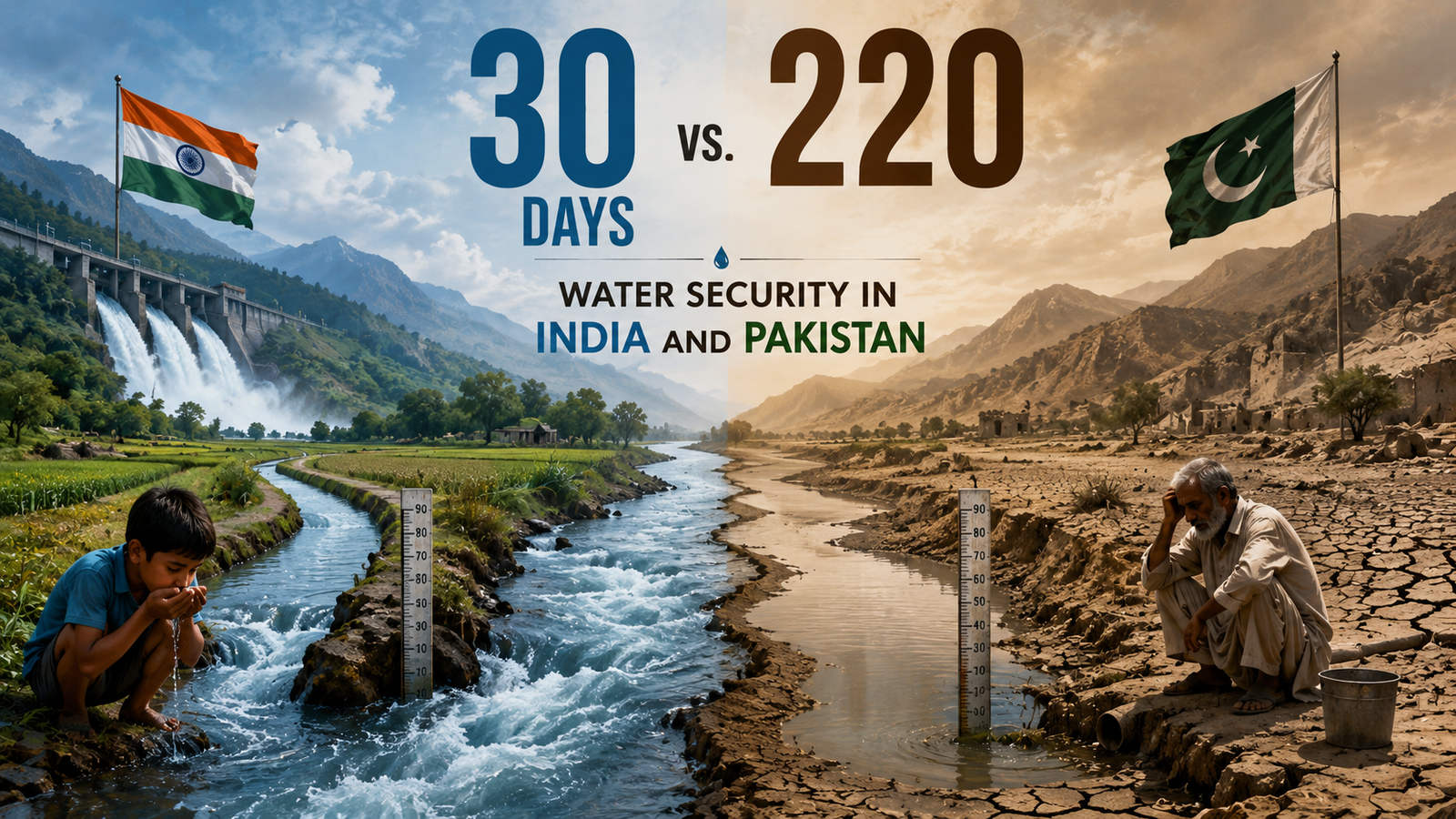
Pakistan and India share the same rivers and monsoons, but Pakistan lacks the water storage capacity coming from India and the treaty that gave it stability has broken down. Fixing what Pakistan can control domestically is the only real leverage now that India is developing upstream unilaterally.
Key Points
- Both, India and Pakistan face the same 2026 monsoon risk, but Pakistan is water-scarce; India isn’t.
- Pakistan can store only 30 days of water vs India’s 220 days.
- The Indus Waters Treaty has been suspended since 2025, and India is now building upstream regardless of its legal status.
India and Pakistan share the same river systems and the same monsoon currents. The Indus River Basin is split between Pakistan (47%) and India (39%). Both countries depend on glacier-fed rivers originating in the Himalayas, Hindu Kush and Karakoram. Pakistan and India both rely on the four-month monsoon, which begins in the month of June and ends in early September, for their annual water supply.
This dependence is asymmetric. Pakistan and its economy depend on the Indus, mostly. The basin sustains around 90% of the country’s food production and 65% of its employment. India has other major river systems, including the Ganges-Brahmaputra basin, to rely on besides the Indus, but Pakistan depends solely on the Indus, leaving it with far less capacity to absorb shocks from water insecurity.
The scale of underlying stress is well documented. The research team from NASA has ranked the Indus basin as the world’s second most over-stressed aquifer. Pakistan’s total water demand is projected to rise from 163 km³ in 2015 to 225 km³ by 2050 (an increase of about 38%). While India’s total water demand is projected to grow even faster: from 710 bcm in 2010 to 1,180 bcm by 2050 (an increase of 66%). Neither country is water-secure on current trends – but they are exposed to that insecurity very differently.
This gap is stark and immediate. Pakistan’s annual water availability has fallen below 1000 m³ per person (it has become “water scarce” not just “stressed”). Whereas India currently stands at 1,545 m³ per person, which is projected to decline to around 1,191 m³ by 2050, which is still above where Pakistan is already today.
The Comparison: Exposure and Response
| Indicator | Pakistan | India |
|---|---|---|
| Share of Indus basin | 47% | 39% |
| Dependence on Indus System | ~90% of food production, ~65% of employment | Diversified across multiple river basins |
| 2026 monsoon outlook | Below-normal rainfall expected nationally (-17%) | Below-average rainfall expected for August (below 94% of LPA) |
| Water Storage Capacity | 30 days (vs. 120-day intl. benchmark) | 220 days |
| Legal/Treaty leverage | Pursued arbitration (PCA), won partial rulings | Rejects the Court of Arbitration’s jurisdiction |
Why It Matters More Now
The Indus Water Treaty (1960) governed both countries’ water-sharing for over 60 years. It has survived many early conflicts and skirmishes. It does not survive in the present moment. In April 2025, following the Pahalgam attack, India places the IWT “in abeyance”. In May 2025, four days of military confrontation, which ended with a US-negotiated ceasefire. India reportedly conducts reservoir flushing along the Indus.
In June 2025 and May 2026, the Court of Arbitration rules twice against India’s position. First, on the legality of unilateral abeyance, and second, on the reservoir storage limits. India rejects both rulings, calling it “illegal”. Since 2024, no Permanent Indus Commission meetings and diplomatic talks have been scheduled.
India has moved from legal standoff to physical action. In June 2026, Pakistan’s Deputy PM said at least 17 Indians projects on the Indus system amount to “hydro-hegemony”. India’s Water Minister has said the goal is to ensure “not a single drop” reaches Pakistan, while Pakistan has clearly said that any disruption in the flow of water coming to Pakistan will be considered an act of war. New projects like the Dulhasti Stage II dam and the Chenab-Beas Link Tunnel, which Pakistan says illegally diverts water, show that this is happening regardless.
Policy Recommendations
Keep building the legal record at the Court of Arbitration. Pakistan should keep submitting applications for each new upstream project (Dulhasti-II, the Chenab–Beas Link Tunnel, Salal flushing) separately, not simply collectively, even if India rejects its rulings. In the interim, Pakistan’s case in parallel international venues (UN, ICJ) is strengthened by a documented, project-by-project record of favorable verdicts, such as the 2026 pondage award, which develops the evidentiary base Pakistan will require if a future Indian administration re-engages.
Include dual-mode seasonal planning in the calendar for disaster management and agriculture. According to PMD’s 2026 forecast, flood and GLOF danger in the north would coincide with below-average rainfall and drought risk in Sindh, Balochistan, and Punjab. Instead of issuing distinct, sequential responses, the National Disaster Management Authority and provincial agriculture departments should release a single integrated seasonal alert that addresses flood readiness for the north and irrigation contingency for the south at the same time.
As a technical resource for arbitration and planning, IRSA or the Ministry of Water Resources should keep an up-to-date, public inventory of the 17+ Indian projects, including location, capacity, status and downstream impact. Simultaneously, WAPDA ought to release quarterly updates on Diamer-Bhasha, Mohmand, and Dasu, all of which are running behind schedule (Diamer-Bhasha is at less than 20% physical progress).
Revisit Kalabagh Dam through a federal-provincial mediation process. It could increase storage capacity, but previous attempts have failed since Sindh and KP’s objections were never formally addressed. Reviving it requires a CCI-led (Council of Common Interests) technical evaluation that especially addresses downstream impact on Sindh and water-sharing assurances.
* Tayyaba Naseer is a graduate from Government College University, Lahore. She has completed BS in International Relations, with the thesis focusing on Pakistan’s shift from geo-strategy to geo-economics. Currently, she is an intern at Diamanium Thinkers (A Global Think Tank). She choose to write about the most significant human emotions and the world we live in. She is passionate about unearthing the hidden conspiracies that shape our world and how each of us is interlinked in this intricate web.
References
- NASA on Indus basin: Study of big groundwater basins in distress
- Pakistan’s water demands: Making Every Drop Count Scarcity Challenge
- India’s water demands: ADR India Water Facts
- Hydro-diplomacy: Food production and employment support
- PMD: Monsoon report of Pakistan 2026 Outlook
- Dawn News: India braces for below-average August monsoon
- Dawn News: 120-day international benchmark for water
- Britannica: Indus Waters Treaty Legal / Treaty leverage
- Reuters: Indian reservoir flushing and project suspension
- Dawn News: Analysis of 17 Indian projects on Indus system
- Express Tribune: Dulhasti II and Chenab River Hydro-politics