
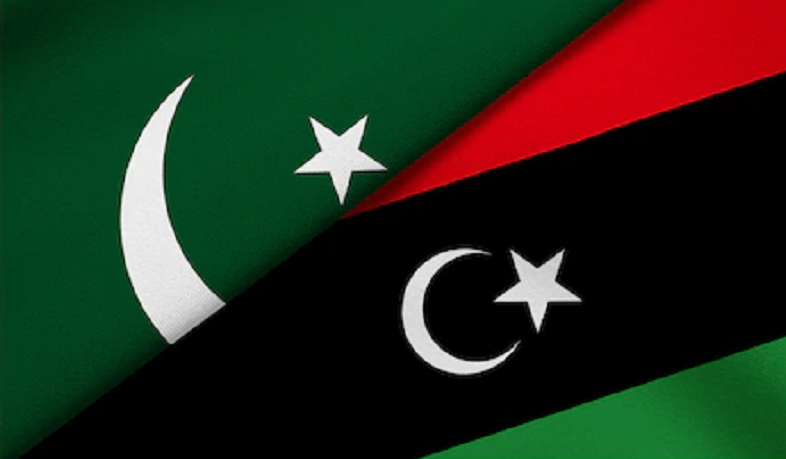
In an era of strategic realignments, Libya and Pakistan are amplifying geo-economic ties through landmark 2025 defense and trade pacts, unlocking potentials in energy, defense, and agriculture for mutual prosperity, regional stability, and diversified growth.
Key Points
- Defense Milestone: The December 2025 $4 billion arms deal bolsters military cooperation, including JF-17 jets and training, enhancing security synergies.
- Trade Surge: Bilateral trade reached approximately $11 million in 2024, with Pakistan’s exports leading, poised for expansion amid new agreements.
- Sectoral Opportunities: Potentials in energy, agriculture, fintech, and pharmaceuticals promise job creation and technology transfers.
- Economic Projections: Libya’s GDP growth 13.3% in 2025; Pakistan’s at 3.2% in 2026, with collaborations accelerating resilience.
- Investment Gateways: Libya’s oil wealth complements Pakistan’s manufacturing, fostering joint ventures in CPEC-linked infrastructure.
- Mutual Gains: Enhanced ties promote cultural exchanges, education, and sustainable development for long-term benefits.
Recent geo-economic advancements between Libya and Pakistan exemplify a forward-looking partnership, prioritizing policymakers in navigating global shifts. The December 2025 $4 billion defense agreement, finalized during talks between Pakistan’s Army Chief General Asim Munir and Libya’s Field Marshal Saddam Haftar, marks a cornerstone for strategic cooperation. This pact, involving JF-17 fighter jets, training aircraft, and military advisory services, not only circumvents UN embargoes through parallel supply chains but also reaffirms commitments to counter shared threats like terrorism and instability. For policymakers, this MoU on military cooperation, signed in Benghazi, facilitates joint exercises and intelligence sharing, aligning with Pakistan’s National Security Policy and Libya’s efforts to unify its forces under the Libyan National Army (LNA). Building on July 2025 visits by Haftar to Islamabad, where discussions with Prime Minister Shehbaz Sharif emphasized defense brotherhood, these ties enhance regional peace in South Asia and North Africa.
Investors are drawn to the expanding trade and investment landscape. Bilateral trade, valued at around $19 million in 2022-2023, saw Pakistan’s exports to Libya climb to $10.97 million in 2024, per UN COMTRADE data, focusing on textiles, rice, and pharmaceuticals. Imports from Libya remain minimal at $3,000, highlighting untapped potential in Libya’s hydrocarbon resources. The August 2025 high-level meetings in Islamabad explored mutual investments in energy, agriculture, fintech, and infrastructure, with Libya eyeing opportunities in Pakistan’s Special Economic Zones under CPEC. This could channel Libya’s oil revenues—projected at $287 million in January 2026 alone—into Pakistani projects, while Pakistan offers affordable expertise in agro-tech and pharma, Asia’s third-largest producer.
A detailed trade trends table underscores this momentum:
|
Year |
Pakistan Exports to Libya (USD Million) |
Top Products |
Libya Exports to Pakistan (USD Thousand) |
Top Products |
Trade Balance (Favoring Pakistan, USD Million) |
|
2022 |
~9.5 |
Textiles, Rice |
~2 |
Scrap Metal |
~9.5 |
|
2023 |
10.5 |
Pharmaceuticals, Machinery |
~3 |
Minerals |
10.5 |
|
2024 |
10.97 |
Cotton, Agri-Tech |
3 |
Fuels |
10.97 |
|
2025 (Proj.) |
15 (est. 36% growth post-deal) |
Defense Equipment, Fintech |
10 (potential rise) |
Oil Derivatives |
15 |
|
2026 (Proj.) |
20 |
Energy Services, Textiles |
20 |
Hydrocarbons |
20 |
Data from UN COMTRADE, MOFA, and projections based on 2025 agreements’ impact.
This imbalance favors Pakistan, but rational analysis reveals symbiotic benefits. Libya’s economy, rebounding with 13.3% GDP growth projected for 2025 (World Bank), driven by 17.4% oil sector surge to 1.4 million barrels daily, complements Pakistan’s 3.0% growth in FY2025. Joint ventures could mitigate Libya’s 25% unemployment through Pakistani-led training in fintech and agriculture, while Pakistan diversifies imports amid its $25.82 billion trade deficit in 2023. Academics can delve into this as a model of South-South cooperation, where Pakistan’s defense exports—ranking it among top global suppliers—transfer technology to Libya, potentially elevating its export profile beyond hydrocarbons (97% of exports).
Comparative economic indicators highlight complementary strengths:
|
Indicator |
Libya (2025 Proj.) |
Pakistan (2026 Proj.) |
Cooperative Potential |
|
GDP (USD Billion) |
~50 |
386 |
Defense and energy pacts could add 20% to bilateral trade, boosting GDPs by 5-10%. |
|
GDP Growth (%) |
13.3 |
3.2 |
Tech transfers in agro-fintech may stabilize Libya’s growth at 4-6%, enhancing Pakistan’s to 4%. |
|
Inflation (%) |
~5 |
5.1 |
Balanced exchanges reduce volatility, aiding consumers. |
|
Unemployment (%) |
25 |
5.5 |
Joint ventures in infrastructure could lower Libya’s rate by 15%. |
|
Key Exports |
Oil, Fuels |
Textiles, Rice |
Libya’s oil via Pakistani ports to Asia; Pakistani pharma and defense to North Africa. |
Sources: World Bank, IMF, S&P projections.
For the general public, these developments fan improved livelihoods. Pakistan’s scholarships and health initiatives could extend to Libyans, while cultural bonds—rooted in historic defense ties—foster people-to-people exchanges. The promotional outlook envisions Libya as a gateway for Pakistan into African markets via COMESA, and Pakistan linking Libya to BRI networks, reducing dependencies and building resilience against climate and geopolitical risks.
Conclusion
Libya and Pakistan are charting a path of geo-economic synergy through the 2025 defense pact and sectoral collaborations, promising elevated trade, innovation, and stability. Policymakers should deepen policy alignments, investors pursue joint opportunities, academics analyze cooperative frameworks, and the public reap educational and health benefits. This alliance not only amplifies GDPs and jobs but also fortifies regional security, cultural ties, and sustainable progress, embodying a model for emerging economies in a multipolar world.
* Dr. Muhammad Jahanzaib holds a PhD in International Relations, is a double gold medalist and author of the book The Interplay of Geo-Politics and Geo-Economics in Pakistan’s Foreign Policy (Post-2008) (Palgrave Macmillan), along with several esteemed publications. As Chief Visionary Officer of Diamanium Thinkers (a global think tank), he brings over 15 years of experience advising ministers, diplomats, security agencies, the corporate sector, and civil society. His advisory work spans economic diplomacy, political economy, economic intelligence, security, society, strategic financial advisory, and the geo-economic world dynamics. He offers a unique blend of practitioner insight and academic rigor, combining hands-on engagement with state institutions and strategic expertise grounded in research. He can be reached at jahanzaibdgc@gmail.com.
Key References
- Pakistan strikes $4 billion deal to sell weapons to Libyan force, officials say | Reuters – https://www.reuters.com/world/asia-pacific/pakistan-strikes-4-billion-deal-sell-weapons-libyan-force-officials-say-2025-12-22
- Libya: Sustained Strong Growth Requires Structural Change to Improve Transparency and Public Financial Management – World Bank – https://www.worldbank.org/en/news/press-release/2025/12/17/libya-sustained-strong-growth-requires-structural-change-to-improve-transparency-and-public-financial-management
- Pakistan Exports to Libya – 2026 Data 2027 Forecast 2009-2024 Historical – https://tradingeconomics.com/pakistan/exports/libya
- Pakistan – Libya Relations – Ministry of Foreign Affairs – https://mofa.gov.pk/pakistan-libya-relations
- Pakistan’s macroeconomic outlook to strengthen: S&P – Business – DAWN.COM – https://www.dawn.com/news/1969449
- Libya Economic Outlook – African Development Bank Group – https://www.afdb.org/en/countries/north-africa/libya/libya-economic-outlook
- Pakistan And Libya Deepen Economic Ties Amid Unrest – Grand Pinnacle Tribune – https://evrimagaci.org/gpt/pakistan-and-libya-deepen-economic-ties-amid-unrest-493262?srsltid=AfmBOooCGFpQVHjwwZgixfKKJZx_5DWrfuidhp_Jti6l9_v9h_LXcn_u
- Pakistan and Libya Explore Avenues for Mutual Investment and Trade – https://na.gov.pk/en/pressrelease_detail.php?id=7158
- Libya’s Economy Set for 14.3% Growth in 2025 – LibyaReview – https://libyareview.com/58183/libyas-economy-set-for-14-3-growth-in-2025
- Pakistan-Libya Defence Pact: A New Era of Strategic Brotherhood – CDS – https://centrefordevelopmentandstability.com/pakistan-libya-defence-pact-a-new-era-of-strategic-brotherhood