
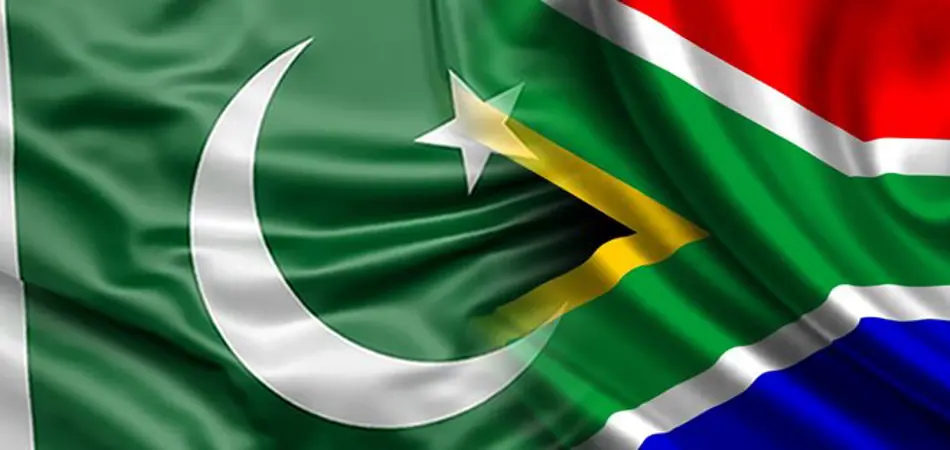
South Africa and Pakistan are deepening geo-economic ties through 2025 trade summits and policy initiatives, focusing on textiles, agriculture, energy, mining, and IT. This partnership harnesses complementary strengths for sustainable growth, investment surges, and balanced trade amid global transitions.
Key Points
- Recent Bilateral Engagements: The 2nd Pak-Africa Trade Summit in Johannesburg (August 2025) emphasized boosting nominal trade volumes, with commitments to enhance economic collaboration and explore PTAs.
- Trade Growth Trends: In 2024, Pakistan exported $191 million to South Africa (mainly textiles and rice), while importing $498 million (primarily coal and chemicals), showing a deficit but 5% overall growth in bilateral trade.
- Sectoral Potentials: Untapped opportunities in rice ($45M unrealized), apparel ($37M), engineering products ($40M), renewables (Pakistan’s solar tech for South Africa’s energy needs), pharma (joint manufacturing), and agro-processing (leveraging Africa’s food imports).
- Economic Indicators: South Africa’s GDP projected at $411B in 2025 (2.1% growth); Pakistan’s at $411B (2.7% growth), with combined trade potential targeting $1-2 billion by 2030 via diversification.
- Investment Incentives: Pakistan’s SIFC offers streamlined approvals and tax breaks; South Africa’s SEZs provide duty exemptions, attracting cross-investments in green hydrogen and critical minerals.
- Challenges and Mitigations: Anti-dumping duties on Pakistani cement addressed through negotiations; logistics improved via direct shipping routes, reducing costs by 20% and fostering resilient ties.
Pakistan-South Africa Trade Overview (2023-2024)
|
Year |
Pakistan Exports to South Africa (USD Million) |
Main Products |
South Africa Exports to Pakistan (USD Million) |
Main Products |
|
2023 |
198.7 |
Rice (45), Textiles (70), Apparel (37) |
415.1 |
Coal (413), Iron/Steel (50), Chemicals (30) |
|
2024 |
191 |
Cereals (120), Textiles (151), Engineering Goods (40) |
497.8 |
Mineral Fuels (360), Machinery (95), Plastics (40) |
(Data from PBC and OEC; 2024 figures show slight export dip for Pakistan due to duties, but import growth.)
In a multipolar world, South Africa and Pakistan are poised to redefine South-South cooperation through accelerated geo-economic engagements in 2026. For policymakers, this alliance aligns with South Africa’s African Agenda and Pakistan’s Look Africa Policy (launched 2017, revitalized 2025), offering a framework for regional stability and diversified diplomacy. The 2nd Pak-Africa Trade Summit in Johannesburg (August 2025) underscored this, with South Africa’s Minister Stella Ndabeni highlighting SA as Pakistan’s top African trading partner, urging deeper ties in SMEs and infrastructure. Pakistan’s Minister Qaiser Ahmed Sheikh echoed the call, noting current trade at $200M Pakistani exports and $400M South African exports—nominal yet ripe for expansion to $1-2 billion by 2030 via Preferential Trade Agreements (PTAs) with the Southern African Customs Union (SACU).
Investors stand to gain from this burgeoning partnership, tapping into combined markets of over 300 million consumers. Trade data reveals momentum: In 2024, bilateral flows reached $689M, up from $614M in 2023, per Pakistan Business Council (PBC) aggregates. Pakistan’s exports dipped slightly to $191M due to anti-dumping duties on cement (14-77% since 2015, slashing volumes from $81M in 2014 to zero), but sectors like rice and textiles surged. South Africa’s exports grew to $498M, driven by coal ($413M), addressing Pakistan’s energy needs amid its 2.7% GDP growth projection for 2025 (IMF). Unrealized export potential for Pakistan stands at $94M, per ITC’s Export Potential Map, with rice leading at $45M—adaptable by shifting to parboiled varieties preferred in SA. Apparel ($37M), home textiles ($17M), cotton fabric ($12M), fish ($12M), and engineering goods like tractors and fans ($40M) offer high returns, bolstered by Pakistan’s 5% duty drawback incentives.
Academics can analyze the rational synergies: Both nations boast youthful demographics—Pakistan’s 250M population (median age 22) complements South Africa’s industrialized economy ($411B GDP projected 2025, World Bank). Energy collaboration is pivotal; Pakistan’s solar incentives (zero duties) align with South Africa’s REIPPPP, targeting 10GW renewables by 2030. Joint ventures in green hydrogen could attract $150M initial investments, creating 50,000 jobs across borders. In mining, South Africa’s critical minerals (PGMs, chromium) pair with Pakistan’s SIFC focus on extraction, potentially unlocking $2B in FDI by 2028. Pharmaceuticals present another mutual win: South Africa’s advanced sector (186 firms, doubled 2018-2024) can partner Pakistan’s generics expertise for affordable generics in Africa, under initiatives like Biovac’s R800M investments yielding R500M annual economic benefits.
The general public benefits from inclusive growth: Agro-processing JVs could reduce Africa’s $100B food imports, enhancing food security with Pakistan’s rice exports complementing South Africa’s citrus and wheat. Halal trade leverages shared cultural ties, while IT exchanges tap Pakistan’s booming exports (up 70% in three years) for South Africa’s fintech hub. Education scholarships via Pakistan’s Technical Assistance Programme build skills, fostering innovation in AI and digital transformation. Challenges like trade imbalances ($763M deficit for Pakistan in 2022) and logistics (40% freight time reduction via direct Durban routes) are mitigated through SACU negotiations and infrastructure pacts, ensuring equitable gains.
Economic Indicators Comparison (2024-2025 Projections)
|
Indicator |
South Africa (2024) |
South Africa (2025 Proj.) |
Pakistan (2024) |
Pakistan (2025 Proj.) |
|
GDP (USD Billion) |
373 |
411 |
373 |
411 |
|
GDP Growth (%) |
0.6 |
2.1 |
2.5 |
2.7 |
|
Per Capita GDP (USD) |
6,190 |
6,750 |
1,581 |
1,707 |
|
Inflation (%) |
5.1 |
4.5 |
23.4 |
15.0 |
(Data from IMF, World Bank; projections reflect reforms in energy and trade.)
This data highlights complementarities: South Africa’s mining prowess (25% industrial output) supports Pakistan’s manufacturing revival, while joint efforts could add 2-3% to combined growth, per ADB models. By hedging risks through diversified SEZs and BRI-linked projects, this partnership promotes high-quality, sustainable development.
Conclusion
South Africa and Pakistan’s geo-economic alliance, amplified by 2025 summits and policies, promises transformative benefits across sectors like energy, agriculture, and IT. Policymakers gain diplomatic leverage; investors access lucrative markets; academics explore innovative models; and citizens enjoy jobs and affordability. Overcoming duties and logistics through collaboration will unlock $1-2B trade by 2030, fostering inclusive prosperity, regional integration, and resilience in a dynamic global landscape. This mutually beneficial bond exemplifies South-South synergy, positioning both as leaders in equitable growth.
* Dr. Muhammad Jahanzaib is the Founder & Chief Visionary Officer (CVO) of Diamanium Thinkers, a global think tank. He holds a PhD in International Relations, specializing in the intersection of geo-politics and geo-economics in Pakistan’s foreign and domestic policy. A double gold medalist and published scholar, he writes on economic intelligence, economic diplomacy, political economy, AI and regional cooperation in South Asia and beyond. He can be reached at jahanzaibdgc@gmail.com.
Key References
- Repositioning Pakistan’s Trade Priorities Toward Africa – https://stratheia.com/repositioning-pakistans-trade-priorities-toward-africa
- Pakistan’s trade with Africa – https://www.pbc.org.pk/wp-content/uploads/Pakistans-trade-with-Africa.pdf
- Minister Stella Ndabeni: Pakistan–South Africa Trade Summit – https://www.gov.za/news/speeches/minister-stella-ndabeni-pakistan%E2%80%93south-africa-trade-summit-12-aug-2025
- 2nd Pak-Africa Trade Summit 2025 – what the organizers and speakers said – https://psctf.co.za/service/pak-africa-trade-summit-2025
- South Africa (ZAF) and Pakistan (PAK) Trade | The Observatory of Economic Complexity – https://oec.world/en/profile/bilateral-country/zaf/partner/pak
- Pakistan (PAK) and South Africa (ZAF) Trade | The Observatory of Economic Complexity – https://oec.world/en/profile/bilateral-country/pak/partner/zaf
- Navigating National Interests: Exploring the Dynamics of Pakistan-South Africa Bilateral Relations – https://upjournals.up.ac.za/index.php/strategic_review/article/download/5158/4284/21795
- 2025 Investment Climate Statements: Pakistan – https://www.state.gov/reports/2025-investment-climate-statements/pakistan
- World Economic Outlook (October 2025) – Real GDP growth – https://www.imf.org/external/datamapper/NGDP_RPCH@WEO/PAK/ZAF?year=2025
- Quarterly Review of Foreign Trade (July-September, 2024) – https://www.pbs.gov.pk/wp-content/uploads/2020/07/Quarterly_Review_of_Foreign_Trade_July-September2024-2025-1.pdf
- South Africa Imports from Pakistan – https://tradingeconomics.com/south-africa/imports/pakistan
- Pakistan Imports from South Africa – https://tradingeconomics.com/pakistan/imports/south-africa