
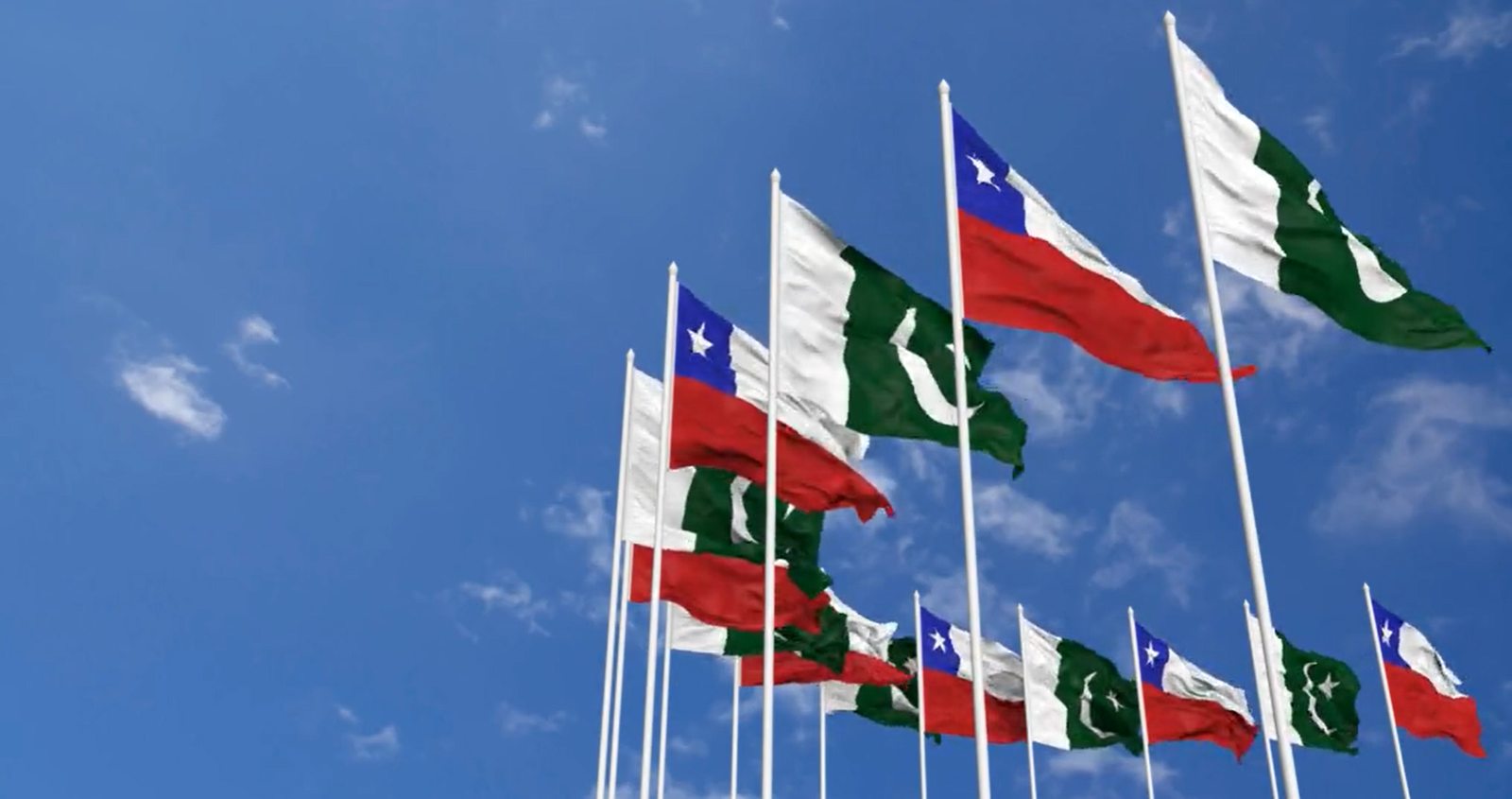
In a globalized era, Chile and Pakistan are strengthening geo-economic ties via diplomatic visits and trade expansion, harnessing potentials in mining, agriculture, and energy for mutual innovation, sustainable growth, and resilience amid international shifts.
Key Points
- Diplomatic Momentum: The June 2025 visit by Pakistan’s Ambassador to Chile fostered discussions on trade enhancement, investment, visa facilitation, and IT cooperation, building on 75 years of relations.
- Trade Expansion: Bilateral trade totaled $98.83M in 2024, with Pakistan exporting $80.1M (textiles, surgical instruments) to Chile, up 12% annually; Chile’s $18.73M exports (copper, fruits) grew 8%, per UN COMTRADE.
- Investment Avenues: Chile’s world-leading mining expertise aligns with Pakistan’s untapped critical minerals; opportunities in agro-tech transfers and renewable energy projects promise FDI inflows.
- Sectoral Potentials: Collaboration in green hydrogen, agriculture modernization, and energy could address climate vulnerabilities, leveraging Chile’s renewable prowess and Pakistan’s labor resources.
- Economic Resilience: Chile’s projected 2.0% GDP growth in 2026 and Pakistan’s 3.0% in FY26, with moderating inflation, underpin stable frameworks for South-South partnerships.
In an interconnected world, the geo-economic relationship between Chile and Pakistan exemplifies South-South cooperation, offering pathways to shared prosperity. Policymakers can leverage frameworks like the 2020 UN co-hosted poverty event to prioritize joint commissions on trade and technology. Investors find promising sectors where Chile’s resource management complements Pakistan’s emerging markets, while academics can study models of sustainable development blending Latin American innovation with South Asian resilience. The general public benefits from job opportunities, affordable goods, and environmental gains, promoting this alliance as a beacon of mutual advancement.
Recent engagements highlight commitment. In June 2025, Pakistan’s Ambassador Hassan Afzal Khan visited Chile, holding productive meetings with key stakeholders, including Jose Miguel Gonzalez (Minister Counsellor, Asia-Pacific Affairs), Pablo Urria (Head, Asia-Oceania Department), and others from Chile’s Foreign Ministry and InvestChile. Discussions centered on boosting bilateral trade and investment, resolving visa issues, enhancing service delivery, and fostering IT sector cooperation. Meetings with Chambers of Commerce in Iquique Free Trade Zone and Governor Jose Miguel Carvajal emphasized business linkages. Consular services were provided to the Pakistani community, strengthening people-to-people ties. This visit builds on historical relations, with neither country having resident ambassadors but maintaining concurrent accreditations—Pakistan from Buenos Aires, Chile from Islamabad.
Economically, both nations exhibit recovery. Chile’s GDP grew 2.5% in 2025, projected at 2.0% for 2026 per IMF, driven by mining and exports amid easing inflation (3.1% in 2026). Domestic demand rose, with investment in machinery and private consumption supported by wage growth. Pakistan’s GDP expanded 3.0% in FY2025-26, per World Bank, bolstered by industrial rebound (4.77%) and services (2.91%), with inflation moderating to 5-6% in FY2026. Remittances and reforms enhance stability, though floods pose risks. These indicators provide a foundation for rational cooperation, where Chile’s high economic complexity (1.2) can elevate Pakistan’s (-0.55) through knowledge sharing.
Bilateral trade, while modest, shows dynamism. In 2024, Pakistan exported $80.1M to Chile, primarily textiles ($40M), surgical instruments ($20M), and apparel ($10M), growing 12% annually. Chile exported $18.73M to Pakistan, led by copper ($8M), fruits ($5M), and wood products ($3M), up 8%. By October 2025, monthly figures indicated Pakistan’s exports at $2.4M and imports at $1.99M, yielding a $410k surplus for Pakistan. Trends suggest diversification: Pakistan’s textiles meet Chile’s demand, while Chile’s commodities support Pakistan’s industries. Under MERCOSUR frameworks (Pakistan ratified in 2024), tariff reductions could amplify volumes, potentially doubling trade via streamlined logistics.
|
Bilateral Trade Overview (2024-2025) |
Chile to Pakistan |
Pakistan to Chile |
|
Total Value (2024) |
$18.73M |
$80.1M |
|
Annual Growth Rate (2023-2024) |
8% |
12% |
|
Key Products |
Copper, Fruits, Wood |
Textiles, Surgical Instruments, Apparel |
|
Monthly Value (Oct 2025) |
$1.99M |
$2.4M |
Investments hold untapped promise. Chile, producing one-third of global copper, offers expertise in sustainable mining—renewables power 50% of its sector. Pakistan’s vast deposits (copper in Reko Diq, etc) could benefit from joint ventures, attracting FDI via SIFC. Agriculture synergies: Chile’s advanced tech could modernize Pakistan’s sector, reducing import dependency ($5B annually in edibles). Energy cooperation in green hydrogen (Chile’s $2.8B tax credits) and renewables aligns with Pakistan’s transition goals, mitigating shortages and climate risks—both nations rank high in vulnerability.
Potentials extend to emerging areas. BRICS aspirations (Pakistan applied 2026) could facilitate market access, with Chile’s observer interest fostering AI and industrialization ties. Analysis indicates balancing geopolitics—Chile’s US/China links complement Pakistan’s multi-alignment—could counter supply chain disruptions. For the public, benefits include Chilean fruits affordability and Pakistani textiles jobs, enhancing cultural exchanges.
Challenges like distances and imbalances require digital platforms and agreements, but optimism prevails: revitalized dialogues can drive inclusive growth, positioning both as Global South innovators.
|
Economic Indicators Comparison (2025-2026 Projections) |
Chile |
Pakistan |
|
GDP Growth (2025) |
2.5% |
3.0% (FY26) |
|
GDP Growth (2026) |
2.0% |
3.4% |
|
Inflation (Jan 2026) |
3.1% |
5.8% |
|
Key Sectors for Cooperation |
Mining, Renewables |
Agriculture, IT |
|
Trade Balance (Recent) |
Surplus |
Managed Surplus |
Conclusion
Chile and Pakistan’s geo-economic partnership, invigorated by the 2025 ambassadorial visit and trade momentum, unlocks potentials in mining, agriculture, and energy. Policymakers can craft frameworks for sustainable alliances; investors pursue ventures in critical minerals and green tech; academics examine innovative models; and the public gains from employment, affordability, and exchanges. This collaboration not only amplifies bilateral growth but also fortifies Global South resilience against uncertainties, charting a path for enduring prosperity through committed synergy.
* Dr. Muhammad Jahanzaib is the Founder & Chief Visionary Officer (CVO) of Diamanium Thinkers, a global think tank. He holds a PhD in International Relations, specializing in the intersection of geo-politics and geo-economics in Pakistan’s foreign and domestic policy. A double gold medalist and published scholar, he writes on economic intelligence, economic diplomacy, political economy, AI and regional cooperation in South Asia and beyond. He can be reached at jahanzaibdgc@gmail.com.
Key References
- “Chile (CHL) and Pakistan (PAK) Trade” – https://oec.world/en/profile/bilateral-country/chl/partner/pak
- “Pakistan (PAK) and Chile (CHL) Trade” – https://oec.world/en/profile/bilateral-country/pak/partner/chl
- “Chile Exports to Pakistan” – https://tradingeconomics.com/chile/exports/pakistan
- “Pakistan Exports to Chile” – https://tradingeconomics.com/pakistan/exports/chile
- “Ambassador Hassan Afzal Khan visited the Republic of Chile” – MoFA
- “Chile–Pakistan relations” – https://en.wikipedia.org/wiki/Chile%E2%80%93Pakistan_relations
- “Chile and the IMF” – https://www.imf.org/en/countries/chl
- “PAKISTAN: Sustained Reforms Needed for Inclusive Growth, Economic Stability and Flood Recovery” – https://www.worldbank.org/en/news/press-release/2025/10/27/-pakistan-sustained-reforms-needed-for-inclusive-growth-economic-stability-and-flood-recovery
- “Transforming Pakistan’s minerals into strategic economic growth” – https://www.app.com.pk/national/transforming-pakistans-minerals-into-strategic-economic-growth
- “Latin America: An Untapped Market for Pakistan” – https://www.issra.pk/insight/2025/Latin-America-An-Untapped-Market-for-Pakistan/insight.html