
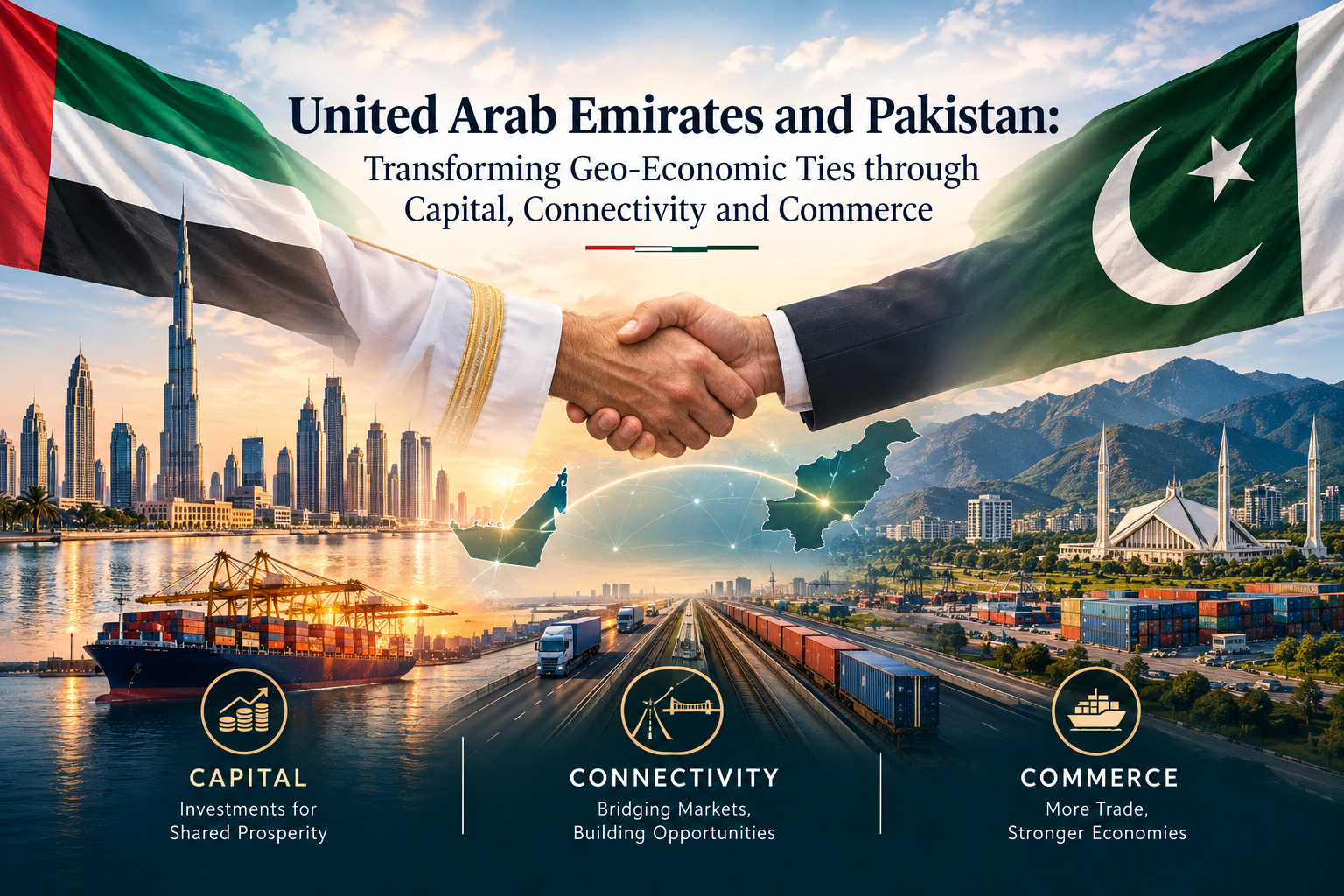
Pakistan–UAE relations possess an exceptional geo-economic foundation: large trade flows, remittances, energy links, established Emirati investment and shared interests in ports and connectivity. Yet the relationship remains import-heavy and periodically dependent upon financial support. The next phase should convert historical closeness into export growth, productive investment, logistics integration and technology-driven economic cooperation.
Key Points
- The UAE was Pakistan’s third-largest export destination and second-largest import source during July–March FY2026.
- Pakistan exported $1.63 billion to the UAE but imported almost $5.96 billion, generating a sizeable bilateral merchandise deficit.
- Remittances make the UAE relationship strategically different from ordinary trade partnerships, with roughly $1.49 billion arriving in July–August FY2027 alone.
- A future CEPA, logistics integration and Emirati investment in infrastructure, technology and food security could shift the relationship toward productive interdependence.
Geo-Economic Landscape and Policy Priorities
A relationship larger than trade statistics
The United Arab Emirates occupies a distinctive place in Pakistan’s geo-economic architecture. It is simultaneously a major trade partner, remittance corridor, source of capital, energy supplier, aviation and logistics hub, and home to a large Pakistani workforce. Consequently, economic relations with the UAE affect Pakistan’s exports, foreign-exchange liquidity, employment and external financing at the same time.
The bilateral commercial relationship is substantial. Pakistan’s ambassador to the UAE reported that goods and services trade exceeded $10.9 billion in FY2023–24, comprising $8.41 billion in goods and $2.56 billion in services. Pakistani goods exports to the UAE had risen 41 percent to $2.08 billion in that fiscal year. UAE and Pakistani officials subsequently reported non-oil trade exceeding $8.6 billion in 2024, underscoring the scale of economic exchange beyond hydrocarbons.
More recent Pakistani data shows a pronounced imbalance. During July–March FY2026, Pakistan exported approximately $1.629 billion to the UAE while importing $5.956 billion, creating a merchandise deficit of around $4.327 billion. The UAE accounted for 7 percent of Pakistan’s exports but 12.7 percent of its imports.
| Indicator | Latest cited period | Value / Share |
| Pakistan exports to UAE | Jul–Mar FY2026 | $1.629 bn / 7.0% of exports |
| Pakistan imports from UAE | Jul–Mar FY2026 | $5.956 bn / 12.7% of imports |
| Pakistan merchandise balance with UAE | Jul–Mar FY2026 | –$4.327 bn |
| UAE–Pakistan goods trade | FY2023–24 | $8.41 bn |
| UAE–Pakistan goods + services trade | FY2023–24 | $10.9+ bn |
| UAE-origin remittances | Jul–Aug FY2027 | about $1.49 bn |
Sources: Pakistan Economic Survey 2025–26, State Bank of Pakistan series and Emirates News Agency. Periods differ and are displayed separately rather than combined.
Correcting the trade imbalance through exports
The deficit itself should not be viewed mechanically as negative because a substantial portion of UAE-origin imports consists of energy and re-exported goods that support Pakistan’s economy. Pakistan’s Economic Survey explicitly links imports from the UAE predominantly to energy and re-exported products. Nevertheless, an import bill almost four times Pakistani exports demonstrates considerable scope for export expansion.
The UAE should be viewed as both a final market and a distribution platform. Dubai and Abu Dhabi connect businesses with the wider Gulf, Africa and global markets. Pakistan can expand food and agricultural exports, meat, rice, fruits and vegetables, textiles, pharmaceuticals, sports goods, surgical instruments, engineering products and IT services while using Emirati free zones and distribution networks for re-export.
This opportunity is reinforced by the UAE’s rapid emergence as a global trade and investment hub. UAE non-oil foreign trade grew 27 percent in 2025 and surpassed $1 trillion, while the country continued expanding its network of Comprehensive Economic Partnership Agreements. The UAE also attracted about $48.3 billion of FDI in 2025 and ranked ninth globally as an FDI destination, while hosting 1,562 announced greenfield projects. For Pakistan, therefore, the UAE is not simply another bilateral customer; it is a potential gateway to global capital and commercial networks.
The remittance corridor is a strategic asset
Workers’ remittances give the bilateral relationship exceptional macroeconomic significance. Pakistan received $41.6 billion in total remittances in FY2026, reinforcing their importance to external-account stability. Country-level data reported for August 2026 showed approximately $749.8 million arriving from the UAE in that month alone, after roughly $737 million in July, taking the first two months of FY2027 to approximately $1.49 billion. SBP’s country-wise remittance database was updated through September 2026 reporting cycles.
The policy objective should now evolve from remittance maximization toward diaspora economic upgrading. Pakistan should coordinate with Emirati employers to increase the proportion of Pakistani engineers, healthcare professionals, finance specialists, programmers, technicians and skilled tradespeople. Higher-skilled migration raises household income, remittance quality and human-capital links while reducing dependence on low-wage employment.
From financial support to productive investment
The UAE has historically contributed to Pakistan’s external financial stability alongside Saudi Arabia, China and multilateral institutions. Yet 2026 demonstrated why Pakistan needs to transform this component of the relationship. In April, Pakistan had to arrange financing around the repayment of a $3.5 billion UAE facility, with Saudi support subsequently helping preserve reserve stability.
The broader lesson is geo-economic rather than diplomatic: recurring deposits and rollovers can relieve liquidity pressures, but they do not substitute for export earnings or productive investment. Pakistan should therefore seek to convert the relationship from balance-of-payments support toward equity, infrastructure finance, joint ventures and export-oriented production.
Emirati firms already have a substantial footprint in telecommunications, banking, aviation, real estate and services. Pakistan’s ambassador has also highlighted agreements involving AD Ports and DP World for port operations and associated railway infrastructure, illustrating how maritime connectivity could become a central pillar of future cooperation. Dubai International Chamber’s decision in December 2025 to establish a representative office in Karachi further institutionalized private-sector commercial engagement.
Ports, logistics and regional connectivity
Pakistan’s geographic position gives the relationship a broader regional logic. Karachi and Port Qasim can complement UAE logistics networks, while Pakistan can offer onward access toward Central Asia and western China. Investment in ports, warehousing, rail freight, cold chains, digital customs and maritime services would connect Emirati capital and logistics capabilities with Pakistan’s geography.
The 2026 Gulf conflict has simultaneously demonstrated the vulnerability of regional shipping and energy supply chains. Disruption around the Strait of Hormuz sharply affected Gulf fuel movements before activity at Fujairah began recovering later in the year. Pakistan’s Economic Survey likewise recorded higher oil prices, freight costs and external-sector pressures following the regional crisis. This strengthens the case for joint work on strategic inventories, alternative logistics routes, renewable energy and resilient food and energy supply chains.
CEPA can provide the institutional breakthrough
A particularly important unfinished agenda is the proposed Pakistan–UAE Comprehensive Economic Partnership Agreement. In January 2026, Pakistan’s Commerce Ministry reported that technical negotiations were nearing conclusion and identified trade, ports, logistics, infrastructure, manufacturing, investment facilitation and joint ventures as major areas of cooperation.
A well-designed CEPA should do more than reduce tariffs. It should address services, standards, investment protection, digital trade, customs facilitation and professional mobility. Pakistan should simultaneously ensure that preferential liberalization encourages domestic productivity rather than merely enlarging imports. The objective must be a more balanced partnership built upon competitive Pakistani exports and Emirati investment in production.
Conclusion
Pakistan and the UAE possess all the ingredients for a mature geo-economic partnership: large trade flows, deep people-to-people links, substantial remittances, energy interdependence, capital and complementary logistics capabilities. Yet the next stage requires structural change. Pakistan must increase exports, upgrade its workforce, convert financial support into productive investment and integrate its ports and industries with Emirati commercial networks. A carefully negotiated CEPA can provide an institutional framework for this transformation. For the UAE, Pakistan offers a major consumer market, workforce and gateway toward wider Asian markets. For Pakistan, the UAE can become not only a financier and energy supplier, but a global investment and connectivity partner.
Author Bio
* Dr. Muhammad Jahanzaib holds a PhD in International Relations, is a double gold medalist and author of the book The Interplay of Geo-Politics and Geo-Economics in Pakistan’s Foreign Policy (Post-2008) (Palgrave Macmillan, 2026), along with several esteemed publications. As Chief Visionary Officer of Diamanium Thinkers (a global think tank), he brings over 15 years of experience advising ministries, diplomats, security agencies, the corporate sector, and civil society. His advisory work spans economic diplomacy, political economy, economic intelligence, strategic financial advisory, security, society and the geo-economic world dynamics. He offers a unique blend of practitioner insight and academic rigor, combining hands-on engagement with state institutions and strategic expertise grounded in research. He can be reached at jahanzaibdgc@gmail.com.
Key References
- Government of Pakistan, Pakistan Economic Survey 2025–26, Trade and Payments. URL: https://www.finance.gov.pk/survey/chapter_26/8_Trade%20and%20Payments.pdf
- State Bank of Pakistan, Economic Data — Country-wise Workers’ Remittances and Foreign Investment. URL: https://www.sbp.org.pk/economic-data
- Press Information Department, Government of Pakistan, Pakistan, UAE move closer to CEPA as technical talks near conclusion, January 14, 2026. URL: https://pid.gov.pk/site/press_detail/31583
- Emirates News Agency, Pakistan-UAE trade surges past $10 billion as remittances near $7 billion, April 11, 2025. URL: https://www.wam.ae/en/article/bj4hzx9-pakistan-uae-trade-surges-past-10-billion
- Emirates News Agency, Political Consultations between UAE and Pakistan discuss deepening cooperation, June 28, 2025. URL: https://www.wam.ae/en/article/bkextkl-political-consultations-between-uae-and-pakistan
- Emirates News Agency, Dubai International Chamber launches new representative office in Karachi, December 9, 2025. URL: https://www.wam.ae/en/article/bn4kwt3-dubai-international-chamber-launches-new
- Reuters, Pakistan says all options on table for funding, weighs strategic fuel reserve, April 14, 2026. URL: https://www.reuters.com/world/asia-pacific/pakistan-says-all-options-table-funding-weighs-strategic-fuel-reserve-2026-04-14/
- Reuters, Pakistan says Saudi Arabia pledges $3 billion more support, April 15, 2026. URL: https://www.reuters.com/world/middle-east/pakistan-says-saudi-arabia-pledges-3-billion-more-support-it-2026-04-15/