
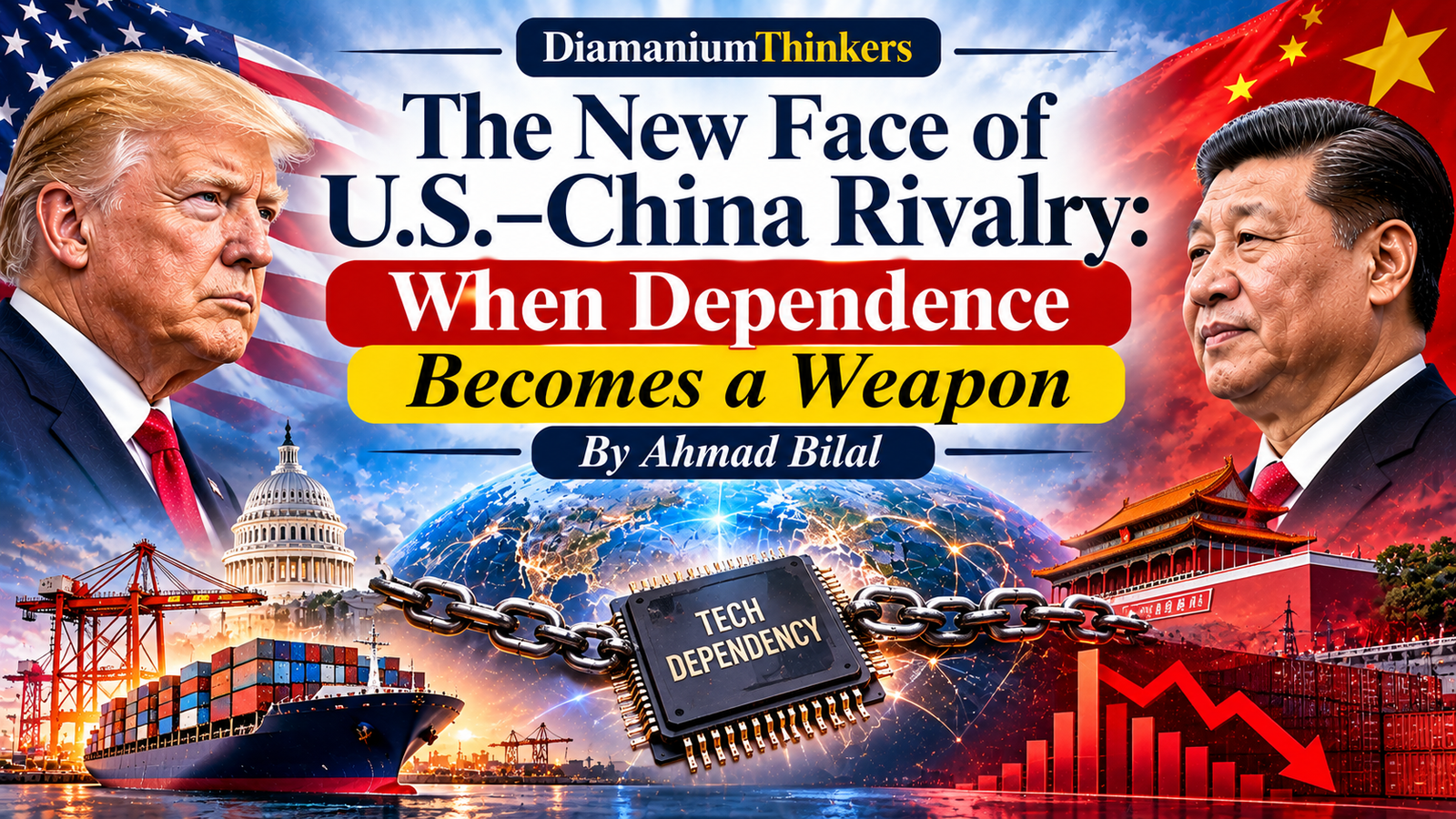
Washington and Beijing are trying to calm trade tensions while tightening control over technologies and resources essential to national security. That contradiction reveals a strategic rivalry unlike the Cold War: two deeply connected powers using their economic links as leverage, even when the resulting pressure threatens their own prosperity and security.
Key Points
- Strategic Competition: U.S.–China competition is already strategic, as both powers increasingly interpret technological and economic gains through the lens of national security.
- Military Spending: China’s military expenditure grew much faster than America’s between 2016 and 2025, although Washington continues to spend nearly three times as much.
- Technological and Resource Leverage: American semiconductor advantages and Chinese dominance in critical mineral processing create different forms of strategic leverage, but neither eliminates the two countries’ deep economic dependence.
- Economic Interdependence: Despite trade restrictions and political tensions, substantial bilateral commercial connections remain, making complete economic separation costly for both sides.
- Security Dilemma: Measures presented as defensive restrictions can be interpreted as economic coercion, encouraging further retaliatory countermeasures and deepening strategic mistrust.
Introduction
In September 2026, Washington and Beijing were negotiating ways to stabilize their economic relationship. Their leaders extended a trade truce. By October, however, the United States was proposing further restrictions on investments in technologies considered vital to national security. China objected. Why would two countries trying to keep trade flowing also seek to limit each other’s technological advancement?
Because their dependence on one another has become a source of both prosperity and fear. For Washington, an investment can help develop a future military capability. For Beijing, an American restriction can appear to be an attempt to slow its rise. What once appeared to be an ordinary business decision is increasingly treated as a security judgment.
The Changing Balance of Power
This is strategic rivalry, not simply a race for larger economies. States can compete for markets without viewing every gain by the other as dangerous. Rivalry begins when each increasingly expects the other to use its strengths against it.
The Stockholm International Peace Research Institute (SIPRI) puts global military expenditure at US$2.887 trillion in 2025, an eleventh consecutive annual increase. The United States spent US$954 billion, while China spent an estimated US$336 billion. Yet, between 2016 and 2025, Chinese military expenditure increased by 62% in real terms, compared with 11% for the United States.
The spending gap remains substantial, but the direction deserves attention. Spending is not the same as fighting power, and these figures cannot independently predict the likelihood of war.
Table 1: Military and Economic Indicators
| Indicator (2025 unless indicated) | United States | China |
|---|---|---|
| Nominal GDP (current US$) | $30.8 trillion | $19.5 trillion |
| Military expenditure | $954 billion | $336 billion* |
| Military spending change, 2016–2025 | +11% | +62% |
*China’s military spending is estimated. Spending growth is real (inflation-adjusted). Sources: SIPRI (2026); World Bank (2025).
Economic Strength and Shared Vulnerability
World Bank data places American nominal GDP at US$30.8 trillion in 2025 and China’s at US$19.5 trillion. Their relationship, however, cannot be reduced to competing economic totals.
According to the U.S. Trade Representative, the two countries exchanged an estimated US$494.6 billion in goods and services in 2025, even after trade fell by 25.1% from 2024. Half a trillion dollars in exchange is hardly economic separation. It represents an awkward reality for governments seeking both the benefits of commerce and protection from its vulnerabilities.
Political scientists Henry Farrell and Abraham Newman describe the use of positions within global economic networks for coercive advantage as “weaponized interdependence.” Globalization did not bury power politics; it supplied power politics with new switches. Whoever controls a crucial link in a supply chain can potentially influence decisions far beyond its borders.
However, not every economic dependence is a weapon, and American technological advantages are not identical to China’s control over mineral processing. Understanding these different forms of leverage is essential to understanding the current rivalry.
Technology Becomes a Security Instrument
Advanced semiconductors are at the centre of the dispute because they are essential to civilian innovation as well as military computing, communications, and surveillance. U.S.-headquartered companies accounted for 53.4% of worldwide semiconductor sales in 2025, according to the Semiconductor Industry Association. This represents a share of global sales, not a claim that the United States manufactures most of the world’s chips.
Washington has restricted exports of selected advanced chips and semiconductor equipment to China. In January 2026, it also allowed case-by-case licence reviews for certain processors under strict conditions. The policy is selective rather than a complete embargo.
On 22 October 2026, the U.S. Treasury proposed expanding outbound-investment controls into additional sensitive areas, including advanced computing, biotechnology, and hypersonic systems. These changes were proposals rather than rules already in force. China’s Ministry of Commerce condemned them as an overextension of national security.
The dispute reveals a significant shift: governments are increasingly asking not only whether an investment is profitable, but also whose future military capabilities it could strengthen.
China’s Leverage Lies in the Supply Chain
China cannot simply replace American chip-design strengths. Rather, it possesses a different strategic advantage. The International Energy Agency (IEA) reports that China accounts for more than 90% of global refining supply for several critical materials, including gallium, graphite, manganese, and rare earths.
These materials are essential to electronics, aerospace, and defence industries. China’s 2025 rare-earth export restrictions disrupted manufacturers abroad. The IEA warns that full implementation of additional suspended restrictions could expose US$6.5 trillion of annual downstream production outside China to supply risks. This figure measures potential exposure, not losses already suffered.
A mineral refinery may attract less attention than an aircraft carrier, but an interruption in specialized inputs can delay production across several countries. Neither Washington nor Beijing needs to cut every commercial connection to exercise pressure. Sometimes, the possibility of withholding access is enough to influence strategic calculations.
Table 2: The Levers of Interdependence
| Strategic Link | Evidence | What It Means |
|---|---|---|
| Semiconductors | U.S. firms: 53.4% of global sales (2025) | Commercial and technological leverage; not fabrication share. |
| Critical minerals | China: over 90% of refining of several key materials | Supply-concentration risk for global industries. |
| Bilateral trade | US$494.6 billion (2025), down 25.1% | Economic dependence persists despite growing restrictions. |
Note: Market share, refining, and trade indicators measure different things and are not directly comparable. Sources: SIA (2026); IEA (2026); USTR (2025).
The Security Dilemma Beyond the Battlefield
In the Indo-Pacific, particularly around Taiwan, these economic pressures exist alongside real military tensions. Technology determines how quickly states can develop advanced systems and maintain them during a crisis. American controls, presented as protection against military applications, encourage China to pursue alternatives. Chinese efforts to secure supplies or restrict exports can then reinforce American suspicions.
Each side views its own policies as precautionary and the other’s as coercive. This is the security dilemma translated into supply chains: measures intended to improve one country’s security can make the other feel more vulnerable, prompting further countermeasures.
There is, however, a serious counterargument: both powers still have strong reasons to cooperate. The September trade-truce extension, continuing negotiations, and selective semiconductor licensing demonstrate that neither side has chosen a complete economic break. Unlike the Cold War, their firms and consumers remain closely connected.
Cutting those links indiscriminately would impose costs on both countries and on other states caught between them. Their economic interdependence therefore remains both a source of vulnerability and an important restraint on escalation.
Conclusion
U.S.–China strategic rivalry is not waiting to re-emerge; it is already here. However, describing it as another Cold War misses its defining contradiction. Both countries can pressure the other through economic networks that also sustain their own prosperity.
Some restrictions may be justified where genuine national security risks exist. Treating every commercial connection as a threat, however, could make both countries less secure. Excessive restrictions risk weakening the very economic relationships that provide stability and shared benefits.
The question is no longer simply who will win the next trade dispute. It is whether Washington and Beijing can protect critical capabilities without turning every chip, investment, and mineral shipment into another test of strategic resolve.
Author’s Bio
Ahmad Bilal is an MPhil scholar in Strategic Studies at the National Defence University, Islamabad. His interests include great power competition, emerging technologies and international security.
References
- SIPRI (2026), Trends in World Military Expenditure, 2025. Read source.
- World Bank, GDP (current US$), United States and China (2025). Read source.
- Office of the U.S. Trade Representative, The People’s Republic of China: Trade Summary. Read source.
- Semiconductor Industry Association (2026), State of the Industry Report. Read source.
- International Energy Agency (2026), Global Critical Minerals Outlook: Executive Summary. Read source.
- IEA (2026), Global Critical Minerals Outlook: Outlook. Read source.
- U.S. Treasury (22 October 2026), Proposed Rule on Outbound Investment. Read source.
- China Ministry of Commerce (24 October 2026), Response to Proposed Investment Restrictions. Read source.
- Reuters (24 September 2026), Five Takeaways from Trump–Xi Summit. Read source.
- Bureau of Industry and Security (13 January 2026), License Review for Semiconductors. Read source.
- Farrell and Newman (2019), Weaponized Interdependence, International Security. Read source.