
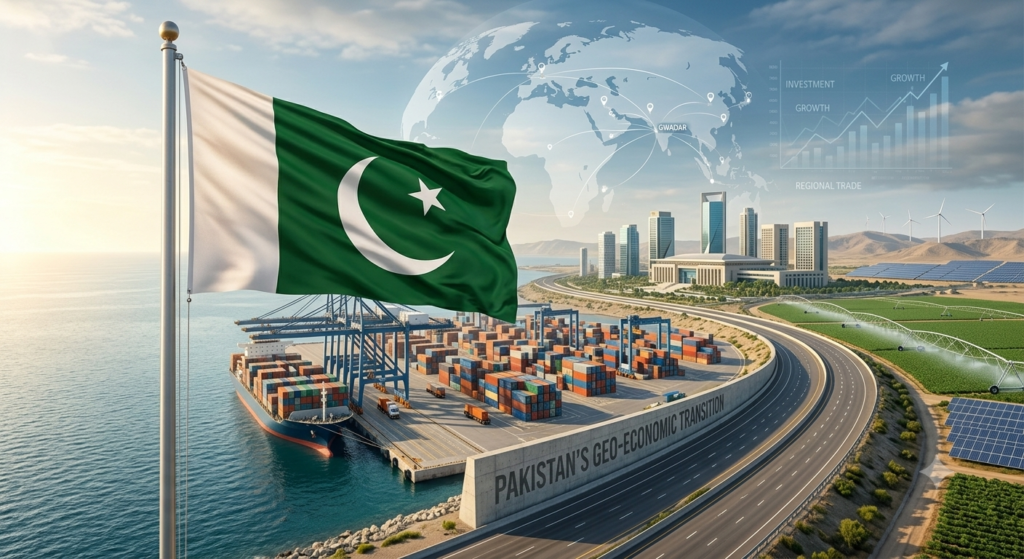
Pakistan’s shift from geostrategic to geo-economics is real in its intent but built on centralized, military-led mechanisms like SIFC, which means the gains so far (minerals, CPEC 2.0, stabilization) may reflect faster deal-making, not structural transformation; unless civilian institutions, security, and regional trade are fixed properly.
Key Points
- The shift in NSP from geopolitics to geo-economics is real in intent, but it is structurally incomplete due to in-efficient mechanisms.
- Investment deals keep getting signed, but the underlying risks are still unresolved.
- Headline agreements will not fix weak tax collection, energy debt, or accountability gaps. These need direct reforms.
- Long term supported institutions by both civilian and military regimes are inevitable (that withstands shift or change in either civilian or military leaderships).
Pakistan’s shift from geo-strategy to geo-economics is real in intent, but it is structurally incomplete. The mechanisms driving the shift largely reproduce the very structures it claims to move away from. Pakistan’s foreign policy has been structured around military alliances, strategic depth, and territorial security since its emergence on the map. Security has been interpreted mostly in the context of the military aspect, while treating the economy as a downstream concern. Not until 2013 did Pakistan reorient its national policy, moving from security-centric to economic-centric, where investment was recast as a strategy and economic security recast as national security. The question is not whether that shift has happened, but how far it goes: is Pakistan genuinely creating a new economic model, or repeating old patterns of centralized, security-anchored decision-making in new, economic language?
The Special Investment Facilitation Council (SIFC) stands as an institutional marker of this shift. SIFC was established in 2023 as a single-window body meant to fast-track foreign investment by cutting through the bureaucratic layers that have historically stalled major deals. Its creation reflects a genuine recognition that the geopolitical positioning alone cannot sustain the state but that it needs capital inflows as well. But recognizing the problems and restructuring the state to solve those problems are two different things, and the distance between the two is where this argument lives.
Progress
The early progress made by SIFC is not negligible. Mining, agriculture, and energy have been the focus of Gulf pledges from Saudi Arabia and the UAE, and authorities cite SIFC as proof that Pakistan can now advance at the rate that capital expects. But here’s the problem: the mechanism that makes SIFC work fast is the one that gives pause. SIFC bypasses normal civilian channels, and its closed coordination with the military leadership means the speed is the consequence of centralized decision-making rather than changing the investment climate itself.
One of the SIFC’s clearest success stories includes the Reko Diq, one of the world’s largest untapped copper deposits located in Balochistan’s Chagai district. It was developed under a joint venture between Barrick Gold and Pakistani state and provincial partners, with first production targeted for the late 2020s. Growing US interest in Pakistan’s vital minerals also adds a truly new dimension, indicating that Washington views Pakistan as a trading and resource partner rather than just a security one. This reorientation is worth considering since it differs structurally from Pakistan’s conventional alliance and donor partnerships. However, a mining deal is not, by itself, an industrial transformation. So moreover for the betterment, Pakistan’s long-standing rentier pattern, which involves importing capital and processing technologies while exporting raw ore and concentrate, may be replicated just as effectively by extraction-led investment. How and which outcome follows depends on terms, the share of value added domestically (smelting and refining versus raw export), and reinvestment, none of which is yet settled.
CPEC’s second phase, the developmental phase, follows a parallel track, shifting from corridor infrastructure to industrial cooperation, agriculture, and Special Economic Zones (SEZs). Yet the SEZs remain thinly populated by diversified investment, and the underlying dependencies – Chinese contractors, Chinese funding, and the same security risk that caused CPEC’s initial phase to stall – remain mostly unchanged. A shift in emphasis is more persuasively described in phase two than a shift in structure.
IT and digital exports appear different in nature, not just in scale, when compared to these top-down tracks. According to data from the State Bank of Pakistan, freelancers now account for 25% of Pakistan’s IT exports, up from 20.3% a year ago. Freelance earnings have crossed $1 billion for the first time, a 49.7% year-over-year increase, compared to $4 billion in total IT exports and $1.6 billion in combined freelance earnings (including non-IT services). However, the general trend remains the same: Pakistan’s most bottom-up geo-economic advantages happen when the government has kept out of the way rather than when it has taken the lead.
A macroeconomic stabilization narrative holds all of this together, and in this case, the record is actually mixed rather than consistently favorable. The total disbursements under the IMF’s Extended Fund Facility and Resilience and Sustainability Facility arrangements now stand at approximately $4.8 billion, with a primary fiscal surplus of 1.6 percent of GDP targeted for FY26. Gross reserves have been rebuilt from $14.5 billion at the end of June 2025 to $16 billion by the end of December. However, as rising global commodity prices, partly due to the Middle East conflict, pass through to domestic energy costs, inflation is actually increasing. Consumer prices are expected to grow from 4.5 percent in FY25 to 7.2 percent in FY26. Therefore, even by the IMF’s own account, stabilization is real but only partial: reserves and fiscal restraint are improving while price stability is not, which supports the main thesis of this article: the pivot is yielding real results on the metrics closest to state control, but the more difficult, wider-based transformation is still unfinished.
Constraints
The clearest constraint is visible in the SIFC itself. Pakistan lacks a depoliticized, civilian-led institution capable of driving economic policy on its own authority. That’s a structural weakness in SIFC, and instead of filling this gap, it gets its speed on a different track. It creates fast-track channels that sit outside the normal civilian bureaucracy, with the military playing a coordinating role. This same gap explains another constraint as well – the political discontinuity. Pakistan has been continuously ruled since 2008 by the Pakistan People’s Party (2008 2013), Pakistan Muslim League-Nawaz (2013-2018), Pakistan Tehreek-e-Insaf (2018 2022), Pakistan Democratic Party coalition administration (2022-2023), and the PML-N led since 2024. No institution is sufficiently protected from political changes to maintain a geo-economic strategy across administrations; every change of government rearranges economic priorities. Continuity, where it exists, is currently dependent more on unofficial, security-related cooperation than on long-lasting civilian or military regime.
These weaknesses in the institutions create material consequences. Security still undermines the economy. Attacks by Baloch insurgents against Chinese people and assets connected to the China-Pakistan Economic Corridor (CPEC), as well as a renewed TTP presence in Khyber Pakhtunkhwa, continue to increase the risk premium on the very investment that SIFC is attempting to draw in. Beneath that are some structural weaknesses that no single deal or council can address, including a continuously low tax-to-GDP ratio, an energy sector burdened by regular debt, and a current account that is still vulnerable to outside shocks.
Finally, these internal weaknesses have an external face. A natural market is closed while regional trade with India remains frozen. The transit trade with Afghanistan continues to be disrupted by border friction and closures, directly undercutting the connectivity that is supposed to be geo-economics’ signature contribution – regional integration, not just the bilateral deal-making.
Way Forward
Even though it is politically challenging to implement, each of these limitations suggests a rather straightforward solution. The institutional gap requires exactly what SIFC presently replaces: a durable, long lasting economic organization supported by civilian and military leadership that can withstand shifts in government and military leadership. Given that the two issues have a common root cause, that would also solve political discontinuity.
Security is a precondition for investment in Balochistan and Khyber Pakhtunkhwa, not background noise absorbed by risk premiums. It cannot be managed indefinitely. The structural weaknesses (tax collection, energy reforms, etc.) are a part of the “genuine but incomplete” argument that, whether it gets resolved or not, no amount of investment facilitation substitutes can replace them. Additionally, as connections cannot be provided through Gulf or Chinese channels alone, the external component requires a genuine push towards regional trade normalization, especially with Afghanistan and Central Asia.
All of this is rooted in a reconciliation that Pakistan has yet to reach between the short-term pace of informal, centralized deal-making as SIFC delivers in the short term, and the long-term task of establishing institutions that are credible enough to support a geo-economic strategy.
Conclusion
Pakistan’s geo-economic pivot is not a mirage; the intent is real, and some of what has followed, particularly the orientation of the US interests towards the economic activities, genuinely shows the shift from old patterns. But what matters more than whether progress has occurred is what kind of “incomplete” this is. If the gap is simply a matter of time, then patience and continuity are the answers. If the current mechanism is structurally incapable of producing full transformation, because it works by concentrating rather than distributing economic authority, then more of the same activity will not close the gap; it will entrench it. The evidence so far points more toward the second reading. Long term supported institutions by both civilian and military regimes are inevitable (that withstands shift or change in either civilian or military leaderships).
Author Details
Tayyaba Naseer is a graduate from Government College University, Lahore. She has completed BS in International Relations, with the thesis focusing on Pakistan’s shift from geo-strategy to geo-economics. Currently, she is Intern in Diamanium Thinkers (A Global Think Tank). She choose to write about the most significant human emotions and the world we live in. She is passionate about unearthing the hidden conspiracies that shape our world and how each of us is interlinked in this intricate web.
References
CPEC 2.0 and SEZs: Express Tribune Article
Reko Diq Project Details: Barrick Gold Official
IT and Freelance Exports Data: Express Tribune Report
Macroeconomic Stability & IMF Review: IMF Official Press Release
Security Issues in KPK and Balochistan: Dawn News Report