
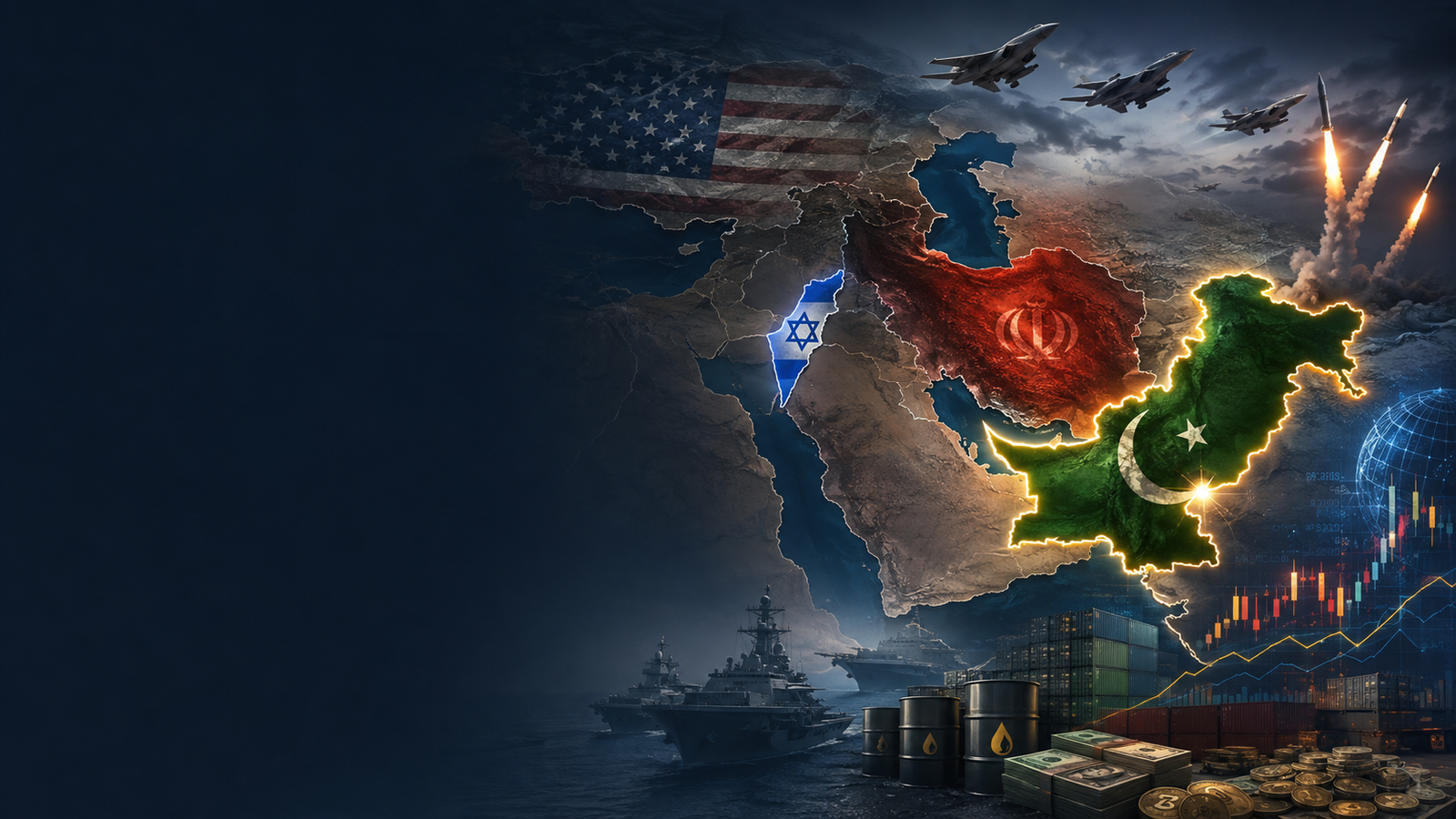
The US-Israel war on Iran, now is in the fifth month; this conflict has reshaped the Middle Eastern Geopolitics and deep economic and security vulnerabilities for the states like Pakistan. Islamabad has shown its loopholes as an oil dependent nation and a diplomatic big brother in the middle Eastern politics, but it did not chose this role but can’t escape this either. It is the best time to convert this rare diplomatic opening in to a strategic leverage.
Key Points
- The war, launched on 28 February 2026, has closed and reopened the Strait of Hormuz repeatedly, disrupting a third of global crude shipments.
- Pakistan’s weekly oil import bill surged from roughly $300 million to $800 million at the conflict’s peak, straining its external account.
- Army Chief Field Marshal Asim Munir has emerged as a key backchannel mediator between Washington and Tehran, elevating Islamabad’s diplomatic profile.
- Remittances and foreign investment from the Gulf remain Pakistan’s most exposed economic lifelines should hostilities resume or widen.
- Renewed strikes as of July 2026 show the ceasefire framework remains fragile, keeping Pakistan’s risk exposure open-ended.
Background
The conflict began on 28 February 2026, when US and Israel launched coordinated precision attacks on the Iranian sites and targeted Iran’s Ayat-Ullah regime under the code name of operation Epic Fury, nuclear infrastructure, power stations, public infrastructure like schools and residential areas in Tehran. In response Iran’s Islamic Revolutionary Guard Corps (IRGC) retaliated with waves of missiles and drones across the Israel and on US military bases in the Arabian gulf states. Iran held the global choke point; Strait of Hormuz was under control of IRGC that halted the global oil supply. A ceasefire and Memorandum of Understanding reached in June 2026 under the diplomatic efforts of Pakistan that sought to reopen the Strait of Hormuz. Due to lack of trust between the conflicting parties Iran’s continued assertion of control over shipping routes, including attacks on commercial vessels in early July, triggered fresh American strikes later that month. US congress had approved a $95 billion package to balance the war cost it shows that “ceasefire” was more of a pause than a conflict resolution mechanism.
Economic Shockwaves for Pakistan
Pakistan is an energy dependent state; it imports 80 percent of its energy needs from Gulf. Any disruption in the supply make it sensitive for Pakistan. When the strait of Hormuz was frozen in early March crude oil prices hiked up to 100 dollars per barrel from 71 dollars per barrel. In Pakistani market fuel prices rose up to 50 percent then normal by May. Prime Minister Shehbaz Sharif told the nation that the country’s weekly oil import bill had risen from roughly $300 million to $800 million, an increase, he said had erased two years of hard-won macroeconomic stabilisation. The government responded with emergency measures, including a shortened government workweek and rotational work-from-home arrangements, in a bid to conserve fuel. Shortage of fuel has broad effects, fuel dependent industry like transport and agriculture pushed inflation higher. Pakistan’s foreign currency reserve came under pressure. The State Bank of Pakistan reported no meaningful foreign inflows into treasury bills in the opening days of FY2027, and equity market outflows for FY2026 exceeded $1 billion against inflows of just over $300 million. Remittances are the main source of foreign currency to Pakistan and have declined slightly in March before bouncing back due to the war, but the officials have cautioned that if the war continues for long, it may have a dilapidating impact on remittance inflows and demand of Pakistani exports via Gulf logistics hubs.
Table 1: Economic and Energy Volatility Indicators (2026 Iran Conflict)
| Indicator | Pre-Conflict Baseline | Peak/Recent Conflict Impact |
|---|---|---|
| Brent crude oil price | ~$71/barrel (Feb 2026) | Surged past $100–120 (Mar–May 2026) |
| Pakistan weekly oil import bill | ~$300 million | ~$800 million (April 2026 peak) |
| Petrol/diesel retail prices (PK) | Baseline | Petrol +50%, diesel +70%+ (May 2026) |
| Foreign equity inflows (FY26) | — | $308M inflows vs >$1B outflows |
| Remittances (Jul–Mar FY26) | — | $30.3 billion, up 8.2% y/y |
| Projected poverty impact | — | Up to 4.3 million additional people at risk |
Sources: Al Jazeera, Dawn, Arab News, Statista, Congress.gov.
Security Dimensions: Mediation, Risk and Reflex
Pakistan’s security has been shaped less by direct attacks than by risk of being attack. Unlike Gulf Arab states and Israel’s other neighbours, Pakistan has not been targeted by Iranian strikes, but it shares a long, porous border with Iran’s Sistan-Balochestan province and remains wary of instability spilling over through Baluch militancy or a destabilised Afghan frontier already troubled by the terrorists. Army Chief Field Marshal Asim Munir has become one of the conflict’s most unusual diplomatic figures, holding direct discussions with both Washington and Tehran and reportedly helping secure a temporary pause in strikes on Iranian energy infrastructure in coordination with Turkey and Egypt. PM Sharif has himself engaged Iranian President Masoud Pezeshkian while maintaining Pakistan’s ties with Gulf and Washington. This balancing act has raised Pakistan’s diplomatic profile, with Islamabad hosting rounds of indirect talks. However, analysts caution that Pakistan’s credibility as an impartial mediator is constrained by its mutual defence obligations to Saudi Arabia and its lack of formal ties with Israel, meaning a wider war may urge Islamabad to tackle the relations very cautiously in order to avoid any direct conflict in the war. Pakistan has played a rational part in handling the situation for the success for peace and prosperity of the region praised by international community as a whole.
Conclusion
US-Israel-Iran conflict has demonstrated that contemporary wars have wider effects on geopolitics, states like Pakistan which are not directly involved in the conflict but cannot be isolated from this middle eastern conflict. Energy dependence has already cost the country billions in higher import bills and lost investment, while remittance and export channels remain exposed to hostilities. Pakistan’s mediation role, anchored by Army Chief Asim Munir’s diplomacy, has given Islamabad extra-ordinary diplomatic visibility in the western world. Whether this translates into lasting strategic gain for Pakistan, rather than temporary goodwill to its neighbor and a western alley, this all will depend on whether the fragile ceasefire holds and whether Pakistan can convert crisis management into durable economic and security partnerships with both Gulf and Western powers.
* Sheikh Eilaf Tariq is a Research Intern at Diamanium Thinkers, holding a degree in Peace and Conflict Studies, National Defense University (NDU), Islamabad. His research interests include conflict dynamics, regional security, and South Asia–Middle East strategic affairs. He provides strategic insights into the interplay of military diplomacy and economic security in the South Asian context. He can be reached at jahanzaibdgc@gmail.com.
References
- Britannica: 2026 Iran War Timeline and Overview
- CFR: Iran’s War with Israel and the United States
- Congress.gov: Iran Conflict and the Strait of Hormuz Impacts
- Wikipedia: Economic Impact of the 2026 Iran War
- Al Jazeera: Soaring Fuel Prices in Pakistan and the Iran War
- Arab News: Middle East Conflict and Remittance Inflows
- Dawn: Gulf Turmoil and Pakistan’s Economic Outlook
- Atlantic Council: Pakistan as an Iran War Mediator
- The New Arab: For Pakistan, Mediation is Self-Preservation